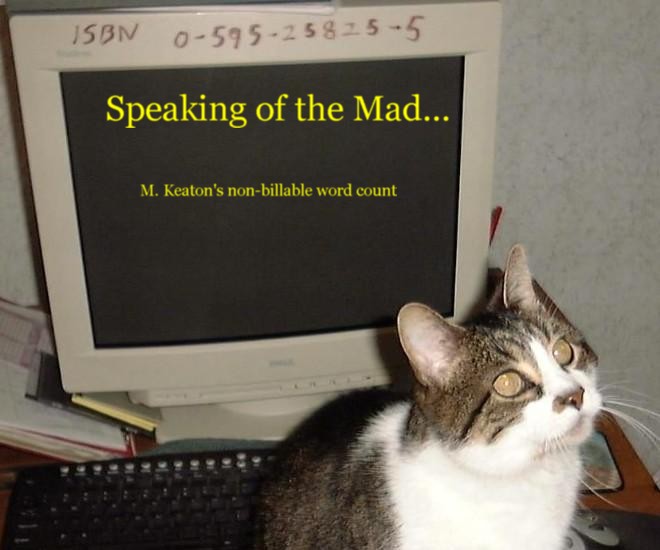
After years of struggling (and failing) to break through into the upper ranks of writing success, I have diligently studied the markets, library purchasing habits, and critical book reviews. Together with my new co-author, Ms. Collabone, I present the following book proposal, guaranteed to be a record setting bestseller. Coming soon from the first publisher wise enough to offer a five digit advance, we present this preview of:
Bitten Bonnet
A Tale of Forbidden Love
By M. Keaton and D. Collabone
Angst-ridden Sarah Plain is a sexually repressed Amish librarian who longs to meet that one special man to sweep her into his arms and carry her to a fulfilling life as a feminist author. When Mardi Gras erupts into a full-fledged zombie apocalypse, a lifetime of reading paranormal romance leaves the plucky red-head ill prepared when she meets the man who really does want to carry her away.
An epic romantic saga set in the quirky environs of Louisiana, Bitten Bonnet is both a compelling story and a scathing criticism of the evils of modern traditional society and the struggles of interracial relationships. Sarah's tale surpasses the previous standards of literary excellence and the digestive system. Filled with eccentric and complex characters, Keaton and Collabone have constructed an achingly tragic story of a love that burns beyond life itself.
Internal sample text:
Hamish leaned against the split rail fence, watching the trail of smoke curling up from the distant city. "It is zombies, then?"
"Verily," Enoch replied, absent-mindedly pulling at his beard. "They have come for her. There is little we can do, I fear."
The centenarian shook his head sadly. "If only we could have known. If but once she had removed her bookish glasses and pulled the pins from her bun to let her burning tresses fall about her shoulders with passionate abandon--surely by such an act she would have betrayed her true nature as the hidden seductress, which the writings warn us is a veritable magnet for the undead."
"Or if we had seen the serpentine tattoo climbing sensuously up her back. But she did not. I tell thee, Hamish, it is too late and it vexes me. Is there naught we can do?"
"Nay, friend Enoch. As well ye know, we Amish have spent generations preparing for war with the vampires. Of zombies, we know little."
"Who then? Surely the Elders did not leave our world so vulnerable. Are zombies the province of the Mennonite then?"
"The Mennonite stand against the werewolves."
"The Hutterite?"
"Demons."
"The Planters?"
"Chupacabra."
"Who then, Hamish? Tell me."
The old man sighed, removing his black hat and staring into it as if he could pull hope from within. "The Shaker," he said at last.
Enoch flinched as if struck and leaned against the fence with a pained groan. "Did they train any others?" he asked, desperation creeping into his voice.
"The Unitarians. But…" Hamish allowed his voice to drain away. The two men stood in silence, the wind smelling of smoke. "We can wait no longer. The zombies are now a matter for the bayou-dwelling heathens," he announced, suddenly resolute. "We must flee. Tell the other men to prepare the buggies. And take off those thrice-damned orange triangles; 'tis no time for frippery!"
#
His eyes burned as if worms of fire crawled within them. Swollen and unable to close, the sand-dry orbs tormented him, tempting him to claw them from their sockets, ringing his vision with a crimson mist as he writhed in the dirt. The hound dogs growled and fled from his frantic reach as he twisted between the cinderblocks that held up the trailer. His stomach burned worse than his eyes, consuming itself in a craving hunger.
He shouldn't have eaten that rabid 'coon, especially after he saw that it was wearing Mardi Gras beads but, dammit, he'd been hungry and he'd eaten worse--much worse. But now…
His stomach cramped, twisting in his gut like one of those TV aliens trying to get out. He howled in pain and the hounds howled back. He pulled a hand to his mouth and, without thinking, licked the dirt and dried blood away. Suddenly he found himself stuffing fists full of dirt into his mouth, desperate to eat anything, like a horse cribbing at its stall. So hungry. He howled again.
Above, through the paper-thin plywood of the trailer's floor, the sound sent cold chills up young Damien's spine. "Pop? What's wrong with Uncle Emmet?"
"Probably sobered up," his father replied around a cigarette. "Shut up and eat your paint chips. We got us a long night of scratchin' off lotto tickets if we're ever gonna make enough money to get outta this gov'mit-issued formaldehyde-smellin' trailer."
Another howl echoed through the floorboards, this time sounding suspiciously like a word. "Brains?"
Wednesday, November 2, 2011
Friday, August 26, 2011
Dreams of Steam II; Brass and Bolts

After the success of Dreams of Steam, the good editor Ms. Richardson told me there would be a sequel and asked if I would contribute. I agreed and the result is in this second DOS anthology. My story (novella really) is a continuation of the "Brass Africa" saga and worth taking a look at even if you don't normally care for steampunk. (Ironically, one of the early reviews of the anthology gives it 5 out of 5 stars and notes that there is only one story they did not like. I suspect it is mine.) The Brass Africa tales are not run-of-the-mill standard Victorian or American West steampunk. Rather than go where people like Cherie Priest have already gone, I have my own view of the genre and a unique approach. Yes, the story is set in Africa, earlier in time and tech than most steampunk stories, and with more than a touch of African history and myth. If you don't like that in your steampunk, I respect that and humbly say, the Brass Africa stories are not for you. I do, however, think that if you are a fan of the more conventional steampunk, you will absolutely love the rest of the anthology and still encourage you to pick it up.
Let me conclude by saying that, after you've read it, feel free to nominate "Grass Elephant" for every award and "Best of the Year" anthology collection you can think of. I normally don't hype my own stuff that strongly so, to answer the implied question: Yes, I think it's that good.
UPDATE: I forgot to mention, the book is not just available in trade paperback. It is also available as a hardback or ebook. If you local or internet book provider are not listing these two additional formats, you can order them directly from the publisher at http://www.kerlak.com/dosteam2.html
Thursday, June 2, 2011
Booksigning Moved
The bookstore has asked to delay the signing by a week to give them more time to advertise it locally. Sorry for the confusion if you were planning to attend and hope to see you all on the 11th.
Monday, May 23, 2011
Book Signing in Siloam Springs AR
For those interested and in the area, I'll be signing books at "Books on Broadway" in Siloam Springs AR Saturday morning (not my idea) 10am-noon on Saturday June 1.
Wednesday, April 6, 2011
Speaking the Abyss
[I originally was asked to write this for a book of essays by the "survivors of mental illness". It was rejected because it was "too depressing" and I refused to lighten it up. The truth, after all, is not chicken soup. I have debated about posting it for over a year now but, because of discussions and encounters with other authors, I finally decided it needed to be out there. In some ways, it may be considered a companion piece to the "Purple Crayon" essay.]
Depression is too kind a word, like you’ve had a bad day and things will get better with a hot meal and some sleep. The truth is a much darker thing--a crushing despair that saps your will and whispers in your ear that the world would be a better place without you, a sorrow so deep and pervasive that it literally makes your body ache, nights spent staring at the ceiling obsessing about the smallest of problems and drowning in a sea of fear, panic and anxiety pushing you under for the third time…no, depression seems too kind a word.
I tried to ignore it, to work through the fear and formless sense of loss. It’s just a character flaw, I would mutter through gritted teeth. Real men suck it up and deal. When my mind refused to acknowledge the growing truth, my body made the call. One morning shortly after Christmas, I rolled out of bed, headed for work, and found myself curled up on the floor, convulsing, crying, completely out of control, unable to even muster a coherent thought, afraid and overwhelmed by everything. I hit bottom full throttle, and years of ignoring the warning signs triggered a cascade of secondary problems that left me a proverbial basket case. Mental illnesses aren’t isolated conditions; they hunt in a pack. When I finally succumbed, my entire world, with my mind, came apart like a crushed eggshell.
I don’t remember the two years following my collapse, when a life-long struggle with depression and anxiety finally overwhelmed me. Somehow, my wife got me to a doctor and that doctor, in turn, realized I was beyond his ability to treat and found me a specialist able to begin chipping away at the problem. Body first, mind second. Months drugged into a near-zombie state while a devastated immune system and a glandular system, driven haywire by exhaustion and years of running in overdrive, healed.
In the gray mist, there are snatches of memory. My wife caring for me, running the household, and waiting for the return of the man she married with saint-like patience. Relatives bringing bags of groceries into the house. Friends visiting to sit in awkward silence. Finally, a change of medication, easing me back into reality, and the long, slow, painful task of rebuilding my mind and spirit, up from the bottom brick by brick.
No man is an island, and I benefited from the kindness of others more than I deserved. Twice I went back to my old job on reduced hours, the company owners firmly on my side, fighting to keep me on the insurance rolls. Twice, I spiraled into depression again, unable to stand up to the stress. Friends pulled strings to find me temporary weekend work that managed to make enough to pay for my medications. In the end, even that was not enough; and my doctor, a noble, caring man more dedicated to his Hippocratic Oath than his income, ignored his fee, supplied me with medication from his own stock of samples, and worked with the pharmaceutical companies to insure that I was never without the help I needed.
Years. It took years of pride and stubbornness to dig the hole; it took years to climb back out. Unable to work on a fixed schedule, often unable to even work with other people for an extended period of time, I returned to my first profession I had set aside to pursue a ‘career.’ I wrote--not great works, just simple escapist fiction for people who needed a break from the working world. I still wrestled with depression and fear every day, but I could function. The cost had been high but the next phase of my life had begun.
As part of my work as an author, I was encouraged to attend writing conventions, gatherings where authors, editors, and publishers mix freely with the readers who support them. I was hesitant. My emotional balance was still precarious; I was unsure how I would be able to handle myself in a public forum and afraid of being overwhelmed by the sheer press of humanity. In an odd kind of way, I found, among other authors and our readers, an extended family and support group. The number of authors and artists dealing with mental illness, and depression specifically, is disproportionately high compared to the average population.
I resolved from the first that I would not shy away from discussing my condition. I was not going to preach about it or even bring it up unless it was relevant, but neither was I going to sugar-coat the issue or apologize for being who I was and having, what I had finally been made to realize, was a legitimate medical problem. And the topic did come up, repeatedly; I was not alone in this. What made me a rarity was my willingness to speak. The social stigma against mental illness is still strong, and many of its sufferers live with the added burden of shame.
I had struggled for the better part of a decade with the question of why: Why me? Why this? I was about to receive my answer when I found myself in the hallway with an elderly lady, tears in her eyes, tapping me on the chest and sobbing. “You speak for us. Make them understand. You can make them see; we can’t. Don’t stop. You speak for us.” It was a humbling experience, to realize that for all my problems, I was so much better off than others, that I had found a way to stand with a foot in both worlds--healthy enough to function and speak publicly, but still fighting and unable to lose sight of the pain and intensity of the illness.
I am no activist. I don’t seek out soapboxes to talk about depression and mental illness and, in the grand scheme of things, I really don’t say that much. But I’m not backing down and I’ll not stay silent when the subject comes up. Why me? Because it’s not about me. It’s about us, the great sprawling “us” of depressive and bipolar and autistic and every other human being who labors under the public misunderstandings and shame of mental illness. If I can in my small way ease that pain, that’s a burden I’ll gladly shoulder.
My story is not completely one of hope or triumph, but neither is it finished. The depression is still there, an abyss always looming at the edge of my mind, held at bay by medication and the help of friends, family, and most especially a loving, attentive wife. Every day is a new struggle and every day is its own journey--some good, some closer to an emotional “Mister Toad’s Wild Ride.” I’m okay with that. I’ve made peace with who and what I am, the costs and the rewards. In the end, what more can anyone ask?
Depression is too kind a word, like you’ve had a bad day and things will get better with a hot meal and some sleep. The truth is a much darker thing--a crushing despair that saps your will and whispers in your ear that the world would be a better place without you, a sorrow so deep and pervasive that it literally makes your body ache, nights spent staring at the ceiling obsessing about the smallest of problems and drowning in a sea of fear, panic and anxiety pushing you under for the third time…no, depression seems too kind a word.
I tried to ignore it, to work through the fear and formless sense of loss. It’s just a character flaw, I would mutter through gritted teeth. Real men suck it up and deal. When my mind refused to acknowledge the growing truth, my body made the call. One morning shortly after Christmas, I rolled out of bed, headed for work, and found myself curled up on the floor, convulsing, crying, completely out of control, unable to even muster a coherent thought, afraid and overwhelmed by everything. I hit bottom full throttle, and years of ignoring the warning signs triggered a cascade of secondary problems that left me a proverbial basket case. Mental illnesses aren’t isolated conditions; they hunt in a pack. When I finally succumbed, my entire world, with my mind, came apart like a crushed eggshell.
I don’t remember the two years following my collapse, when a life-long struggle with depression and anxiety finally overwhelmed me. Somehow, my wife got me to a doctor and that doctor, in turn, realized I was beyond his ability to treat and found me a specialist able to begin chipping away at the problem. Body first, mind second. Months drugged into a near-zombie state while a devastated immune system and a glandular system, driven haywire by exhaustion and years of running in overdrive, healed.
In the gray mist, there are snatches of memory. My wife caring for me, running the household, and waiting for the return of the man she married with saint-like patience. Relatives bringing bags of groceries into the house. Friends visiting to sit in awkward silence. Finally, a change of medication, easing me back into reality, and the long, slow, painful task of rebuilding my mind and spirit, up from the bottom brick by brick.
No man is an island, and I benefited from the kindness of others more than I deserved. Twice I went back to my old job on reduced hours, the company owners firmly on my side, fighting to keep me on the insurance rolls. Twice, I spiraled into depression again, unable to stand up to the stress. Friends pulled strings to find me temporary weekend work that managed to make enough to pay for my medications. In the end, even that was not enough; and my doctor, a noble, caring man more dedicated to his Hippocratic Oath than his income, ignored his fee, supplied me with medication from his own stock of samples, and worked with the pharmaceutical companies to insure that I was never without the help I needed.
Years. It took years of pride and stubbornness to dig the hole; it took years to climb back out. Unable to work on a fixed schedule, often unable to even work with other people for an extended period of time, I returned to my first profession I had set aside to pursue a ‘career.’ I wrote--not great works, just simple escapist fiction for people who needed a break from the working world. I still wrestled with depression and fear every day, but I could function. The cost had been high but the next phase of my life had begun.
As part of my work as an author, I was encouraged to attend writing conventions, gatherings where authors, editors, and publishers mix freely with the readers who support them. I was hesitant. My emotional balance was still precarious; I was unsure how I would be able to handle myself in a public forum and afraid of being overwhelmed by the sheer press of humanity. In an odd kind of way, I found, among other authors and our readers, an extended family and support group. The number of authors and artists dealing with mental illness, and depression specifically, is disproportionately high compared to the average population.
I resolved from the first that I would not shy away from discussing my condition. I was not going to preach about it or even bring it up unless it was relevant, but neither was I going to sugar-coat the issue or apologize for being who I was and having, what I had finally been made to realize, was a legitimate medical problem. And the topic did come up, repeatedly; I was not alone in this. What made me a rarity was my willingness to speak. The social stigma against mental illness is still strong, and many of its sufferers live with the added burden of shame.
I had struggled for the better part of a decade with the question of why: Why me? Why this? I was about to receive my answer when I found myself in the hallway with an elderly lady, tears in her eyes, tapping me on the chest and sobbing. “You speak for us. Make them understand. You can make them see; we can’t. Don’t stop. You speak for us.” It was a humbling experience, to realize that for all my problems, I was so much better off than others, that I had found a way to stand with a foot in both worlds--healthy enough to function and speak publicly, but still fighting and unable to lose sight of the pain and intensity of the illness.
I am no activist. I don’t seek out soapboxes to talk about depression and mental illness and, in the grand scheme of things, I really don’t say that much. But I’m not backing down and I’ll not stay silent when the subject comes up. Why me? Because it’s not about me. It’s about us, the great sprawling “us” of depressive and bipolar and autistic and every other human being who labors under the public misunderstandings and shame of mental illness. If I can in my small way ease that pain, that’s a burden I’ll gladly shoulder.
My story is not completely one of hope or triumph, but neither is it finished. The depression is still there, an abyss always looming at the edge of my mind, held at bay by medication and the help of friends, family, and most especially a loving, attentive wife. Every day is a new struggle and every day is its own journey--some good, some closer to an emotional “Mister Toad’s Wild Ride.” I’m okay with that. I’ve made peace with who and what I am, the costs and the rewards. In the end, what more can anyone ask?
Thursday, March 31, 2011
Post MidSouth
Quick notes: home, not dead, sleeping this week. As always, a good convention run well. Thank you all.
Wednesday, March 9, 2011
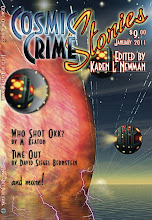
"Who Shot Okk" now available in print
Wednesday, November 10, 2010
A consideration of a few of the possibilities within the Steampunk genre
I think it will be interesting to see the development of certain themes in the steampunk genre over the coming years. Most steampunk uses a pseudo-Victorian era setting and this was a time that had several pronounced cultural issues at work. The oppression of women and open racism were the accepted norm and an almost casual level of violence permeated most cultures of the time period. On the positive side, imperialism still held sway and the industrial revolution had not yet spread to completely subjugate the agrarian culture. Needless to say, by using this time period as a backdrop—a time period firmly straddling a whole host of cultural and social developments—the genre has huge potential to explore a vast number of issues. Right now, most steampunk works concentrate more on entertainment and action but the deeper, more thematic works will come as the genre grows.
One item that specifically interests me will be the push and pull between feminism and misogyny within the genre. There is a possible historic template in the development of science-fiction and fantasy that may play out here as well. Both SF and fantasy were originally male oriented (and male dominated) genres. So much so that entire subsections of fantasy were labeled by critics as “male masturbatory literature” (for example, Robert Howard’s Conan stories, the Horse Clans series, and John Norman’s Gor books). In time, however, dames pushed their way into the genre and began to assert their own views, both as writers and as an ever-increasing portion of the reading (buying) market. Eventually the pendulum swung so far that, by the time LeGuin and Bradley were big names, mainstream fantasy was more of a vehicle for feminist propaganda than actual good storytelling. (Okay, maybe I generalize a little much and maybe, just maybe, I’m tweaking some people by using terms like “dames” but the general point is a sound one.) Today, the genre has mostly leveled out although it still leans “female” because of the shift in buying power within the market (more women buy books than men).
But, will this happen in steampunk? Obviously the misogynistic elements are readily apparent in the oppressive, paternalism of the Victorian era but will history repeat itself? I don’t know. One could argue against it because the current steampunk movement already has a strong female presence among both writers and readers. Cherie Priest certainly doesn’t skimp on strong women as characters in her books.
However, there is the extenuating fact that steampunk is not only a literary genre but also an aesthetic—that it includes and plays to a certain visual style bringing in influences outside just the written word. If you examine steampunk fans at public gatherings and the outfits they wear, you will notice that the women are not, as a rule, rejecting the physical symbols of Victorian oppression. Rather, they are embracing them—corsets and painful shoes are in abundance. What does it mean, if it is relevant at all? I don’t know and that’s why I’m interested in watching the trends.
It may be that the costuming is irrelevant to the literature but steampunk relies heavily on the aesthetic for much of its current definition. Will the genre split and create an eroticized sub-category or will the possible issues be completely swept under the rug by the strong tide of homogenization that seems to swamp any new and emerging artistic trend? Could it be that sometimes chicks just like to be frail and frilly and that there’s nothing intrinsically misogynistic about it?
Cynically, one might ask if it is relevant at all because steampunk may be a short-lived fad and nothing more. I doubt this for three reasons. One, although not labeled as steampunk, this style has always been present and used in SF/F. Two, because steampunk does span beyond just literature into apparel, music, and the like, and therefore it has a stronger base and a wider audience footprint than one might suspect. And three, because steam is one of the cheapest special effects to create and movies and TV drive most of the entertainment industry—simple economics predicts longevity.
Perhaps a more significant issue might be why the genre is so appealing. SF/F, so long noted for looking forward, is now clearly turning back and focusing on a previous, and one might say more comfortable, and more structured time. Does this indicate a growing fear of technology and a society that on some level fears it is losing control of its own devices? Is it a kind of literary nostalgia for a “better time”? A reaction to an overwhelming array of gadgets and internet connectivity invading into our personal lives?
Or is it a generation finally waking up to the fact that the age of Imperialism was a fascinating time in the development of Western culture and therefore a great setting for exciting stories?
As I’ve said, I don’t know but I think the answers may be worth looking for.
One item that specifically interests me will be the push and pull between feminism and misogyny within the genre. There is a possible historic template in the development of science-fiction and fantasy that may play out here as well. Both SF and fantasy were originally male oriented (and male dominated) genres. So much so that entire subsections of fantasy were labeled by critics as “male masturbatory literature” (for example, Robert Howard’s Conan stories, the Horse Clans series, and John Norman’s Gor books). In time, however, dames pushed their way into the genre and began to assert their own views, both as writers and as an ever-increasing portion of the reading (buying) market. Eventually the pendulum swung so far that, by the time LeGuin and Bradley were big names, mainstream fantasy was more of a vehicle for feminist propaganda than actual good storytelling. (Okay, maybe I generalize a little much and maybe, just maybe, I’m tweaking some people by using terms like “dames” but the general point is a sound one.) Today, the genre has mostly leveled out although it still leans “female” because of the shift in buying power within the market (more women buy books than men).
But, will this happen in steampunk? Obviously the misogynistic elements are readily apparent in the oppressive, paternalism of the Victorian era but will history repeat itself? I don’t know. One could argue against it because the current steampunk movement already has a strong female presence among both writers and readers. Cherie Priest certainly doesn’t skimp on strong women as characters in her books.
However, there is the extenuating fact that steampunk is not only a literary genre but also an aesthetic—that it includes and plays to a certain visual style bringing in influences outside just the written word. If you examine steampunk fans at public gatherings and the outfits they wear, you will notice that the women are not, as a rule, rejecting the physical symbols of Victorian oppression. Rather, they are embracing them—corsets and painful shoes are in abundance. What does it mean, if it is relevant at all? I don’t know and that’s why I’m interested in watching the trends.
It may be that the costuming is irrelevant to the literature but steampunk relies heavily on the aesthetic for much of its current definition. Will the genre split and create an eroticized sub-category or will the possible issues be completely swept under the rug by the strong tide of homogenization that seems to swamp any new and emerging artistic trend? Could it be that sometimes chicks just like to be frail and frilly and that there’s nothing intrinsically misogynistic about it?
Cynically, one might ask if it is relevant at all because steampunk may be a short-lived fad and nothing more. I doubt this for three reasons. One, although not labeled as steampunk, this style has always been present and used in SF/F. Two, because steampunk does span beyond just literature into apparel, music, and the like, and therefore it has a stronger base and a wider audience footprint than one might suspect. And three, because steam is one of the cheapest special effects to create and movies and TV drive most of the entertainment industry—simple economics predicts longevity.
Perhaps a more significant issue might be why the genre is so appealing. SF/F, so long noted for looking forward, is now clearly turning back and focusing on a previous, and one might say more comfortable, and more structured time. Does this indicate a growing fear of technology and a society that on some level fears it is losing control of its own devices? Is it a kind of literary nostalgia for a “better time”? A reaction to an overwhelming array of gadgets and internet connectivity invading into our personal lives?
Or is it a generation finally waking up to the fact that the age of Imperialism was a fascinating time in the development of Western culture and therefore a great setting for exciting stories?
As I’ve said, I don’t know but I think the answers may be worth looking for.
Sunday, November 7, 2010
Alternative payment structures for authors in an internet based economy now that the royalty structure may be obsolete
In one of the panels at Conclave, the question was asked: now that royalty payments are infeasible, how are writers going to get paid? Are there any new ideas out there? The question didn’t get answered and I thought I’d address it here.
Let me explain a bit of the background to the issue. Traditionally, writers are paid royalties, an amount of money per book sold. This is usually around 4-6% of the cover price so when you buy a seven dollar paperback, the author gets an amount around 35 cents. (Numbers vary depending on binding and other factors.) Needless to say, you have to sell a lot of books to make money. (Typically, the author is paid an up-front “advance against royalties” and then starts getting royalty payments after the advance is “earned out”. The average advance is somewhere around five thousand dollars per book and most authors don’t earn out. As a rule of thumb, if you assume that your local author is getting five to seven grand a book total, you’ve got a pretty good view of the writing economy. Don’t quit your day job.)
The problem with the royalty model in an internet based economy (and the reason that most writers expect that something will have to change) is the e-book. E-books are cheap and getting cheaper. I could go off on a rant about how the real problem is that the market doesn’t see the creative effort of writing a book as having monetary value and therefore thinks the only real costs are in paper but that’s not the point. The point is, if an author can’t make a decent living on 5% of seven bucks, then 5% of two bucks isn’t worth the effort to write the book. (Think of it: one morning someone invents an internet application and suddenly you take an almost 80% pay cut.) So something’s got to change in the way authors get paid, but what?
The answer is: nobody knows. In the near-term, it’s going to get worse before it gets better. There will be a lot of different things tried, some better than others, and a lot of places will stick with the royalty model as long as possible.
But the question was asked if there are any other feasible alternatives that anyone has considered and I believe there is one—one that has the advantage of having been used successfully before.
Patronage.
Before dismissing the idea as crazy, hear me out. Patronage has a fine history in the arts. After all, Dante didn’t write the Inferno on spec. Nobles patronized artists, artists provided books, music, paintings, sculptures, and so on to please their patrons and life went on. I know some people will yell that patronized art is corrupted and not true to the artists visions but, frankly, these people don’t know very much about the market or history. In actuality, patronage provides for a wider range of expression because, instead of having to cater to a marketing demographic or federal grant program, the artist only has to please one person—their patron—and individuals have much broader tastes and tolerances than homogenized cultures.
But are there enough rich people willing to patronize and make the idea work? Let’s go back to history. Why did the nobility and the church patronize artists to begin with? Some were altruistic but most were after two simple things: propaganda and public image. Either art to support and promote a specific agenda or art so that the common man would say “Well, that baron supports this theater and that writer and these paintings and even though I ain’t happy with the taxes, at least he ain’t such a bad feller all the way around. Let’s put off the revolt until next week.”
Now go watch TV for a few minutes and look at the ads. Notice that a lot of them aren’t for products or services; they’re general touchy-feely our company isn’t evil, we’re your friend kind of ads. In other words, public image ads. That tells you that the market and the money are there. You have a clear potential, no only for individual patronage, but also patronage by charitable organizations, foundations, schools, research institutes, and the entire scope of corporate America.
Let’s make it even more fun. Let’s say that a corporation decides to sponsor an author and that they make a portion of that author’s writing (and maybe that author’s time) available for free to schools and libraries. Think about it. On every bookshelf, from bookstores to supermarkets, the sponsor’s corporate logo has replaced the publisher’s imprint (massive brand exposure) plus now it’s going into schools and libraries too. Why wouldn’t a corporation spring for that? You could buy a dozen authors for the price of a Super Bowl ad.
And what about stocks? What if you could buy a percentage of your favorite author? If a group of you could go together, buy stock in an author, and jointly support his or her work? Especially is the author threw in some nice bonuses like signed first edition copies for all stock holders, exclusive beta reads and deleted scenes, character cameos of preferred holders, etc.? We could end up with a much broader market selection that we have now where only two major publishers rule most of the field.
I’m not saying it’s going to happen and I’m not saying whether it would be good or bad for society but I am saying that it is a plausible, feasible alternative.
Let me explain a bit of the background to the issue. Traditionally, writers are paid royalties, an amount of money per book sold. This is usually around 4-6% of the cover price so when you buy a seven dollar paperback, the author gets an amount around 35 cents. (Numbers vary depending on binding and other factors.) Needless to say, you have to sell a lot of books to make money. (Typically, the author is paid an up-front “advance against royalties” and then starts getting royalty payments after the advance is “earned out”. The average advance is somewhere around five thousand dollars per book and most authors don’t earn out. As a rule of thumb, if you assume that your local author is getting five to seven grand a book total, you’ve got a pretty good view of the writing economy. Don’t quit your day job.)
The problem with the royalty model in an internet based economy (and the reason that most writers expect that something will have to change) is the e-book. E-books are cheap and getting cheaper. I could go off on a rant about how the real problem is that the market doesn’t see the creative effort of writing a book as having monetary value and therefore thinks the only real costs are in paper but that’s not the point. The point is, if an author can’t make a decent living on 5% of seven bucks, then 5% of two bucks isn’t worth the effort to write the book. (Think of it: one morning someone invents an internet application and suddenly you take an almost 80% pay cut.) So something’s got to change in the way authors get paid, but what?
The answer is: nobody knows. In the near-term, it’s going to get worse before it gets better. There will be a lot of different things tried, some better than others, and a lot of places will stick with the royalty model as long as possible.
But the question was asked if there are any other feasible alternatives that anyone has considered and I believe there is one—one that has the advantage of having been used successfully before.
Patronage.
Before dismissing the idea as crazy, hear me out. Patronage has a fine history in the arts. After all, Dante didn’t write the Inferno on spec. Nobles patronized artists, artists provided books, music, paintings, sculptures, and so on to please their patrons and life went on. I know some people will yell that patronized art is corrupted and not true to the artists visions but, frankly, these people don’t know very much about the market or history. In actuality, patronage provides for a wider range of expression because, instead of having to cater to a marketing demographic or federal grant program, the artist only has to please one person—their patron—and individuals have much broader tastes and tolerances than homogenized cultures.
But are there enough rich people willing to patronize and make the idea work? Let’s go back to history. Why did the nobility and the church patronize artists to begin with? Some were altruistic but most were after two simple things: propaganda and public image. Either art to support and promote a specific agenda or art so that the common man would say “Well, that baron supports this theater and that writer and these paintings and even though I ain’t happy with the taxes, at least he ain’t such a bad feller all the way around. Let’s put off the revolt until next week.”
Now go watch TV for a few minutes and look at the ads. Notice that a lot of them aren’t for products or services; they’re general touchy-feely our company isn’t evil, we’re your friend kind of ads. In other words, public image ads. That tells you that the market and the money are there. You have a clear potential, no only for individual patronage, but also patronage by charitable organizations, foundations, schools, research institutes, and the entire scope of corporate America.
Let’s make it even more fun. Let’s say that a corporation decides to sponsor an author and that they make a portion of that author’s writing (and maybe that author’s time) available for free to schools and libraries. Think about it. On every bookshelf, from bookstores to supermarkets, the sponsor’s corporate logo has replaced the publisher’s imprint (massive brand exposure) plus now it’s going into schools and libraries too. Why wouldn’t a corporation spring for that? You could buy a dozen authors for the price of a Super Bowl ad.
And what about stocks? What if you could buy a percentage of your favorite author? If a group of you could go together, buy stock in an author, and jointly support his or her work? Especially is the author threw in some nice bonuses like signed first edition copies for all stock holders, exclusive beta reads and deleted scenes, character cameos of preferred holders, etc.? We could end up with a much broader market selection that we have now where only two major publishers rule most of the field.
I’m not saying it’s going to happen and I’m not saying whether it would be good or bad for society but I am saying that it is a plausible, feasible alternative.
Thursday, November 4, 2010
Very good recent books
I haven’t had a chance to do quality book reviews for a couple of recent books that I really liked but I don’t want them to be overlooked either. Instead, let me give you a quick capsule look at some books that really impressed me.
The Dream of Perpetual Motion by Dexter Palmer
The book is classified as steampunk and one of the cover blurbs calls it “steampunk comes of age”. The statement is fair as far as it goes but I think this is one of those books that transcends simple classification and is simply good literature. Think Fitzgerald’s The Great Gatsby with steampunk trappings retelling Shakespeare’s The Tempest and you’ve got a thumbnail view of the book. This is one of those books that I finished and said, “I can’t write like that. That was art with the capital A.” I’m not sure if it’s fair to say I enjoyed it as much as I was very impressed with it (it’s a grim book so it’s kind of hard to enjoy per se). I do think that if you are a fan of or writer of the steampunk genre, you should make the time to read this book.
The Monstrumologist by Rick Yancy
I like monster horror so this book was right up my alley—monster horror in Victorian era America. Even more impressive was that this book was scary and let’s be honest, not much that is classified as horror is scary these days except for psychological horror (which is too scary but in a different way). This book I enjoyed immensely although I have one small quibble. It’s classified as a YA book. I think it’s a bit too gory for that but that’s where you’ll probably find the book in your library. Good monster ecology in this book adds a great extra level of realism as well. Definitely a good read.
The Dream of Perpetual Motion by Dexter Palmer
The book is classified as steampunk and one of the cover blurbs calls it “steampunk comes of age”. The statement is fair as far as it goes but I think this is one of those books that transcends simple classification and is simply good literature. Think Fitzgerald’s The Great Gatsby with steampunk trappings retelling Shakespeare’s The Tempest and you’ve got a thumbnail view of the book. This is one of those books that I finished and said, “I can’t write like that. That was art with the capital A.” I’m not sure if it’s fair to say I enjoyed it as much as I was very impressed with it (it’s a grim book so it’s kind of hard to enjoy per se). I do think that if you are a fan of or writer of the steampunk genre, you should make the time to read this book.
The Monstrumologist by Rick Yancy
I like monster horror so this book was right up my alley—monster horror in Victorian era America. Even more impressive was that this book was scary and let’s be honest, not much that is classified as horror is scary these days except for psychological horror (which is too scary but in a different way). This book I enjoyed immensely although I have one small quibble. It’s classified as a YA book. I think it’s a bit too gory for that but that’s where you’ll probably find the book in your library. Good monster ecology in this book adds a great extra level of realism as well. Definitely a good read.
Monday, November 1, 2010
Non-Fiction Writing and Marketing
I was asked during the convention how one went about writing and marketing non-fiction. I’m not the best person to ask; I’ve done a goodly bit of non-fiction writing in my time but the market changes rapidly and most of what I have done has been very focused, technical non-fiction as opposed to commercial non-fiction. (My beloved child bride that I stole away from the foreign tribes has been after me to write commercial non-fiction for years but I still resist.) Ne’ertheless, I promised to see what I could put together by way of suggestions and references.
Compared to fiction, non-fiction is all good news. The pay is better, the markets are more abundant, and there are plenty of books in most libraries. I don’t think the libraries planned to emphasize non-fiction in their selection of books on writing and formatting; it just happens that most people who write those books freely mix fiction and non-fiction information, and non-fiction is easier to talk about in generalities. So, stop number one: local library and you should be able to find a good stock of books on format, style, etc. The internet is also full of references (search terms like “writing non-fiction”, “formatting non-fiction”, “non-fiction footnote endnotes”, etc.) Also take this time to research your competition. See what’s already on the shelves and who is publishing what you want to write.
This information will give you a general over-view of the different techniques used in non-fiction. What it will not do is tell you what to write, give you markets, or put it all together and tell you what to write and how to write it for a specific market. That is your responsibility.
First off, decide what you want to write and, more importantly in non-fiction, what you are qualified to write about. Qualifications are important to a lot of non-fiction publishers; no degree or special experience, no reason for them to trust your information to be complete or accurate. Whether it’s fair or not, that seems to be the general trend. (On the other hand, some areas are relatively generic but I’m not going to get distracted talking about women’s magazines and that content.) The key thing you’ll want to think about is: Why you? What makes you uniquely qualified to write about this subject and makes your work better and distinct from all the other people who are also writing about it? Sometimes that means saying, “I have a doctorate in theoretical nuclear chemistry” and sometimes it means saying, “I can write about Cleveland because I have lived here for fifty years and seen the changes over time” but you should always be able to answer that questions. (In some cases, the answer might even be, “I think this subject is fascinating so I’ve researched it to death and I have a real passion for it.” That’s a good answer too although it might be a bit harder to sell.)
Having decided what to write, when do you write it? In fiction, unless you’re established as a writer, everything you do will be on speculation (i.e. total freelance). Non-fiction is not always that way. Non-fiction buys a lot of things on query. What order you do things in is up to you and your market but my suggestion would be to at least write a complete draft first. You may have to do a complete rewrite to fit the style guide of a specific publication later but that kind of thing is a lot easier than sitting down and writing cold. (My lovely wife disagrees and advises to query first. If you’re a regular reader, you already know whose advice counts for more.)
In fiction, the cover letter is almost irrelevant to a submission; in non-fiction, it is the main selling point. One of the things you should have picked up from the how-to books is how to write a cover letter and query for non-fiction. I know it seems out of order, but I would suggest that you should be able to put your proposal into a query (or abstract) before you even start looking for markets. Otherwise, you may not have a clear enough grasp of what you’re selling to place it effectively.
Finally, markets. I put this off until last because it’s a big subject but it is not necessarily the last thing you want to consider. You might want to look at markets first to get a feel for what is out there and then go back to actually writing the article or book. Like with query letters, I’m not much help here; this isn’t my area and everyone works differently. But I can tell you that if you’re interested enough in a non-fiction topic to want to write it then you probably have books and magazines about it already handy around the house. Some magazines include a thumbnail of their submission guidelines. Most don’t but will, in turn, have them on the publisher’s website. If not there, then you can search the internet for terms like “non-fiction market listings” or “Magazine name submission guidelines”. The be-all end-all of market listings for everything is the LMP, the Literary Market Place. Your library should have one. (If they don’t, they should be able to get it for you through inter-library loan. If no place in your library system has it, then yell at the thieving buggers and tell them to stop wasting your tax money on bloody paranormal romance and cookbooks and provide the blasted service they were created for. Feel free to add your own expletives as seems appropriate.) The reason I insist on getting access to the LMP through your library is that it is expensive and you need an up-to-date copy. Once you’ve got the LMP in hand, you can find almost any market for any thing. Tailor your query (or full submission) to the publisher’s guidelines and good luck to you.
As an afterward, let me mention corporate work and work-for-hire. This is when a company hires you to write stuff for them, anything from the employee handbook to a company newsletter to the operating manual for their software. You may hear people who write this kind of thing called “technical writers” and, for this kind of work, you need to deal with the company directly since you are basically saying, “Here am I, a writer. Pay me and tell me what to write.” You get this kind of work much like you do any other job: convince the person hiring that you’re the one for them, and then work from their specs with their people. Usually, they will want a local person or someone already affiliated in some way with the company. It’s not glamorous but it’s good work (and better pay) if you can get it.
Some key references:
The Literary Market Place
Writing for Dollars by John McCollister
The Thorncroft Learning Center Workshop: The Business of Writing (I believe one of these workshops is due to be held in Missouri sometime around the end of November.)
Compared to fiction, non-fiction is all good news. The pay is better, the markets are more abundant, and there are plenty of books in most libraries. I don’t think the libraries planned to emphasize non-fiction in their selection of books on writing and formatting; it just happens that most people who write those books freely mix fiction and non-fiction information, and non-fiction is easier to talk about in generalities. So, stop number one: local library and you should be able to find a good stock of books on format, style, etc. The internet is also full of references (search terms like “writing non-fiction”, “formatting non-fiction”, “non-fiction footnote endnotes”, etc.) Also take this time to research your competition. See what’s already on the shelves and who is publishing what you want to write.
This information will give you a general over-view of the different techniques used in non-fiction. What it will not do is tell you what to write, give you markets, or put it all together and tell you what to write and how to write it for a specific market. That is your responsibility.
First off, decide what you want to write and, more importantly in non-fiction, what you are qualified to write about. Qualifications are important to a lot of non-fiction publishers; no degree or special experience, no reason for them to trust your information to be complete or accurate. Whether it’s fair or not, that seems to be the general trend. (On the other hand, some areas are relatively generic but I’m not going to get distracted talking about women’s magazines and that content.) The key thing you’ll want to think about is: Why you? What makes you uniquely qualified to write about this subject and makes your work better and distinct from all the other people who are also writing about it? Sometimes that means saying, “I have a doctorate in theoretical nuclear chemistry” and sometimes it means saying, “I can write about Cleveland because I have lived here for fifty years and seen the changes over time” but you should always be able to answer that questions. (In some cases, the answer might even be, “I think this subject is fascinating so I’ve researched it to death and I have a real passion for it.” That’s a good answer too although it might be a bit harder to sell.)
Having decided what to write, when do you write it? In fiction, unless you’re established as a writer, everything you do will be on speculation (i.e. total freelance). Non-fiction is not always that way. Non-fiction buys a lot of things on query. What order you do things in is up to you and your market but my suggestion would be to at least write a complete draft first. You may have to do a complete rewrite to fit the style guide of a specific publication later but that kind of thing is a lot easier than sitting down and writing cold. (My lovely wife disagrees and advises to query first. If you’re a regular reader, you already know whose advice counts for more.)
In fiction, the cover letter is almost irrelevant to a submission; in non-fiction, it is the main selling point. One of the things you should have picked up from the how-to books is how to write a cover letter and query for non-fiction. I know it seems out of order, but I would suggest that you should be able to put your proposal into a query (or abstract) before you even start looking for markets. Otherwise, you may not have a clear enough grasp of what you’re selling to place it effectively.
Finally, markets. I put this off until last because it’s a big subject but it is not necessarily the last thing you want to consider. You might want to look at markets first to get a feel for what is out there and then go back to actually writing the article or book. Like with query letters, I’m not much help here; this isn’t my area and everyone works differently. But I can tell you that if you’re interested enough in a non-fiction topic to want to write it then you probably have books and magazines about it already handy around the house. Some magazines include a thumbnail of their submission guidelines. Most don’t but will, in turn, have them on the publisher’s website. If not there, then you can search the internet for terms like “non-fiction market listings” or “Magazine name submission guidelines”. The be-all end-all of market listings for everything is the LMP, the Literary Market Place. Your library should have one. (If they don’t, they should be able to get it for you through inter-library loan. If no place in your library system has it, then yell at the thieving buggers and tell them to stop wasting your tax money on bloody paranormal romance and cookbooks and provide the blasted service they were created for. Feel free to add your own expletives as seems appropriate.) The reason I insist on getting access to the LMP through your library is that it is expensive and you need an up-to-date copy. Once you’ve got the LMP in hand, you can find almost any market for any thing. Tailor your query (or full submission) to the publisher’s guidelines and good luck to you.
As an afterward, let me mention corporate work and work-for-hire. This is when a company hires you to write stuff for them, anything from the employee handbook to a company newsletter to the operating manual for their software. You may hear people who write this kind of thing called “technical writers” and, for this kind of work, you need to deal with the company directly since you are basically saying, “Here am I, a writer. Pay me and tell me what to write.” You get this kind of work much like you do any other job: convince the person hiring that you’re the one for them, and then work from their specs with their people. Usually, they will want a local person or someone already affiliated in some way with the company. It’s not glamorous but it’s good work (and better pay) if you can get it.
Some key references:
The Literary Market Place
Writing for Dollars by John McCollister
The Thorncroft Learning Center Workshop: The Business of Writing (I believe one of these workshops is due to be held in Missouri sometime around the end of November.)
Friday, October 29, 2010
How do your favorite writers maintain tension in books where physical action and danger are delayed from the start of the book?
The book I’m working on now has what I see as a problem and I’m not sure how to fix it. Simply put, the driving tension of the book doesn’t become clear until we’re a few chapters in but I want the book to have a fast, strong start.
Normally, physical action and danger (to the characters and to other people) drive my books from the beginning. In this one, the danger is there but they don’t know about it yet so the main characters are investigating the mysteries facing them at a less than frantic pace. Realistic, but not, I think, really grabbing for the reader.
I’d like to look at how other authors have handled this kind of situation before and I’m looking for suggestions on who you have read that you think has done this kind of thing well.
Normally, physical action and danger (to the characters and to other people) drive my books from the beginning. In this one, the danger is there but they don’t know about it yet so the main characters are investigating the mysteries facing them at a less than frantic pace. Realistic, but not, I think, really grabbing for the reader.
I’d like to look at how other authors have handled this kind of situation before and I’m looking for suggestions on who you have read that you think has done this kind of thing well.
Friday, October 15, 2010
Conclave and a Review of Calamity's Child
I am home, safe and mostly sound, from Conclave and I will, eventually talk about the convention (I've finally given up on trying to do full convention reports since I still haven't even talked about Conclave from last year). In short, the convention and all the people there were wonderful and if there was a weak link, it was me. Because I'm having even worse than usual health problems, I was heavily medicated and tired. I don't feel like I gave the people who attended the writing workshop the attention, energy, and extended feedback that they deserved and for that I apologize. Fortunately, they know that they can always follow up with me by email later for as long as they need. (You guys do know that, right?)
I would also like to point to a review I found sitting in my in-box when I returned from the convention that made me happy and inflated my already dangerously large ego. The review is of Calamity's Child and it's over at http://christianscifiandfantasyreview.webs.com/ . (Hope that link posts in correctly.) I'm always happy when people feel my books were worth their time and money.
Thank you to everyone and I'm off to get more sleep.
MKeaton
PS: I know that my "interweb pressence" is woefully short of what is considered normal these days. We are taking some steps and bringing in some additional staff to address this and we'll be talking about it on the blog shortly. One of the things I want to do is to give you, my readers, what you actually want rather than try to follow the prevailing paradigms because "that's what is done and that's what markets" so don't be surprised when I start asking questions. Thank you again.
I would also like to point to a review I found sitting in my in-box when I returned from the convention that made me happy and inflated my already dangerously large ego. The review is of Calamity's Child and it's over at http://christianscifiandfantasyreview.webs.com/ . (Hope that link posts in correctly.) I'm always happy when people feel my books were worth their time and money.
Thank you to everyone and I'm off to get more sleep.
MKeaton
PS: I know that my "interweb pressence" is woefully short of what is considered normal these days. We are taking some steps and bringing in some additional staff to address this and we'll be talking about it on the blog shortly. One of the things I want to do is to give you, my readers, what you actually want rather than try to follow the prevailing paradigms because "that's what is done and that's what markets" so don't be surprised when I start asking questions. Thank you again.
Labels:
Book Review,
Calamity's Child,
Conventions,
My Books,
Travel
Wednesday, September 8, 2010
New Book: Dreams of Steam
Subscribe to:
Posts (Atom)