Since I wasn’t scheduled for anything until late Saturday, I didn’t even show up to the convention until after noon. I talked with Bill, Allan, and the Gambers then wandered over to chat with Glen Cook and finally Tyree Campbell from Samsdot. Better still, Lynn Abbey had snuck into the convention unannounced and I got to talk with her about Robert and several other folks we have in common. This was the first time we’ve met face-to-face but, because of the people we share, I felt like I already knew her. Let me just say, she is one classy lady. She had come up to see C. J. Cherryh whom I also got to meet. I also pestered Jeremy and Joy at their signing then talked to Dr. Les Johnson about dark matter and some other non-fiction physics coolness. (In case I forget to mention it later, I think ConClave and especially Penguicon should consider inviting Les as a science guest.)
After this, I wandered upstairs to do a panel with Mr. Resnick, Mr. Ostrander, Ruth Souther, and another really nice person whose name I forgot. (I’m sorry, truly. It’s not a matter of being disrespectful or anything like that; it’s just that I don’t remember names well and I lost my program so I can’t cheat and look it up.) The panel was on how to kill character’s you love. Mostly we use bullets or blunt objects although Mr. Ostrander (who writes for comics) cheats because he gets to bring them back in a few issues. Once that was settled, we wandered over a dozen different topics related to the industry (as usually happens at conventions) and I argued with Mike. Not violently, we just disagree on certain subjects. For example, I consider the short story a loss-leader and therefore part of my marketing presence instead of a for-profit act. Mike thinks if you sell your words cheap, that means you don’t value your work and therefore aren’t professional. It’s a business decision that we disagree on so we argue, politely. It was a lot like when I argue with Scalzi. We just have different business models but we still get along personally.
I went to Jeremy and Allan’s panel (yes, there were other people but they were the two I knew and went for) on horror from Lovecraft to King. Once it was over, since we both had panels coming up on the same floor, Jeremy and I stood around and talked about writing and projects we had stashed away in our idea boxes that we were trying to get to when we found the time. (Inside baseball—I think maybe Jeremy and I should talk about doing the fairy realm detective/justice outside of time series together. You know, in our spare time.)
Before we headed to our separate panels, Dan Gamber grabbed me and introduced me to Anne VanderMeer. Again, the first time to meet face-to-face but we’ve exchanged emails (and mss. and rejection slips) for some time. Jeremy’s panel started but I still had an hour open so I wandered over to talk to Wild Mercy. While they were being interviewed, Andrew was gracious enough to talk to me about an idol of mine, George Alec Effinger (Andrew was in his writers group and knew him for several years before he died. It was an enriching conversation and I’m in his debt for his kindness). I did get to talk to Wild Mercy and thank them for Summer Storm. Both regular readers of this weblog know that I listened to that CD while writing Calamity’s Child and I wanted to say thanks. They thought it was pretty neat that I wrote to their music and I thought it was incredibly exciting that Barry (that’s the giraffe) has finished his song cycle and the CD is out! Steve Lapata joined us and we talked about absent friends, especially Cat’s Laughing, Emma Bull, and Will Shetterly before Steve and I had to go to our panel.
Steve and I were together on the same panel and joined by Glen Cook to discuss high tech weaponry. Pretty much, the best weapon around at any tech level is a rock (especially if you can heave it down a planetary gravity well) so we broadened our discussion to military things in general. It was a great panel that began with cutting edge military tech, progressed back through history as we discussed the timelessness of certain basic tactics and each of us talked about an area of history we were currently reading and the interesting things we were learning. By the end of the panel, we were with Hannibal, sans elephants, harassing Rome. I enjoyed it and I think the audience and the other panelists did too. Steve and I continued our conversation for about another hour before She Who Must Not Be Named arrived to claim me and drag me off to eat and sleep.
Friday, April 17, 2009

Tuesday, April 14, 2009
Midsouth Convention Report (Part 2 of a half-dozen or so)
My first programming assignment, and the only one I had on Friday, was a reading for the children’s track. (I am not a children’s author! Does anyone even believe me anymore when I say that?) Since it was Friday, I didn’t expect anyone to show and figured I’d have a quiet hour to get organized. Ha! To my pleasant surprise, I had both children and adults and so “Purple Wings and Troll Snot” put in yet another live performance. (Really need to find a publisher for that thing—it makes too many people too happy to not be in print.) It was here that I got to meet Andrew Fox and, more importantly, his three wonderful sons, Levi, Asher, and Judah. (See! I remember their names. Adults I forget and have to look up in the programming book but anyone shorter than four feet I remember. But I am not a children’s author!) It was a good reading but an interesting way to start the convention. I was panting and trying to catch my breath for the rest of the evening. A kid’s reading is not a reading. It’s throwing yourself down a flight of stairs while reciting a story from memory.
I tagged back in with Bill and Jeremy and was ready to call it a night and head back to the Super 8 when Gary Babb caught me and told me there was a “meet and greet” where the folks could meet the guests. Being one of the guests, I figured I’d best attend and there was free food. I’m already in trouble with my publicist for turning down dinner with an editor so I wasn’t going to turn down free food. Andrew introduced me to Marty Halpern (his editor) and I ended up sitting next to Mr. Resnick talking Africa. When the gathering broke up, Mr. Resnick invited me to come up to the movie room and watch a pair of his short stories with him but, due to the lateness of the hour, I declined and called it a night. It was a good first day, I’d been up since about 6 a. m., and Mike was going to be watching movies until at least 1 in the morning. (I almost forgot to mention, I also met Glen Cook in the dealer room and didn’t recognize him. Somewhere between funny and awkward that.)
Before I managed to make good on my escape, I did an interview (really nice pair of guys) but then I was on my way. Half-an-hour later I found the rental car in the now-packed parking lot and eventually made it back to She Who Must Not Be Named.
Saturday, April 11, 2009
Midsouth Convention Report (Part 1 of a half-dozen or so)
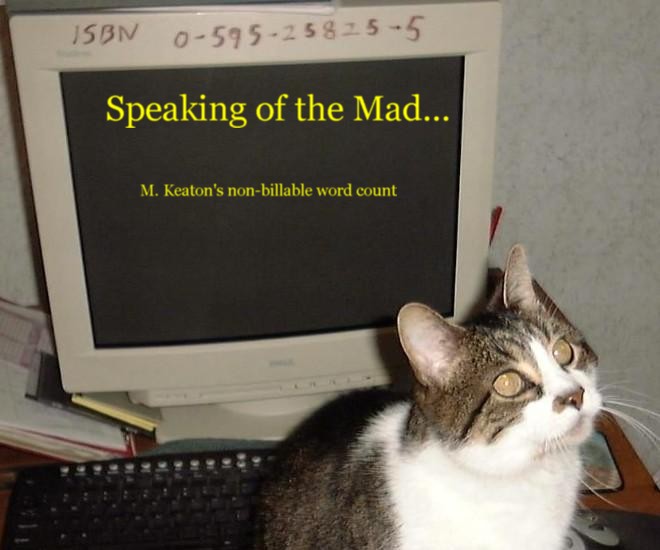
Faithful readers, I, your helpful feline host, have managed to convince the Thin Man that, since he has to fill blog space anyhow (i.e. non-billable words) to give an extended convention report and spread it over several days. He’s still not 100% after the trip (he still has the painful stress/medication reaction rash) but he’s close and so, without further delay, we present an extended discussion of Midsouthcon 27.
Stupid cat, acts like everything should be announced with trumpets. Let me set down a few rules first. I met several folks that I want to talk about separately so I’m going to give you the chronological story and then go back after and talk about the individual people. I also want to make clear that the reason I say so much about things and people is because I have all this space to fill so I can go into it in depth. In no way should this be considered a slight on my long-time home convention ConClave—a people I consider family and love dearly. And I fully intend to discuss this year’s ‘Clave as well.
Anyhow, She Who Must Not Be Named and I left Friday early. She drove, I slept, and we reached Memphis (actually, Olive Branch Mississippi but basically still Memphis) just after mid-day. I settled her into a hotel room and set off up the road to the convention. (Miserable bugger to try to find. Here’s a tip: if you build a convention center, put up a blasted sign—and not one that says ‘Private Drive’; that confused me even worse.) The sight was good although seriously shy on parking.
Going into this, I was stressed like I haven’t been in years. I’d never been to this convention and I didn’t have any ‘inside people’ to look after me (and I only have 5 total hours of programming) so I was scared to death. She Who Must Not Be Named was afraid I was going to be sick before the con; apparently I looked that bad. Gray, to use her term. Needless to say, I was walking soft and timid but, there are certain commonalities to all conventions and I was quickly and efficiently checked in, issued a badge and schedule, and released to my own recognizance. That, of course, was the root of my problem—I don’t know what to do ‘on my own recognizance’ other than leave. I like structure and the familiar. Lacking any clue what was proper social protocol, I opted to swing by the dealer room and talk to my publisher.
It was at this point that my weekend went from scary to very good. Not only was Bill Snodgrass (my publisher) there and happy to see me but so was my favorite Nordic heretic and brother in Christ Jeremy Lewis. I love Jeremy (even if he does eat sushi) and I humbly think he’s fairly fond of me. We get along swimmingly and could talk life and writing for hours on end. Plus, he’s just as non-neurotypical as me.
But it got even better. I discovered Bill’s booth was in the middle of what I jokingly called ‘incest row’ because everyone there was a familiar face from the ill-fated Omegacon. Meadowhawk Publishing was on one side and that means Dan and Jackie Gamber (wonderful people with the ability to make you feel at home in moments) along with their very talented children. (Bill’s two sons were there too but I didn’t get to see much of them.) On the other side was Kerlack Publishing (whose website I can’t get to open up—frustrating since Allan wants to see manuscripts). Not only was Allan Gillsbreath there but his entire rouge’s gallery including such caring and gentle people as Joy Ward. Now I had a place to retreat to and people who knew me.
Tuesday, April 7, 2009
Guys Read Short Stories
We rarely talk about specific short stories but there’s one that deserves a special mention. Originally copywritten in 1928 and published in The Eternal Moment and Other Stories, The Machine Stops by E. M. Forster is worthy of designation as a masterwork. It’s prescient sight of modern society, it’s delicate treatment of a subject that could, in a lesser work, degenerate into a sermon instead of a story, and the author’s ability to strike that all-to-rare balance between dystopia and hope all combine for a truly powerful effect. It is also a layered piece, on of the few stories that benefit from immediate rereading. The Thin Man read it twice, once to himself and then again to SHE WHO MUST NOT BE NAMED aloud. Each reading was a different experience, the difference in cadences and retracing of steps with fresh eyes revealed nuances and truly artistic touches that are the mark of a truly great piece. We strongly recommend you seek out a copy of this work and read it, at least once. It is, after all, quite fitting for the “spirit of the age”.
Saturday, April 4, 2009
Requiem
We gather here today to pay tribute to one of our fallen, a mighty warrior who has passed on into the Dream of a Thousand Cats and whose clay has returned once more to the earth. The great Xenocrates is gone. He, whose kittenish face looks down from the tree boughs, whose visage watches over all who enter the website. Xenocrates, son of Lola and a wandering bobcat, brother of Chuckie and of the changeling Euisgue (now returned to the glamor) has left us.
It falls to me, as is my right as eldest, to tell you of him and I alone among you am qualified to tell. I, Chaos, the Mighty Kos, Lord of the Guild, am older than you all. I was there when Xeno, fourth of the litter of four plus one, was born. He was never timid, as kitten or cat, and in the end I fear the very boldness which endeared him to us all may have led to his undoing. As we look at his body, massed with scar tissue, misshapen from poorly healed bones, we must remember that his tattered clay is a monument to his life and a testment that he surely lived more than nine lives.
I remember well his first great injury, the breaking of the tail. It entered into his young mind that he need not pause at the top of the slat fence but that he could leap it in a single bound. He did. His tail did not. And so he hung, tail caught between the slats, bones broken, tail twisted at an angle, waiting patiently until the Thin Man arrived with thumbs to extract him. And once free, did Xeno tend his wounds and sulk to the house? No. He immediately rose and attempted to leap the fence again—and hence the 'z' in his tail. But he did learn to clear the fence and once across he discovered upon the bordering property a live trap, baited with food laced with poison. And after the Thin Man freed him from the trap, he returned again while our thumbed guardian was still trying to hoist himself back over the fence. Twice freed and well cursed, he returned home. Of the poison, he never showed any ill effect. For Xenocrates was a cat of strong constitution if, perhaps, low wisdom.
His battles with the Thin Man over bathing are the thing of viking legend. What other creature has ever fought so hard and done so much damage to the Thumbed One and lived? Who else has the courage to strike the human in the eye and, piercing his lower eyelid, hang on with all his weight to insure the point is made? And did the Thin Man begrudge him this? Well, yes. But such was the loving, jovial nature of Xeno that eventually he was forgiven. A greater accomplishment, I cannot think of.
Throughout his troubled, violent life, sporting a broken nose and torn ear, Xeno was always a friend to dogs. To his last day, he was a friend to the collies of the farm and a willing playmate of any canine who came to visit. I believe he even felt kindly toward the savage beast that, years ago, crushed his ribcage, broke his shoulderblade, and left him for dead. Four long days, our Xed was missing before he turned up on the doorstep bloodied and battered, dried dog saliva matting his fur, but I doubt he held emnity for the perpetrator. Such was not his way. Though the injuries would leave him permanently twisted and lacking one lung, Xee-brick persevered, loving dogs and believing "A cat must do what a cat must do while being who he is." And Xeno was a forgiving cat, filled with love and optimism—and loyalty.
The dedication of Xenocrates to She Who Must Not Be Named is the stuff of legend. Being a cat, he was incapable of resisting any tempting female with a handful of treats and his attention span was, to put it kindly, shorter than most, but his heart belonged to his human. He was her jester, her battered baby boy, friend and playmate, clumsy fool and discerning wise man. We are shamed by the depths of her grief but we are but cats and we know that, though the clay rests, the spirit of Xeno has returned to the Dream and waits for the humans to carry his soul to heaven. Perhaps the Thin Man will explain, perhaps he will not, but we are secure in the knowledge that, in a way, animals do go to heaven, returning with their owners just as, in the end, the humans return to theirs.
Lift high your glasses and toast the fallen hero. Xenocrates has sailed upon the black barge; fire your flaming arrows true. This day a new hero runs headfirst into the table legs in the feasthall of Valhalla. This day, the broken hero returns to the Dream. Give grief for the living and glory for the fallen.
Saturday, March 28, 2009
Post-Con
It's been several days so I tip-toed in on little cat feet to see how the Thin Man was doing. He was still in bed, watching me with one baleful, blood-shot eye.
"What do you want, cat?"
"Time to update the blog."
He groaned. "Fine. Make something up." I waited and finally he continued in a sepulchuric voice. "You know, I go to conventions and take more medicine than I ought to but I feel like I do pretty good. By the time I come home, I'm starting to think that I'm not that crazy after all and that maybe I could go out more often if I wanted to...then I get home. Once I go back down on the meds and the manic phase passes..." He groaned again and pulled the blankets over his head.
"DTs?" I asked.
"Not too bad. My stomach's torn all to pieces though. The shaking is mostly exhaustion. The worst is the way that my head feels full of cotton. What day is it?"
"Saturday. You've been down all week."
"Five days? That's not too bad. I'll be up tomorrow."
With that I left him and wished he was exaggerating.
Tuesday, March 24, 2009
One More Question
And one more question to clear the backlog while we're waiting for the Thin Man to recover from his road trip: Why is your blog so scattered? Why not stick to one subject instead of wandering all over the place?
Ummm, because I left a cat in charge of it and they're really known for their attention span? Actually, I think the topics are closely related if you look close enough. Then again, I also agree with Fort that "One begins a circle drawing anywhere." and that everything is interrelated.
The other answer is that I am a raccoon (or maybe a crow). Like most authors, everything I do in life ties back to scuttling around, finding neat shiny things that attract my attention, then bringing them back and showing them off to you, the reader. That puts me all over the board in interests, makes me knowledgeable about many things and master of none, and leaves me a repository of hosts of worthless trivia but, I think, it also makes me a better author (and able to write about a broader range of things). In the case of the weblog, the cat frequently ends up with the odd scraps that I haven't found a place for yet or that I want to share but their project may not come up in the queue for quite some time.
I'm also curious, why is there a presumption that blogs should be about a specific area of interest? Are there unwritten (or written) rules or some kind of meme governing the medium?
Wednesday, March 18, 2009
Guys Read Anybody Named E. E.
Way of the Wolf (Book One of The Vampire Earth) by E. E. Knight
The back cover of the paperback edition includes a quote from Paul Witcover, describing the books as “…(if) The Red Badge of Courage had been written by H. P. Lovecraft.” It is a fair description, perhaps also with a dash of the movie Red Dawn and some coloring from White Wolf’s World of Darkness. The Old Ones are on top and the free fringes of the human cattle fight against them.
The book is structured as a series of vignettes, major moments in the life of the central character. Knight uses the in medias res technique to hook the reader immediately then works into flashbacks. The characters are adequate with occasional flashes of real brilliance. The action is well described and paced nicely—fast enough to read well and convey urgency, slow enough to allow the reader to absorb the nuances of the setting. The underlying concept is, obviously, genre-blending and presented smoothly without heavy-handed plot devices or hackneyed clichés. Dialogue is a tool Knight uses to his advantage and he definitely has a knack for it—realistic and informative. Theme and plot are necessarily simple but, in the first book of a series, this is not a weakness. Character and milieu drive the work.
The book is reasonably self-contained and the second book of The Vampire Earth is scheduled for release in May 2004. The book and the series promise to be an enjoyable mixture of military (guerrilla) adventure and horror, both content and style are reminiscent of Matheson’s classic I Am Legend. As happens with increasing frequency these days, the author’s website provides even more information on the series and more details on the backdrop setting.
On a related note, E. E. Knight is most likely a rising star in genre writing (and yes, I know it's a pseudonym). Not only is he talented but he has spent his time in the trenches, has an impressive portfolio of short work, and has shown the single most important skill in a writer—a workman’s ethic, the willingness to work hard and long based on faith in his own abilities irrespective of the whims of fate and editors. This hard work is beginning to pay off. In addition to The Vampire Earth books, Knight has also been tapped by Del Ray to write a new Lara Kroft Tomb Raider novel for mid-2004.
The recommended reading is Knight’s own list of influences and respected peers.
Recommended Reading:
Lord of the Rings et. al. by J. R. R. Tolkien
The Rise and Fall of the Third Reich by Shirer
R. E. Howard, any and all, esp. the Conan series
C. S. Forester’s Horatio Hornblower series
Watership Down by Richard Adam
Alan Dean Foster, any and all, esp. the Commonwealth books
Robert Lumley’s Necroscope series
Risen by J. Knight (an e-book)
Earthcore by Scott Siegler
The Fan-Shaped Destiny of William Seabrook by Paul Pipkin
(This review original written and published in Kilimanjaro magazine, reprinted with permission.)
Sunday, March 15, 2009
Questions on Chapter Titles
Another question for the Thin Man today: Why do you name your chapters instead of just numbering them?
Why? Why not?
Seriously, why not? Whether the chapter is headed with the words "Subject Real" or "Chapter One" it's still the same amount of space in the book and the same cost in the project. That's the way I look at it; those words are a chance for me to add value to the book with no additional cost to the reader or the publisher. Plus, unlike the main narrative, chapter titles (or headers or whatever you want to call them) can be slightly non sequitor and sometimes you can do more with allusion than direct illustration. For example, the chapter "Dante's Fourth, by Gaslight" in "Calamity's Child". The reference to gaslight presets the reader's mind to Victorian imagery and the fourth circle of Hell in Dante's inferno was reserved for hoarders and wasters. Themes and images are set before the chapter even begins. Obviously, the technique of naming chapters doesn't work for every book but, if it can be done, I see no reason not to do it.
Thursday, March 12, 2009
ConspiriThursday
Conspiracy Notes:
Disclaimer: The following information is presented for consideration only. The author assumes no exclusive responsibility for the accuracy of the information (although the attempt has been made to be wholly factual). Unless expressly stated, the author does not necessarily agree with the conclusions implied by the data presented. In other words, this stuff is for you to look at and start researching yourself if it strikes a cord. Don't blame us for what you find, don't assume we mean everything we bring up for consideration, and don't take our word as a final authority. We're talking about conspiracies here; we just might lie.
Welcome to the world of Jude St. James...
Gun Control
1929--USSR implements gun control. 1929-1953--approximately 20 million dissidents executed by the state.
1938--Germany implements gun control. 1939-1945--13 million Jews, gypsies, and others executed by the state.
1935--China implements gun control. 1948-1952--20 million dissidents executed by the state.
You see the pattern, and the above only skims the tip of the iceberg. Gun control can be traced to the execution of around 60 million killed by their own government in purges shortly after it disarms its citizens. And now, the UK wants to outlaw knives. What the heck are they thinking about?
Meanwhile, governments continue to develop weapons designed, not to kill, but to subjegate: Acoustic rifles, microwave rifles, a pulse-wave rifle designed to cause muscle spasms, psychotronic generators, and ultrasound generators. (Of these, ultrasound is the most commonly known to the public since it is already being used productively on a small scale as a surgical tool.)
Monday, March 9, 2009
Midsouth Convention
So, yes indeed we are sending the Thin Man to another southern convention. It's no great secret that he's been looking for a southern home con (I'd consider ConClave his first and northern home convention--lovely people) and hopefully this will work out. Below, I've posted his tentative programming schedule. If you're interested in the convention, their website is midsouthcon.org and they're located just outside Memphis TN.
A quick glance at the schedule will leave long time fans thinking "Well, that's a good start but where are the other two-thirds of his panels"? Thus far, these are the only ones they have him scheduled for so by all means drop by and chat with him.
Date Time Event Name Location Name
03/20/2009 17:00:00 M Keaton Children’s Reading Juniper
03/21/2009 16:00:00 Killing a Character You Love Ash
03/21/2009 21:00:00 High Tech Weapons Panel Ash
03/22/2009 10:00:00 Writing for Children Ash
03/22/2009 14:00:00 Is the Short Story Dead? Ash
Just for fun, I asked the Thin Man for a preview of his view on the topics:
Children's Reading: I'm all in favor of children reading. Oh, you mean I'm reading to them. In that case, I'd say look forward to Purple Wings and Troll Snot.
Killing a Character You Love: I use bullets.
High Tech Weapons Panel: Can you say two years of research for CSW? Stuff goes boom. Maybe I'll even bring up Q-Balls.
Writing for Children: Don't cuss as much.
Is the Short Story Dead? No. Is the bank account of the short story writer dead? Yes.
Friday, March 6, 2009
Still nuts...
(This is, in a way, a follow-up to the telephone post so I'll get right to the Thin Man.)
I mentioned before that just being around me is hell on my wife (though she never complains or begrudges me a moment of it). I think, in the context of mental illness, the greatest untold tragedy is the toll it takes on the family and, specifically, spouses. I've been trying to figure out a way to explain this that doesn't sound like the normal platitudes spewed by every doctor and councilor in the field because it's a more complicated and more subtly destructive dynamic than the "oh, form a support group and share your problems" kind of approach a lot of people give it. Let me speak of spouses specifically although I think most other family connections suffer a variant on the theme.
First off, we marry people who are like ourselves. Maybe not as completely nuts but people who understand—and this means that, most of the time, they're not that far from the edge of normal themselves. Add to that the fact that dealing with a mentally ill spouse (especially like in my case where I was diagnosed after we were married and I suffered a complete collapse) is enough to drive anyone into deep depression. The result is that, de facto, I broke my wife. Imagine two rods welded together supporting a terrible strain. Together, they can bear the load but, if one of them breaks, one of two things is going to happen. Either the weld (the marriage itself) gives way or the other rod bends or breaks itself (and sometimes both). That's the best way I can find to illustrate it. That's bad, but it gets worse.
Once the certifiable non-neurotypical is under treatment, medical disability, and all the other measures designed to help that person, the spouse is very, very reluctant (often refuses, flat out) to use those same facilities for themselves. They don't think that they deserve this same care (after all, they're nowhere near as sick as their spouse), they refuse assistance (since their spouse is already there and it just doesn't seem proper), and they draw in on themselves. At least the "officially sick" person has the freedom to be sick; the spouse typically tries to simply soldier on and hold things together. And, because the spouse has to be the strong and protective member of the partnership, they tend to be regarded and treated poorly by other family members who don't understand that maybe they're not up to coming to the stupid family dinner and playing nice-nice social games for hours about nothing when they really NEED a few hours alone. And they don't really have the patience (and definitely no sympathy) to listen to somebody stand around and whine about how they didn't get that raise at work when they're trying to figure out how to pay the next electric bill. Other people, even relatives, don't know the full picture (nor really should they) and human's tend to kill there wounded rather than take care of them. Suddenly, the spouse becomes an outcast from the very people who ought to be helping them the most. It's not about support groups and therapy; it's about realizing that the spouse of a non-neurotypical is under an incredible amount of permanent stress and looking outside your narrow, self-centered world and trying to help—without understanding.
So, what's my point? Simply this: If you know a mentally ill person who is managing to do a credible impression of functioning, then go say thank you to their family and, most especially, their spouse. They are much more important than all the doctors and medications in the world.
Tuesday, March 3, 2009
Telephones
A few people have noticed that the Thin Man avoids the telephone like the plague and even asks editors and publishers to email first and set up times when they're going to call. It seems a strange behavior so I thought I'd have him explain it and how it relates to his neurological state. (Okay, boss, you're on.)
It's kind of hard to explain, actually. I guess I should start at the beginning and take the long route like I usually do. This may be difficult for normal people to understand but, some days, it's all I can do to hold my head on with both hands and get through the day. People will ask, "What did you do today?" and my answer is, "Lived" and they think I'm joking but I'm not. There are triggers and medications and a host of contributing and mitigating factors but even so, half of my mood swings and problems are effectively random (indeed, my current theory is that the weather and barometric pressure specifically may play a very significant role). So, some mornings I get up and I'm overwhelmed just by the job of being alive and not hurting anyone, my head's stuffed with cotton and my thoughts move at the speed of molasses, and every nerve is a raw ending where the slightest sound is like fingernails on slate. Worse yet, I'm so strung out and tense when this happens that I'm an emotional sponge, soaking up the slightest tension or anxiety from anyone around me, so much so that I'll read things into other people's statements and body language that aren't there or that is a massive over-reaction. I know I'm that way and that's part of why I choose to live like a hermit in a tarpaper shack on the side of a mountain. (Let me assure you, it's hell on my wife too. Any good thing I ever did or wrote, you can blame on her because without her, I'd be locked up or dead by now. Tragically, she's had to give up a lot of her own life and dreams because of it.)
On a day like this, I've only got two options. I can try to write as best I can (which usually involved a lot of staring at blank pages and very little progress) or I can take the medication I'm supposed to when this happens (but if I do that, then I'm so groggy I have to go back to bed and sleep all day). Usually, I try to write. And that brings us to the telephone.
Even on a good day, I startle easy. Loud noises, surprises, interruption—all these things throw me for a complete tailspin, not just when they happen, but for about an hour after while I settle back down and try to get my concentration back. The telephone is a loud noise, a surprise, and an interruption (the use of a "deaf" phone eliminates the former but not the two latter problems). (To add insult to injury, I also have mild auditory hallucinations resulting from short, recurring noises. Which is to say that, once the telephone rings, I may continue to hear it ring faintly for an hour after. I have the same kind of problem with construction, traffic, etc.) In other words, one telephone call can really mess up the day.
The phone is never good news. People use the phone when there's a problem or an emergency. Good news comes by mail. Furthermore, the basic premise of the telephone is rude. The demanding bell screaming for attention is based on the assumption that I have nothing better to do than drop what I'm working on and race to attend to whatever random demand awaits on the other end of the line—an incredible level of hubris. With all of this in mind, I would hope you can understand why I don't like the phone and frequently have it unplugged when I work and why I ask people who need to call me to email first and schedule a time so that I can be prepared for their call. I honestly don't think that's too much to ask.
While I'm on the subject, let me answer another question/accusation. When the telephone is on, do I screen my calls? Heck yes, and why wouldn't I? Trust me, it's in your best interest if I do. Depending on what the call is, I can decide if I can handle the call plus, if you're calling to leave important information, I'd rather have it recorded so I can review it later and make sure I have all the important details. I know that in our brave new world of Blackteeth and Blueberries where everyone is wearing an earwig this makes me a bit of an oddball but, well, that's my call and, honestly, I think the entire world would be better off pulling out their ear-placebos and dealing with the real people around them. Ah, but I'm just a grumpy nutcase anyhow.
Saturday, February 28, 2009
Guys Read Anthologies by Dead Guys
May There Be a Road (a collection of short stories) by Louis L’Amour
At this point, there are very few compliments left unbestowed on L’Amour. He was a major force in the development of western literature, so much so, that his non-western works, especially those from early in his career, have been obscured. In correction of this, the reading public has come to owe a debt to his wife Kathy, daughters Angelique and Beau, and Bantam Books, for recovering and reprinting these rare gems in a series of posthumous collections.
May There Be a Road is most notable for its title story and the inclusion of another Ponga Jim Mayo tale. Ponga Jim Mayo was an early prototype of the “Indiana Jones” style of World War Two adventuring hero. May There Be a Road is historical tale writing by L’Amour in 1960 in an attempt to educate and alert the American people to the significance of the Red Chinese invasion of the Tibetan plateau.
Readers familiar with L’Amour’s westerns will find the stories in this collection simultaneously familiar and different as tales otherwise lost are resurrected and presented again for another generation.
Related Reading:
Louis L’Amour, any and all, esp. Bantam’s posthumous short story collections
Wednesday, February 25, 2009
Foreshadowing
We had a question a few weeks back from a (significantly) younger writer and the Thin Man wanted to repost his answer here. I left the questioner's name off since I don't know if he would want to be identified (can't figure out why not but I suppose it's not always safe to be affiliated with the Thin Man).
Q: I have a question about writing. Do you consciously use foreshadowing and other things we look for in English class?
To answer your question on foreshadowing--yes, I do it a lot, especially in my horror. A lot of foreshadowing comes naturally though. Let me see if I can explain that: When you study the techniques in lit. classes, it looks like the author spends a lot of time going back and planting clues and doing all these fancy techniques. When I was in school, I reached the point I looked at all that stuff and said to myself "I'm not smart enough to write" and decided to just tell my stories and be done with. What I found out is that a lot of the fancy techniques aren't techniques as much as they are part of the writing itself. For example, if I'm writing a story and I know that one of the characters is actually a were-panther, I use a lot of feline descriptive terms for that character. It makes sense and it kind of sets the reader up to accept that revelation when it occurs. To an English teacher, that's foreshadowing. To me, it's a natural part of the process.
Sunday, February 22, 2009
Reading Lately
Once again, I prowl through the Thin Man's stacks to see what he's been reading. I've finally figured out a way to keep track of it. Since he's semi-homeless, he lives out of boxes. All I have to do is check the outgoing box to see what he's read in the last month. The only thing I miss are the library books. Once I get that figured out, I'll finally be able to see what he reads and relate it to all of you. (That is, both people who have accidentally ended up here looking for something else and are too dazzled by all the gorgeous cat pictures to look away.)
Earthman, Come Home, Black Easter, and Day of Judgment by James Blish
Paying the Piper and The Military Dimension (Mark II) by David Drake
Fleet (Book 1) edited by Drake and Fawcett
The Wizard and the Warlord by Elizabeth Boyer
The Destroyer #46: Next of Kin by Warren Murphy
The Burglar in the Library and Everybody Dies by Lawrence Block
Skeleton Man by Tony Hillerman
Mind of My Mind by Octavia Butler
H. P. Lovecraft's Book of the Supernatural edited by Steven Jones
The Light Fantastic edited by Harry Harrison
Skeleton Crew by Steven King
(plus about twenty graphic novels including all the Hellboy stories)
Thursday, February 19, 2009
ConspiriThursday
Disclaimer: The following information is presented for consideration only. The author assumes no exclusive responsibility for the accuracy of the information (although the attempt has been made to be wholly factual). Unless expressly stated, the author does not necessarily agree with the conclusions implied by the data presented. In other words, this stuff is for you to look at and start researching yourself if it strikes a cord. Don't blame us for what you find, don't assume we mean everything we bring up for consideration, and don't take our word as a final authority. We're talking about conspiracies here; we just might lie.
Welcome to the world of Jude St. James...
A few people know that FEMA has constructed approximately 43 primary and over 100 secondary "relocation" facilities to house and constrain refugees from massive natural disasters. Depending on your faith in government this is either completely understandable or more than a little eerie but the power granted to FEMA through recent Executive Orders is a little disturbing.
Executive Order 10995--Authorizes FEMA to seize all communications media in US
Executive Order 10997--Authorizes FEMA to seize all electric poser, petroleum, gas, fuels, and minerals both public and private
Executive Order 10998--Authorizes FEMA to seize all food supplies and resources, public and private, including all farms, lands, and equipment
Executive Order 10999--Authorizes FEMA to seize all means of transport including personal cars, trucks, or vehicles of any kind and total control of all highways, seaports, and waterways
Executive Order 11000--Authorizes the seizure of all American people for federally supervised work forces. If deemed necessary, families may be split up.
Executive Order 11001--Authorizes seizure of all functions of health, education, and welfare
Executive Order 11002--Empowers the postmaster general to conduct a national registration of all persons whereupon families may be separated and members assigned to new areas
Executive Order 11003--Authorizes the take over of all airports and aircraft, commercial, public, and private
Executive Order 11004--Authorizes Housing and Finance Authority to relocate communities, designate areas to be abandoned, and designate new areas to be repopulated
Executive Order 11005--Authorizes seizure of all railroads, inland waterways, and public storage facilities (presumably including their contents)
Executive Order 11051--Activates FEMA's extended powers during times of increased international or domestic tension (beyond the previous limit of natural disasters/emergencies)
Executive Order 12148--Places FEMA in charge during national security emergencies including, not only natural disasters, but also national unrest, insurrection, or national social crisis
Monday, February 16, 2009
Progress Report
Once again, I risked the ire of my (lesser) boss and demanded a progress report so that you, both devoted readers will know what's going on behind the scenes. The look that came with the answer sent me clawing for cover.
"Still not a damned thing! Except for shorts, and blasted few of those, I haven't made progress on anything. It's no excuse but it's been a madhouse around here—even worse than usual. We had all those strangers (he means relatives) crawling all over the place for the so-called holidays then I had to pack up all my junk and move it to a different place for storage. Twice! Then that bleeding ice storm and moving down into the hybrid tin can/tar paper shack and now I don't even have an office, for screaming out loud! No excuses. Circumstances don't matter—they can't. If you let 'em, you'll starve to death before you get to perfect day to work. I'm just lazy."
Fair enough point, I suppose but, he's right. It has been crazy, even by cat standards. "So, what's coming up?"
"Well, it looks like I'll be at Midsouth Con the end of March, so there's my spring convention on the schedule. As far as writing, I got a bunch more papers from Drexler on nanotech but I think I'm going to hold off on more research until I get farther into the story. 'Tales Out of Miskatonic' is still supposed to come out sometime this year. 'Calamity's Child' is still being serialized over at RGR. Still no takers on 'Troll Snot' or 'Red Scythian'. That leaves me working on 'Chuin Sarte's Wall'; probably starting over again and trying to focus on character's more. I don't like the beginning—feels flat. Normally, I'd say just keep on writing and fix it after the book's done but, since I've been DOA so long, I think a restart is probably justified."
"Anything else?"
"Probably but I'm tired. Go away, cat. Your blog posts are non-billable hours."
And there we are. Anyone not already on the Mewses list who wants to kibitz on CSW as it gets grinding again, shoot me an email and I'll add you to the list. While you're at it, let me know if I should talk the Thin Man into another contest.
Friday, February 13, 2009
All the Trees Look Dead and the Sky is Grey
It's been a strange (and rough) couple of weeks, bad enough, in fact, that I've seen the Thin Man toss his meds into his mouth and chew them dry rather than taking the time to run a glass of water and swallow them properly. (He dropped one a few months back and I got excited thinking it was a cat treat because of the sound when it bounce. Let me assure you, they're as bitter as quinine and I slept for about two days straight.)
Anyway, I've been putting off cornering him for the weblog until things settled down a bit. I finally caught up with him this morning, standing on the side of the mountain, just kind of staring out across all the downed trees and broken trunks.
"Write what you know," he said when I sat down beside him to wash my paws. I had no idea what brought it up. He's like that—sometimes you join his mental conversation already in progress. You get used to it after a while. "Oldest advice in this business, cat. Write what you know."
"Sure," I agreed. "What's the problem with that?"
He snorted and smiled in that weird kind of way that has no trace of humor in it. "Do you know what I know? Frustration, anger, disappointment, despair—that's what I know."
"And fear," I added.
"Lawd but I know about fear, for a surety." He stood there a while and I didn't say anything. I figure human pity-parties are spectator sports, not something I need to participate in.
"Now, here's the weird part of it," he says at last. "You know the one thing I don't really know? The same thing people think I write about. Both books and my short stories too, I get mail telling me that my writing is full of hope. Figure that, boyo. Hope. The one thing I'm not sure if I'd know if it bit me in the fundament and somehow people are seeing it creep into my writing." He laughed and shook his head. "Don't worry you're fuzzy head; I'll get back to writing and your webish stuff soon enough. Right now, I've got to go cut brush. It looks bad now but I reckon, come spring, there'll be forest enough. Trees are tough."
I let him go and didn't press for more. There's no point talking to him when he's this fey. For my own purposes, I'm wondering what both people that read this mess though of the sciency stuff (was it clear enough, too boring, etc.) and what you'd like to see next. I'm thinking of asking the Thin Man to talk theology and maybe give a peak into the background work of a couple of projects he's got on the burner.
Friday, February 6, 2009
What a Week
Just after the last post went up, the lines came down--in a big way. The local news stations have been calling last week's ice storm as the worst in a decade. The Thin Man is marginally more sanguine on the subject ("We lived.") but no one is denying that it's been rough. From a cat's-eye-view, it's the first time I've ever seen so much ice that it is not only hanging down from every tree limb, ridge line, and wire in sight but also pushing up from the ground like stalagmites. I could go on to tell tales of horror, relating how the road was blocked for two days until the Thin Man cut his way out with a hand saw, how we ran out of propane, the cold--the terrible, terrible cold like something from a Jack London novel, and how it took over a week for electricity to be returned, but that would just be whining.
It is enough simply to say that we survived (slightly the worse for wear though) and will resume our normal broadcasting schedule shortly.
It is enough simply to say that we survived (slightly the worse for wear though) and will resume our normal broadcasting schedule shortly.
Saturday, January 24, 2009
Guys Read Old Beat-Up Copies
We love old books.
The Mad King by Edgar Rice Burroughs
With the success of Burroughs’ series—Venus, Mars, Tarzan, Pellucidar—many of his self-contained novels have been overlooked and, while the others were reprinted, these other works allowed to fade from memory. Certainly, The Mad King deserves a better fate and is worth the effort to track down and acquire. Set at the turn of the nineteenth century, the book is best described with adjectives such as skullduggery and swashbuckling. In the timeframe, the sword is as useful as the single-shot revolver and a horse can be a more reliable means of transportation than an automobile. Within this setting, Burroughs is able to combine modern intrigue with individual heroism to achieve a maximum of adventure on top of a complex plot.
Like the more popular Prisoner of Zenda by Hope, Burroughs uses the plot mechanic of look-alike traveler and prince along with mistaken identity to put his pieces into play. The heroes are noble, women pure, and villains unambiguously evil—traits all to rare in most ‘modern’ literature and a refreshing change of pace.
Related Reading:
Edgar Rice Burroughs, any and all
Prisoner of Zenda by Anthony Hope
Graustark by George Barr McCutcheon
The Phoenix Guard by Steven Brust
Wednesday, January 21, 2009
Dark Matter, New Wheels On the Wagon
"Hey, it's time again."
"Five more minutes."
"No, boss. Now. Wake up."
"I'm old, let me sleep. You're a cat, you should understand the importance of a solid 14 hours a day."
"Last one, I promise."
"Sure. Until next time. Do you have any idea how much hate mail I get?"
"It's good for your blood pressure. Now go."
"Fine, fine..."
A final problem:
Recent observations have indicated that the expansion rate of the universe is actually increasing, invalidating numerous previous assumptions and putting the theory of Quintessence (Ether) back into play. This problem has revitalized superstring theory (previously dismissed in the early 1970s in favor of Quantum chromodynamics) and bringing Maxwell's unification of electricity, magnetism, and light back to the fore of discussion.
At the root of the entire discussion is the blind assumption that Einstein's unified space-time continuum is correct. The sticking point is and always has been gravity.
So, let me offer a different theory altogether. It increasingly looks like Maxwell was right (I'd say it's just about a done deal at this point, as much as science can close a deal. Remember, science as a tool cannot prove anything. It only disproves things until we are left with a sufficiently limited scope of functioning theories.) It also is very possible that Einstein's general relativity is wrong and that Lorentzian Relativity (LR) is right. Now factor in the idea from quantum mechanics that there can be additional dimensions. (Last time I looked, we were up to a minimum of four and a maximum of eleven depending on which formula you need to make your math work for string theory. This is another area more rightly classified as pre-science than true science. It's early in the game still.)
LR allows faster-than-light propagation (a phenomenon already demonstrated experimentally back in about 2005) and it assumes time is not, in fact, inextricably bound with space into a single continuum. Time exists independently of space and therefore can, within certain boundaries, have an absolute value. (Remember, Einstein's theories of specific and general relativity are difference theories and Einstein himself proposed a universal constant.)
(I would like to side track here for a moment to observe that the clocks within all orbital GPS satellites are synchronized and have evidenced no time dilation despite years of different speeds. This should be impossible under general relativity and yet, as far as I know, this phenomenon has never been properly addressed.)
So, taking FTL propagation and space-time separation from LR and multiple dimensions from quantum mechanics and applying this against the observed gravimetric quandaries of Dark Matter, I ask, why not a second dimension of TIME rather than space. There has never been any reason to assume that extra dimensions must be spatial and the idea comes a lot closer to explaining the observed gravimetric data than making up an entire host of random magically invisible particles. What if the gravimetric effects that we cannot explain currently are because the force of gravity extends into a second temporal dimension? Mass (or more precisely masses) out of temporal phase with our universe would fit all the criteria of Dark Matter with fewer complications. It may very well be that gravity turns out to be the unifying universal force instead of the half-ignored, despised step-child that modern physics treats it as. Do I think my idea is the one true and perfect answer? Absolutely not. I do, however, think it deserves equal consideration with the other theories that have been presented and I also think that our blind subservience to the theory of general relativity has gone on long enough. Rather than build new castles in the air, it is time to re-examine the foundation beneath. Just as Einstein assaulted the orthodoxy of Newtonian physics, it is legitimate to question in turn the orthodoxy of Einstein.
Ah but what do I know? I'm just a crazy old man.
Sunday, January 18, 2009
Dark Matter, Nomenclatural Nightmares
"Shut up, cat, I got it."
And now,
Back to the theories:
WIMPs--Weakly Interacting Massive Particles. Mathematically, Sparticales must be significantly much more massive than their partners and interact only where very weak nuclear forces are involved. Thus, SUSY particles are often discussed as WIMP. Theoretically, WIMPs would have been formed during the big bang but, being unstable, decayed into lighter particles. This makes the most likely candidate for actual detection the LSP (lightest supersymmetrical particle) considered to be either the photino or something referred to as the neutralino (because it may be a quantum mixture of different neutral sparticles). It has been postulated that MACHOs may be comprised of WIMPs or that WIMPs permeate the universe to account for the matter discrepancy.
Neutrinos--A neutral charge particle of mass similar to that of an electron. Neutrinos have been tentatively detected through experiments within nuclear reactors. Neutrinos may make up a portion of Dark Matter but lack sufficient mass to account for the whole. Further, many astronomers now argue (based on cosmic background radiation) that Dark Matter cannot be baryonic matter. Neutrinos are actually fermionic but act similar enough to baryonic to remove them from contention as an explanation. Because of their properties, neutrinos would form hot Dark Matter and most astronomers (again based on the background radiation) believe Dark Matter must be cold. (Hot and cold referring to mass, interaction, etc.)
SIDM (also called SIMPs)--Self-Interacting Dark Matter (Strongly Interacting Massive Particles). Big fat WIMPs that react strongly instead of weakly, considered to be self-interacting because they have never been observed and therefore cannot be interacting with non-dark matter.
Q-Balls--Lumps of matter that may have formed when sparticles coagulated during the hot dense phase of the early big bang universe. The real fun of Q-Balls is not their possibility of explaining Dark Matter (very unlikely) but that they would blow up REAL good. These would be coagulated balls of squarks and sleptons that, rather than being the actual explosive themselves, would be a quantum catalyst. Fed by a proton stream, the internal sparticles of a Q-Ball would rip proton quarks apart, releasing the fundamental energy of the quarks (about 100X H-bomb yield).
Q-Balls are a good example of where the sci-fi writer in me takes a walk away from the critical scientist. As a theory, even the guys who came up with the idea of Q-Balls say it's highly unlikely and fairly weak. But as an idea to use in a story, it's rich with possibilities and it's scientifically plausible.
Next Time: Quintessence
Thursday, January 15, 2009
Dark Matter--Long road to Tipperary
"Psst, boss."
"I'm on it already."
One of the earliest Dark Matter theories was that of MACHOs.
MACHOs--Massive Compact Halo Objects; theorized massive compact objects the size of small stars formed of dark matter and present in the outer reaches (halos) of galaxies. May be formed of Mirror Matter. This theory most likely still does not provide sufficient "dark matter" to explain observed gravimetric phenomena.
But wait, you say, what's this about Mirror Matter? Is that the universe with the evil Kirk in it?
Well, maybe but not quite. To go much further, we'll have to run through some related, supporting theories and definitions.
Supporting theories:
Negativity--When Dirac discovered electron spin, a problem arose in the equations. Since the equation employed a square root, it allowed for a solution both positive and negative. (The square root is present because Einstein's relativity equation uses the speed of light squared.) That is, mathematically, electrons could possess negative energy. This led him to propose antimatter (matter possessed of negative energy) and the further theory of antiparticles in general. The antielectron or positive electron (positron) is supposed to be observed in the form of cosmic rays.
This lead to the idea of Mirror Matter via the Symmetry argument.
Mirror Matter--Every type of particle in nature has a mirror partner that is utterly invisible (does not interact with light) and can be detected only by its gravity.
SUSY--Supersymmetry. A mathematical framework now accepted as proven that proposes, as a function of the principle of conservation of energy, the net state of the universe must be zero-sum and have particular, physical symmetry. Actual experimental evidence of SUSY is effectively non-existent despite the common assumption of its infallibility. The primary argument in its favor is the philosophical principle that math arises from the forms of nature. Rather than simply a human invention for book-keeping, math is an intrinsic part of the natural form observed and recorded by humans.
Which in turn gives us the nomenclatural nightmare of Sparticles.
Sparticles--Supersymmetric partner particles. The theory that there exists a new subatomic partner for every kind of particle now known within the quantum dimensions (sizeless dimesnions). SUSY quantum theory adds the idea of a fermionic dimension as well as the traditional, observable bosonic dinension. Fermionic (fundamental matter particles) and bosonic (fundamental force particles) particles are necessary to support SUSY via the argument that force and matter are to aspects of the same thing (again, a legacy of Einstein). This argument has merit, beyond merely E=mc2, since the defining feature of a boson vs. a fermion is simply spin. Sparticles are named by placing an 's' in front of the particle they theoretically partner with. I. E. quarks and squarks. Force Sparticles gain 'ino' at the end. I. E. photons and photinos.
Next Time: WIMPs, SIMPs, and Q-Balls!
Monday, January 12, 2009
Dark Matter, What and Why
"This thing ready, cat?"
"Whenever you are."
"Right, let's get on with it then..."
Let's start of with: Why Dark Matter and What is it?
Dark Matter--Some heavy stuff we can't detect floating around in space. Cosmologists believe its existence is necessary because otherwise all their fancy schemes fall apart. Specifically, the calculable mass of matter in the universe is insufficient to account for the gravimetric effects observed on numerous fronts. Therefore, there must be matter that we are not detecting. I know that sounds like an oversimplification but that's really what it comes down to if you boil away the hype.
Remember when I mentioned circular assumptions? Dark Matter may turn out to be one of the greatest circular assumptions of all time. The entire Dark Matter discussion is predicated on the assumption that our current understanding of gravity is correct and that Einstein's theory of general relativity is also correct. Further, Dark Matter is automatically a metaphysical theory, rather than a scientific physical one, because as yet we can detect no evidence and may never be able to beyond inference. This is a good example of why metaphysics is a fine and useful tool and should not be shoved into the gutter as many scientists today try to do. Without the metaphysical postulation of Dark Matter, we cannot derive hypotheses or experiments to look for Dark Matter and could therefore never elevate it into the category of scientific investigation. In other words, without the roots of metaphysics—the schemes and dreams of 'what if'—we could not make scientific progress. Despite its pre-scientific trappings, Dark Matter is a metaphysical or pseudo-scientific theory (or set of theories) at this point. There is nothing wrong with this so long as we understand that it is in the "pre-science" stage rather than running to the media, pointing to the sky and yelling "Lo, I have found a new thing, proven by science!" (Small Charles Fort reference there for your amusement.)
Next Time: MACHOs!
Friday, January 9, 2009
Sciency Stuff, Groundrules
Finally, I have badgered the Thin Man into condensing his Dark Matter notes into a (for him) coherent form and letting me put them on the weblog. (I told him we needed to be more contraversial to get more hits to which he nodded and said "My views on science will do it.")
The reason for Dark Matter as a first topic is simple. It was background research for a sci-fi/horror project that may or may not get off the ground. The project is on hold but I argued that we might as well use the research.
I now yield the podium to our esteemed...well, to the guy that feeds me.
"I ought to feed you to a dog."
"Boss, you're on already."
"Oh Vey!"
Before I get started on Dark Matter, and scientific topics in general, let me issue a few disclaimers right off the top. The first is that I am an ex-scientist. I say 'ex' because I'm now a full time writer but in truth I still am a scientist. I research my work very heavily and I try to stay current in my chosen field (nuclear chemistry). Prior to the collapse of my health, I was an analytic (environmental) analyst and, in time, took over the quality assurance program of the laboratory I worked at. I say all of this, not to brag, but to silence in advance any scurrilous attacks on my credibility or my ability to "understand the complexities of scientific theory and research."
Second, I should like to remind the reader that, as any author already knows, all synopses look silly. Any idea, be it book plot or scientific theory, stripped to its barest essence tends to appear foolish and shallow. That being said, some theories are silly. If it looks like a dumb idea, it probably is. Science is full of dumb ideas; we have to try them all—the silly and the respectable because science as a procedure is determined by observation, not public relations and sound bites.
Third (and this should probably be its own set of posts), science is a tool, not a worldview or religion. Many people, especially in the media but also in science, take it as a be all and end all and try to apply science to solve all problems. That's like trying to do titration with a hammer because one tool is as good as another but there it is. By definition, science the tool is based on reproducibility and predictive falsibility. Scientists from Hawkings to Holton have repeatedly pointed out that science is incompatible with unique phenomena such as beginnings and endings but this point is ignored by those who wish to use science as a replacement for religion and therefore extend science into metaphysics. (Side note: There is nothing wrong with the studies of metaphysics and pseudo-science. Many great scientific theories have originated in these two areas. There is no shame in either and yet, in our science worshiping society, every theorist insists that their work be regarded as "real science" instead of the equally valuable and properly termed metaphysics or pseudo-science. As always, through the history of science, ego is more important than proper protocol.)
Finally, I have a personal and long-standing grudge against cosmology. It is not a universal hatred of the subject nor its students. Indeed, I count Brother Guy Consolmagno as a dear brother in Christ and look forward to seeing him and hopefully doing panel discussions with him in the coming year at ConClave (if the powers that be see fit to have me back again). That being said, my problem with cosmology is three-fold: the overwhelming hubris of its practitioners (generally, not everyone of them) especially their insistence in engaging in metaphysics and pseudo-science while demanding to be treated with an almost religious reverence, the constant use of data mining and selective damning of data to validate prior claims rather than adjusting theory to fit observed facts, and the consistent invocation of circular assumptions.
(By circular assumptions, I refer to situations where, for example, one researcher makes tentative assumptions by necessity as a baseline for their work—such as taking as a given that the speed of light is a constant or that the age of the universe is in the trillions of years. A second researcher then takes the first worker's results, without examining the baseline assumptions behind them, assumes them as his givens, and then proceeded to "prove" the first researcher's necessary assumptions. If the two sets of work were compared and rendered down to their truest form, we would then have a total view something like this: Researcher One: Assuming that the moon is made of Styrofoam, I have investigated the topography of the lunar surface and concluded, based on cratering, that, if it is, then the moon is only a week old. Researcher Two: Since Researcher One, in his previous paper, demonstrated that the moon is only a week old, I have examined the extent to cratering on the lunar surface and must conclude that the moon must be made of Styrofoam.)
Having said all this, we'll continue on with a basic explanations of the latest theories on dark matter but I do encourage you to consider both the qualifications and biases of the source.
Next Time: Actual information!
Tuesday, January 6, 2009
Guys Read Good Books
Another Kilimanjaro book review of an excellent trilogy.
Igniting the Reaches, Through the Breach, & Fireships by David Drake
While each of these books is complete on their own, together they form a trilogy. The narrative is tight and the action handled with the proficiency readers have come to expect from the author. These books come with an added treat for the reader: character development.
Drake’s writing is typically plot rather than character driven. His characters develop in relation to their external circumstances, typically warfare, rather than in relation to any internal struggles. Already proficient at portraying the effects of combat on the psyche, the longer structure available to him across this trilogy allows him to also explore the combatant’s reactions to himself and to what he has to become to survive. Each book lets the reader see the central characters from differing perspectives and across the span of several years. For a long time fan of Drake’s work, this added dimension adds a sobering level of depth to the books.
Not to say that these books are heavy with introspection and angst, quiet the opposite, the books move with a surprisingly brisk pace. The scope is epic. Though science fiction, this trilogy was inspired by the life and times of Sir Francis Drake. The themes of pirateering and empire play heavily on the overarching plot. The descriptions have a decidedly nautical feeling and the books favor their attention on the men rather than the machines. In each book, Drake includes a brief explanation of his inspirations for the books and a peak into the ‘story behind the story’. Drake’s final notes, at the end of the third book, when the author discusses how the theme of personal costs ‘grew’ throughout the writing of the trilogy. For some readers, two paragraphs from the author himself, coming on the heels of the work, will be as moving as the books themselves.
Combining technical precision in the narrative with historical perspective and true depth of theme, these three books comprise a rare treat for Drake’s readers.
Related Reading:
David Drake, any and all, esp. Hammers Slammers
The Principall Navigations of the English Nation, the 1958 edition, edited by Richard Hakluyt: Hakluyt’s Voyages (This was Drake’s primary source of inspiration and information. It is an eight volume set, difficult to acquire, and dense reading. It is also an amazing and exhaustive historic record.)
C. S. Forester, any and all, esp. the Horatio Hornblower series
David Weber’s Honor Harrington series
Saturday, January 3, 2009
Speaking of the Mad
To be honest with you, neither the Thin Man nor I had intended to repost things that were already on the main website but we've been persuaded otherwise. We both agreed, if we were going to repost anything, then first and foremost should be the essay that is the very reason this weblog is entitled as it is. Some of you have seen this before and I hope you'll forgive the redundancy but, in the interest of getting it in front of the most eyes as possible:
On Autism and Society
One begins a circle drawing anywhere, especially if one is Asbergian. I must approach this subject by stalking it, circuitously tacking toward a central point that is not, in fact, a point but rather a hedge of possible relations. I will most likely say as many things that are wrong as I do things that are correct because, without permission to fail, no progress can be made. I speak from a broad foundation of knowledge, personal experience, and research. In order to provide examples, I have chosen to reference a New York Times Magazine article by Emily Bazelon ("What Are Autistic Girls Made of?" NYTM 08/05/2007). It is not the only source for the information I discuss, but it is representative of the current state of research and it is easily accessible.
Much of what I present is drawn from anecdotal evidence. There is a widespread fallacy in scientific circles that "anecdotal evidence is no evidence at all"; that the experiences and observations of one individual are not sufficient data to draw conclusions from. Setting aside that these specific anecdotes in question are representative observations, the root premise — that "anecdotal evidence is no evidence at all" — is a flawed one and its frequent invocation is a detriment to science and the increase of knowledge. At its root, all evidence is anecdotal. Even if I acquire empirical results from a bank of analytical machinery, my record of these results, my calculations, and my eventual conclusions are, in point of fact, anecdotal. All things are filtered through a singular observer. Finally, all evidence is anecdotal.
For my own part, I was diagnosed late in life with a host of mental "deficiencies", all of which may be lumped into a single category of "the boy ain't like us." I am non-neurotypical — crazy if you will. That's really all any mental "disorder" is: non-neurotypical, not like the rest of us. Further labeling is pejorative and facile. As I said, I was diagnosed late in life; every person who had known me previously responded, "So, you're the same as you've always been, but now it's official." If I were a child today, I would be caught, tranquilized, and relocated a safe distance from the "good" people. Instead, I grew up among people, not unlike myself, who accommodated my idiosyncrasies (this was a time when eccentricity was quaint rather than threatening). In the meantime, I learned to mimic the average human and do a credible impression for short periods of time.
I would add to this one further personal note. Once I could no longer maintain the mask and was forced, by the cost to my personal health, to retire from the field, I found within the government — within the institutions so publicly dedicated to "serving" the differently-abled and so vocally the defendants of the downtrodden — the highest levels of discrimination and harassment I have ever faced. At times, the situation came to resemble Camus' The Stranger as I was punished by the system for not properly cringing and bowing, for not giving up and dying quietly. There are decent people within the system, but the overarching bureaucracy itself is a condescending evil.
As a society, we still relegate our insane to asylums. Only now, the walls are invisible and the padding is around those who must deal with us, to protect them from us, an insidious imprisonment of arbitrary regulations, a subtle prejudice cloaked in platitudes of compassion. Because they are afraid of us.
To clarify terms, autism is now defined as social and communication impairments and restricted interests. Allow me to present this definition as it is seen from the other side of the mirror: doesn't tolerate inanity or stupidity well, speaks directly, and doesn't give a damn what was on SNL last night because there are more important things.
Autism now includes Asberger's syndrome, considering it high-functioning autism. As the study of mental abnormality expands, it is increasingly common for one disorder to "swallow" another in this manner. It is my own studied opinion (and I am not alone in this), that most mental abnormalities are simply variations on a theme. There is a continuum of behaviors and functionalities all sliding and blurring into each other and only severity separates one "disorder" from another. Further, the mental state of every human being exists on this continuum and that the normal and sane have the same potentials and traits as the abnormal, simply less pronounced. If you need further proof, I ask you to consider the societal virtue called logical thought. It is defined as the ability to consider a situation or problem objectively rather than subjectively, to separate one's personal interests from the situation. Psychology also has a term that matches this definition: dissociative thinking, the first symptom of schizoid behavior.
In the specific case of autism, researchers are quick to point out that autistics, especially female patients, suffer from tremendous levels of anxiety and depression. It is currently their belief that the anxiety and depression arise from the situations created by the necessary lifestyles of the autistic. Personally, I think they overcomplicate the matter. Autism and bipolar disorder are both stops on the mental continuum; to attempt to divide them into two separate disorders based on cause and effect is pure sophistry. More troubling, it is counterproductive.
Let the hunt begin. Observe the trail signs.
""All I require is a purple marker," the boy said over and over again, refusing to write with the black marker he had been given."
A small track indicating a huge beast. If you, as a researcher, are preparing to perform a study involving autistic patients, is it unreasonable to expect this kind of simple resistance? Of course not. This kind of action is so common, a researcher should be surprised if it doesn't occur in a sample population. Yet, to me, there is an even brighter warning flag waving, an obvious question that strikes to the core of the matter. What is so important about the color of marker the patient uses that the doctors must bring the entire proceeding to a halt until this single individual is forced to conform to their arbitrary decision? Why not give him a purple marker? Why must the doctors establish such trivial dominance, like dogs squabbling for pack supremacy? For an autistic patient, this small measure of situational control is paramount to his comfort and his ability to continue to function in the environment; he needs to maintain some level of control and has chosen to express it in what is, ultimately, a very reasonable request. He is neither disruptive not demonstrative, merely resistant. This kind of irrational power struggle on the part of the normals is common, bordering on systemic, in the handling of non-neurotypicals. Why? Is there an unacknowledged psychosis common to doctors, a kind of deity-complex megalomania, or is it something more widespread?
"...they [girls] often fare better than boys at an early age because they tend to be less disruptive."
The question begs itself: do the autistic girls fare better or do the normals around them fare better because the autistic does not intrude on them? Yet, that question is never asked, never investigated. It is a problem that the autistic faces throughout society. Docility is confused with success. Culturally, we are conditioned to the thoughtless rigors of classroom passivity to prepare us for the drone mechanics of the industrial world. Indeed, a quick perusal of the writings of Horace Mann, founder of the modern educational system, makes it clear that the entire purpose of the system is not, in fact, to educate the student but to prepare the student to accept their place within the social strata and industrial mechanism without thought or question. The autistic, by their very nature challenges — must challenge — this basic presumption. By definition, they are not satisfied with social minutia or polite small talk. They are driven to focus on those matters that interest them. In generations past, these traits were used to define geniuses and future leaders, not mental disorders. It is reasonable to speculate that, perhaps, the climbing numbers of autistic diagnoses is due, not to an actual increase in mental abnormalities, but to a change to the cultural fabric. The societal bar has been lowered and, when the autistic refuses to lower themselves, they are marginalized.
"A psychology professor and director of the Autism Research Centre at Cambridge University, Baron-Cohen has characterized autism as a condition of the 'extreme male brain.' His research shows that in the general population men are more likely than women to score low on a test of empathy and high on a test of recognizing rules and patterns, or 'systemizing.' High systemizing together with low empathy correlates with social and communications deficits and, at the extreme end of the scale, with autism...Baron-Cohen says that he believes that autistic girls are strong systemizers. That quality may manifest itself in letters rather than numbers."
Baron-Cohen may be the leading autism researcher of our generation. In this, I find great hope for the future. Although it may not be politically correct to call autism "extreme male brain", I believe he is correct. It is frequently noted that autistic males have an obsession with numbers, music, and similar "arcane" knowledge. It has also been noted that Asbergian females are some of the leading readers and writers of fantasy and fan fiction.
I would add to this body of evidence my own experiences with other authors and readers, especially women. Accepting the terminology of masculine for traits such as patterning and feminine for traits like empathy, Baron-Cohen's observations are, in hindsight, almost intuitively obvious. I fear that his work will be obscured by rhetoric because of phantom perceptions of sexism; but I wonder how many women among my own fellow writers and readers recognized themselves in his definition. Given the historic predisposition of authors to mental illness (or vice versa), I believe this aspect of his research lends itself not only to a better understanding of autism but also a greater understanding of literature and especially the current state of fantasy literature and children's literacy. In this culture of specialization however, I fear this will never be explored, unless by a fellow non-neurotypical.
I would like to take a moment to address the contention that autistics have communication difficulties. This is a sweeping generalization based on definitions created by normals. Most autistics (depending on severity) do communicate. What they do not do is communicate trivially. A request for permission to an autistic that is not met with dissent is permission; they see no need for wasteful pleasantries. A statement that does not require a direct response will not receive one. That does not mean the autistic did not hear or care, they just have no need to respond. Of course, the "difficulties socializing" are co-morbid with this minimalistic communication.
Let me say that I have, of necessity, made sweeping generalizations regarding the condition of autism. I understand and acknowledge that each case is different, that the level of functional severity alters the situation significantly. Primarily, my focus has been on high-functioning autism or Asberger's Syndrome. I humbly admit that I am not an expert on this situation, merely a participant, and apologize in advance if I have offended anyone or seemed insensitive to any specific circumstance.
I believe I speak for many non-neurotypicals when I say that I do not want "cured". I am not a ham or a side of bacon. There is nothing wrong with me. There is only wrongness as it relates to our interaction with mainstream round-peg culture. Rather, I wish to be understood and accepted as I am. If this is not possible, which I suspect it is not, I wish the society of normals to permit the necessary accommodations for my people to live among you. We cannot go to your schools (I suspect that you should not go to them either) and we cannot conform to your nine-to-five cages. This does not make us less, only different.
All I require is a purple marker.
Originally posted:
Wednesday, December 31, 2008
Calamity's Child
And here's the interview for Calamity's Child.
An Interview with the Author of Calamity's Child
Q: How'd it all get started?
A: Originally, there was no Calamity's Child; there was only a short story. In fact, before there was a short story, there were two authors at a convention...
I had known John Scalzi for a few years previously. Old Man's War had only recently come out and he was gearing up to edit a special edition of Subterranean. It was to be a theme edition and he chose sci-fi clichés. All the old, ugly, beaten-to-death ideas that filled every submission guideline under the heading of "Do not send us this", but done right. He asked if I'd send something in and, after a bit of noodling, I came up with Subject Real. Its cliché was one of my own pet peeves—the holodeck episode. (If a machine messed up half as often for no more benefit than various incarnations of VR in sci-fi, then we'd lynch the inventor and outlaw the premise. My challenge was to make the risks of the technology worthwhile; I vent a bit of my own opinion when Ivan insists that anyone trapped in VR deserves to stay there.)
In the end, the story didn't fit the issue. John tracked me down the next time we were in the same building and made sure I knew it was a matter of making the issue consistent in tone (he opted for more hard sci-fi than space opera); he was quite happy with the story. (John's a class act that way and he doesn't blow smoke. If he'd disliked it, he'd have told me that too. I'd expect no less and I respect him for it.) To digress a bit, it is ironic that,in the Foreword to the book, the editor compares Calamity's Child to Scalzi's work (as well as Mike Resnick's).
I shopped the story a bit but, as most RGR (Ray Gun Revival) readers know, space opera is not a sellers market (though, with the benefit of hindsight, I probably could have sold it to Jim Baen’s Universe). To shorten a long story a bit, a reader of mine pointed me at RGR and asked if I'd send something over. I sent Subject Real and overall, I think everyone was happy.
Several months passed and I didn't give the matter much thought, but I kept getting mail asking where the rest of the story was—the object real part. Roughly parallel to this, timewise, I pitched a serial to RGR (“FT7" for those who've read the slush). That story didn't go, but out of the ensuing give and take emerged Calamity's Child.
Q: After Speakers and Kings, why space opera?
A: Timing mostly. I had actually started work on two other books—one epic fantasy, the other military sci-fi, also on an epic scope—when RGR (and Double-Edged Publishing) picked up the pitch for Calamity's Child. In addition, after S&K, I felt that I needed to do more work on character development and character-driven stories.
Q: You're happy with the characters in Calamity's Child?
A: I am. One of my biggest worries was Kylee herself. I was really worried over whether I could present a teenage girl accurately—that split between little girl and grown woman at the same time. Plus, she has a good deal of other problems mixed in as well. I worried that, in presenting her baggage in addition to the 'normal' behaviors of that age, she might come across as forced. As it is, I've had a couple of early readers tell me that I hit it spot on.
Q: Why write space opera at all? It's not exactly a hot commodity with publishers these days.
A: More's the pity, assuming it's true and I'm not so certain it is. I am sure that the reading public has an appetite for it.
To understand space opera, you have to understand the history of the entire genre. First, space opera is part of a larger block of literature: the literature of the frontier. It includes space opera, westerns, H. Rider Haggard, Joseph Conrad, Rudyard Kipling, and a host of others. With the recent success of shows like Firefly, a lot of people have the misconception that space opera is westerns in space—Bat Durstans—but it's a lot more that that. It's the literature of man on the edge, away from 'civilization' and truly free. To paraphrase Kipling, it's where a man must be who he is and do what he must.
The one great defining theme of all these works is loyalty, with honor and duty vying for second. I believe that, while these themes may go out of vogue with publishers, they will always have a place with readers.
As for space opera specifically, it all began with the pulps. Most readers and almost every writer fondly remembers a childhood diet of Doc Savage, Tarzan, John Carter, the Lensmen, and Tom Swift or their equivalents. You have to ask yourself why. The pulps were the gateway to science fiction, the entry-level books. They were clean and simple. You could enjoy them without an extensive knowledge of the genre or literary theory and the science involved didn't stand in the way of seeing the story. Many were poorly written, but there was always an earnest energy to the writing and a feeling of mutual enjoyment between the author and the reader. The honest enthusiasm, straightforward presentation, and sheer fun of the books hooked more people on reading, and on reading science fiction specifically, than all the fancier, 'better' books around at the same time. More importantly, without these books—these much-maligned pulps—the 'better' books would never have been read at all, because it's the pulps that suck you in. Come for the gunfight, stay for the show.
Somewhere along the way, we lost a lot of that. Science fiction talked about itself and to itself more and more often. As it did so, the reader base dwindled. That's not an accident. You have to start reading somewhere; it's unrealistic to assume that the average reader is going to jump straight into the hard core dystopias of John Brunner or Gibson's cyberpunk. And heaven forefend that a reader's first exposure to science fiction is the Left Hand of Darkness, because then they're gone for good.
To come full circle, look at the excitement for Firefly, Star Wars, and Scalzi's Old Man's War. They're the pulps come back again with a new coat of chrome; the stories of war and the frontier, good versus evil, the stories of and for the Everyman.
Without space opera, we give up our childhood. To dismiss space opera and pulp as 'junk' is to disdain the very heart and love of the science fiction genre itself.
Q: The obvious question then is: what did you do with Calamity's Child to stay true to that history and still give a good story for modern readers?
A: Good storytelling is timeless; worrying about the 'modern reader' as opposed to any other reader is largely a waste of time better spent writing. For Calamity, I set certain guidelines for myself early on. The story should be clean enough for young adult readers but deep enough for the hard-core sci-fi fan. I wanted to keep the main themes of loyalty, duty, honor, sacrifice, and the frontier ethos intact without turning the characters, even the antagonists, into mere caricatures. Ivan, for example, is initially presented as a grizzled, cynical bounty hunter; a stereotype that the reader starts to see through by the second chapter. I also wanted the story to be approachable to anyone, not just science fiction readers. That meant I had to back off the fancy technical descriptions, keep the vocabulary simple, and really focus in on the story itself and the characters. In some ways, it's harder to write that way because all your bells and whistles are put away and you're back to the basics of the craft.
That's not to say the book is simple; it's not. There's depth, but it's the kind of depth that springs from the characters themselves, not the fancy technology or sweeping worlds. Good versus evil is primal and basic, but not simplistic.
I also tried to make certain that my aliens, the few that there are, were truly alien, not just humans in funny hats; and that my humans, like the Kwakiutl, were real and diverse as well. That meant a lot background work on biology and cultures that never made it into the novel. Especially in the case of Red Dog; if you've got a few hours to kill, ask me to explain the nidus and the vespiary.
Q: Last question. Overall, which is a better book, Speakers and Kings or Calamity's Child?
A: Apples to oranges. S&K is about big, sweeping gestures: language, communi-cation, the coming of age of an entire race and what it means to be unique. Calamity is about the smaller scope. It's more intimate, more driven by characters than plot. If I were to guess, I'd say with S&K either you love it and it really sticks with you or you don't get it at all. Calamity offers entertainment over a wide scope but might not strike as deep. S&K was serious and consciously thematic. Calamity is just a fun ride.
Sunday, December 28, 2008
Speakers and Kings
I thought I'd round out the year by posting the two interviews the Thin Man has done for Kilimanjaro magazine about his novels, just in case you were new to the site and wanted to know a little more about them. First, the S&K interview.
An Interview With the Author of Speakers and Kings, M. Keaton
Q: To start with, what is Speakers and Kings about?
A: The short answer is: wartime epic fantasy in a medieval, quasi-Arabic context. The long answer is, well, longer. The “what if” premise is a race of spirit beings (called the Eerith) that are telepathic, which means they have no language, and are ex-slaves with no history; they joined the world ‘in progress’ and were immediately enslaved. With no history and no language, what kind of people are they? What do they do? That’s where it all starts. How important is the past to the present? How important is history and a physical body to language and how important is language to individuality?
Q: So, pretty heavy philosophy?
A: No, yes, a little. Those are the underlying themes that drive the actions and the story is about the actions. The book really covers the decade or so of jyhad with these spirits being caught in the middle of the war. There’s plenty of action. Let me try it again: the book is the story of a war and the focus is the people caught in the middle of this war. The deeper themes come into play with the actions of the Eerith on both sides. The story is on two levels. There are some parts that can get deep if the reader wants to really dwell on them but if the reader doesn’t want to, they don’t have to, the action moves things along on its own.
Q: You dedicated the book to the men and women of the armed forces. Why?
A: First off, the fact that they are out there defending my country is always sufficient reason to dedicate something to them. In this case, there was a little more to it.
A lot of my ‘beta-readers’, the folks I run my rough drafts past, are in the military and they were a lot of help to begin with since this book is about a war. But, while I wrote it, there was the attack on the USS Cole and the embassy bombings and then 9-11. I was about halfway through the final version when the US was attacked and I just froze. It just didn’t seem right to be writing about a made up war when we were in the middle of the real one.
Now the humbling thing occurs. These guys out there, going off to fight and die, start e-mailing me to see if I’m all right. That’s the kind of men and women we have in this country’s military, that kind of selflessness. They tell me, to paraphrase, “Write the book. We need it. Distract us and tell us a story of honor and nobility, good versus evil.” The book became a lot deeper, a lot more personal, and a lot more important then because it really became for them. I went to press right before we rolled into Iraq.
As a nation, really as a culture, we’ve lost the good wholesome stories. Everything is about ‘sensitive cultural issues’ and angst and navel gazing and shades of gray. Nobody’s telling the good tales of men being men and fighting the good fight. I’ve always said that my writing was to balance that kind of thing, that I’d tell the good pulp adventure and let other people worry about writing the great novels. I really hope that with SK I’ve done that, for them.
Q: Did you do anything different in this book than you would have otherwise because of that?
A: Yes, but no one seems to have noticed it. I broke a lot of the so-called rules of writing to cater to the real-world needs of my readers. I’ve jokingly called myself the modern master of the serial because of the way I structured the book. Every chapter is like an episode in the old movie reel serials. Each chapter begins and ends and the reader can put the book down at the end of each chapter. Like the old serials, there are cliff-hangers and the like but I break the rule that says never give the reader a good stopping point. Also I tried to keep each chapter under fourteen thousand words so that it could be read in about an hour and I don’t slow down or repeat myself or explain everything to death. The reason is, these guy have a few hours a day of free time and then hours of duty at station, much of which is watching and waiting. I tried to give them a book that they could read one chapter at a time, in the time window that they had, with enough meat on the bones that they could think and talk about it while they were on duty if it was a boring day—and I pray that every day on duty is a boring day.
The one thing that I couldn’t change that I wish I could is the price. I truly wish that the economics were such that I could give the book to our soldiers for free. That’s part of why I’m such a proponent of the ASEs. We pay fat toad Senators a small fortune to pass laws stealing our freedoms while we give the poor guys risking their lives to protect our freedoms a shiny nickel and a pat on the head. Free books are the least we should do.
Q: What about non-military people, is the book accessible to them?
A: Oh yes. It’s a solid book no matter where you come at it from. In fact, I’ve gotten a lot of feedback from teenagers and women who really like it. That surprised me because I figured that I was writing a very masculine book but I also have strong women as main characters too. I think the, well, moral clarity of the characters and the fact that they struggle with themselves without selling out, angst without lapsing into self-pity; I think that’s really refreshing to a lot of people, especially young readers.
Q: A required interview question, why buy your book?
A: I need to buy groceries. Seriously though, it’s a good book, maybe a great one. That’s not me talking, I can’t judge my own work. That’s what the readers are telling me. They don’t just like it; they’re blown away. I have a weird kind of second-hand confidence. Enough people have told me it’s good that I have to admit that it is.
Q: Last question. What is Dog?
A: (laughs) Nope. No way. I’m not telling.
Friday, December 26, 2008
Calamity's Child Music (Part 3 of 3)
Character specific music:
Ivan Steponovich
Freedom's Child by Billy Joe Shaver
Stone of Destiny by Steve McDonald
Handful of Rain by Savatage (esp. Handful of Rain and Chance)
The Highwayman by Danny Doyle
Snowblind Friend by Hoyt Axton
Gunfighter Ballads and Trail Songs by Marty Robbins
Red Dog
Lost in the Beauty You Slay by Sacrilege
The Best of Rob Zombie by Rob Zombie
Projekt Gothic by various artists (esp. When You're Evil by Voltaire)
Euthanasia by Megadeath
Bombtrack by Rage Against the Machine (esp. the one with all the bad words in it--I won't do what you tell me!)
Kylee Steponovich
Summer Storm by Wild Mercy
Lullabies (Celtic Twilight 3) by various artists
The Best of Rob Zombie by Rob Zombie (most esp. More Human Than Human)
Ugly As It Gets by Ugly Kid Joe (esp. Cat's in the Cradle)
Quicksilver Rose
Fallen and The Open Door by Evanescence
Nina Simone, The Definitive Collection by Nina Simone
Another Town... by The Whole Shabang
The Druid and the Dreamer by Draiocht
Ivan and Rose together
River of Dreams by Billy Joel (esp. Blond Over Blue)
Titania, The Fairy Queen by Mike Rowland
Rainmaker and Solomon (Cajuns in Space!)
Bayou Deluxe by Michael Doucet and Beausoleil
Mardi Gras Mambo by Cubanismo
Bobby Bare Super Hits by Bobby Bare
Pharaoh et. al. on Selous
Zambian Acapella by Zambian Acapella
Nina Simone, The Definitive Collection by Nina Simone
Lady First by Bob Thompson
On the Beach by Edgar Wallace Jr.
Fiddler On the Roof Soundtrack from the MGM movie
Monday, December 22, 2008
Calamity's Child Music (Part 2 of 3)
Chapter specific music:
1-Subject Real
No music, just the background crash of a SF/F convention and a long bus ride
2-Potlatch, 3-Suicide Straight, and 4-Domino
Dead Winter Dead by Savatage
Operation Mindcrime by Queensryche
Bond by Bond
Americana by The Offspring
5-Skip a Rope
Skip a Rope by Jimmy Dean
Kansas Super Hits by Kansas
A Rose for Iconoclasts by Steven Brust
6-Dante's Fourth by Gaslight
Eine kleine Nachtmusik, Idomeneo, The Abduction from the Seraglio, Don Giovanni by Mozart
The Four Seasons by Vivaldi
Canon (D major), Suite Number 6 (B flat major) by Pachelbel
Suite (G major), Concerto (D major), Symphony (G major), Symphony (A major) by Fasch
River of Dreams by Billy Joel
7-Rodeo Bull Ballet, 8-King in the Corner, and 9-Ransom in the Fall of the Mountain King
Snowblind Friend by Hoyt Axton (especially Water for My Horses, Funeral of The King, and Seven Come)
Gunfighter Ballads and Trail Songs by Marty Robbins
10-Ave Maria
River of Dreams by Billy Joel
Stigmata Movie Soundtrack by various artists (esp. Mary Mary)
Timeless Crime by Labyrinth (esp. Save Me)
Unleashed, The Half Tail by Wolfstone
Man of La Mancha, Original Cast Recording
11-Object Real
Handful of Rain by Savatage (esp. Taunting Cobras)
For the Sake of Revenge by Sonata Arctica
Timeless Crime by Labyrinth
Subscribe to:
Posts (Atom)





 Posts

