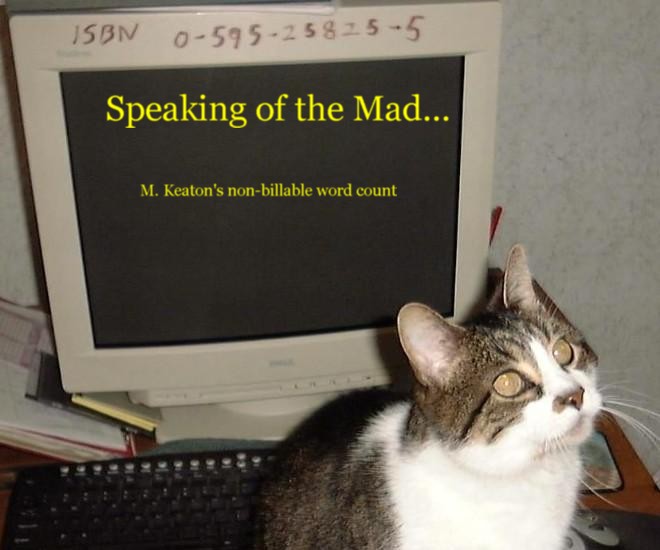
I finally mewed at the Thin Man until he agreed to explain, at least in brief, his philosophy of the soul and why animals do go to heaven. Because it is pedantic and of little interest to the reader (in his opinion) he wants me to spread it out (I’m thinking of instituting ‘TheoTuesdays’ like the current ‘ConspiriThursday’) and he insists on the following disclaimer:
There are public theologies and private thoughts. Likewise, there are core, vital doctrines and then there are those speculations that are not truly relevant in the grand scheme of Salvation. This is a private speculation based largely on two foundations: the fact that it seems intuitively correct and does not contradict anything extant in the Holy Writ; and a reasoned extension of the already-displayed character and consistency of God documented in the Holy Writ. These are one man’s thoughts in the long hours of the night and should not be considered in any way worthwhile doctrine or even subjects of debate (except, perhaps, where the reader may find the Holy Ghost prompting within—and at that point it is an issue between God and the reader).
[This is the last part of the Thin Man's fat essay: "A Brief Discourse on the Animistic and Anthropomorphic Extensions of the Nature of the Soul". Hope you enjoyed the ride.]
Throughout human history, the belief that animals will exist in heaven has been present. They may be present as prey to be hunted, mounts to be ridden, or pets to be coddled but they are there. It seems that to question their presence in the afterlife is a modern invention rather than an age-old question. The sheep of the shepherd and the fish of the fisherman apostles will be present. This is intuitively known; it is only later that men began to ask how. Animals do not possess souls of their own (souls seem to be the province of humans alone) and so, we are taught, only souls pass from the mortal to the immortal world. Does that mean there are, in fact, no animals in heaven? How grotesquely we underestimate God.
If the influence of the soul can be extended to other humans, why can the same not be true of animals? Indeed, since animals do not possess souls of their own, would it not stand to reason that, for a time, they borrow a portion of a person’s soul to use as their own? And if the spirit arises from the interaction of body and soul, then would this not explain why certain animals seem to have very human personalities while others, more distant to humans, remain ‘simply’ animals? (In fact, I would extend this beyond animals and out to include things such as trees and the land itself.)
Let me specifically address animals on three different levels: pets, livestock (and prey), and incidental contact.
It is with pets that this theory needs the least explanation except to clarify that, as with people, a pet may be influenced by more than one human being. It is not about the animal’s owner, but about the people who invest themselves in the animal.
Livestock (animals raised for food) and prey (animals hunted for food) are more difficult to explain. The reason is because many people (including many farmers and hunters) do not understand the love that exists between the herdsman, the hunter, and the beasts of field and forest. To an animal, the human is their god. It is man who sets the time of their coming and going, the days of their lives and the tasks they perform in between. And with that power comes a terrible duty—a duty that, without a deep and abiding love, is impossible to perform properly. That the animal must, in the end, die is inconsequential to the greater truth that, first, the animal must live and live well. But man is not God and he cannot change what must be. He cannot cure all of the disease, cannot ease all the suffering, and, in the end, man’s duty to his family and his clan requires that the animal he loves so much must fulfill one final role. Many a farmer grieves the slaughter; many hunters weep for the fallen. This relationship is one of those matters that, I fear, cannot be fully explained, only understood or not depending on the experiences of the person involved.
I cite incidental contact as an example of the natural empathy that exists between man and animal. A pet or herd animal is well known, but the great stag seen in passing or the hawk that alights once in the yard and is never seen again may still have a profound effect on the viewer. It seems logical, then, to believe that in these small contacts some transference and investment occurs just as it does when two humans meet as strangers. There is still contact, there is still significance.
Do animals go to heaven? Yes; they ride along with us, as part of our souls, parts that we loaned to them while we shared this life together and that they give back to us increased a hundredfold.
I honestly don’t feel that this is a sufficient explanation and by no means complete but it is the best I can express in the time at hand. In no way do I believe this fragile theory of mine should be used as a basis for any doctrine nor is it an excuse to somehow worship the creation instead of the Creator. I state all these things only that you, the reader, may think about it and, perhaps, find in the contemplation a portion of the wonder and mystery, the glimpse of God’s glory in nature that I have found.
Showing posts with label Theology. Show all posts
Showing posts with label Theology. Show all posts
Tuesday, June 30, 2009

Tuesday, June 23, 2009
TheoTuesdays: The Regenerative Nature of the Soul
I finally mewed at the Thin Man until he agreed to explain, at least in brief, his philosophy of the soul and why animals do go to heaven. Because it is pedantic and of little interest to the reader (in his opinion) he wants me to spread it out (I’m thinking of instituting ‘TheoTuesdays’ like the current ‘ConspiriThursday’) and he insists on the following disclaimer:
There are public theologies and private thoughts. Likewise, there are core, vital doctrines and then there are those speculations that are not truly relevant in the grand scheme of Salvation. This is a private speculation based largely on two foundations: the fact that it seems intuitively correct and does not contradict anything extant in the Holy Writ; and a reasoned extension of the already-displayed character and consistency of God documented in the Holy Writ. These are one man’s thoughts in the long hours of the night and should not be considered in any way worthwhile doctrine or even subjects of debate (except, perhaps, where the reader may find the Holy Ghost prompting within—and at that point it is an issue between God and the reader).
The materialist paradigm long ago infested religious thought. Nowhere is this more obvious than in the prevailing view of the soul. We take for granted a kind of ‘assembly line soul’ on a lease-to-own plan—one per customer, standard size, one size fits all, no alterations, return it when you’re done and pay for any damages. This is not a view based on nature, experience, or Holy Scripture; it is a view rooted in an industrial worldview.
We are never told the limits of the soul and I believe that is for a reason: there are no limits of the soul. There is no maximum or minimum amount of ‘soul’ and no limits of breadth or width or height. The soul is unquantifiable. It has quality but not quantity. If the soul could be summed up into a set of dimensions, definitions, and limits, if it could be bound up in a trap of words, then it would not be a soul. The soul must be more than mundane. It must exceed measurement for, if it did not, then it would not be worth the terrible cost that has been paid to redeem it. And because of this, there is no reason not to assume (and every experiential reason to accept) that the soul can be hurt, can be (at least temporarily) diminished and oppressed (though never extinguished, for it is sustained by an indefatigable spark of divine grace), and that the soul can, in turn, heal, grow, and expand without limits.
I have previously discussed that the soul can be taken, given, and distributed across vast distances of space and time. The logical question is: Why? Why allow something as precious as the soul to be spread outside the physical body into the entire sphere of influence of the individual? I contend it is exactly that: so that the influence of an individual’s soul can be spread across the entirety of that person’s reach. It would diminish the value and usefulness of the soul if it were to be tied only to the physical body. If I could not reach out and lend encouragement, comfort, ennoblement, and all the other virtues of the soul across time and space, then my usefulness to the overall plan of God would be pointlessly diminished. God is not wasteful or shortsighted and I would therefore argue that, if it is gainful, there is no reason to doubt at least the possibility of the extension and transference of the soul from and to other people.
There is a term for this in business: investiture. Modern Christianity has an even more incomplete term: discipleship. I prefer the simpler terms. I call it friendship and, beyond that, compassion. We give of ourselves to other people, close friends or strangers, of our time, caring, labor—in a word, we choose to love them. And some, in turn, do the same for us. This is an example of the sharing of the soul. We may be hurt because we make ourselves vulnerable. To a zero-sum believer, this is a terrifying prospect. Surely to give of your soul diminishes the grace you retain within; to love is to become less than you were before. To a transcendent believer, this ability to give is a cause for great joy. We do not run out—there is no empty tank of soul—and, though we may and will be hurt, we may also increase someone else. In turn, when we are weak and tired, others will do the same for us. It is a strange, confusing, frightening process that we can never fully understand but that, on a spiritual level, we are impelled instinctively to do; the whole of the human experience—ours, those around us, and total strangers possibly even generation removed (for remember, the soul is extemporal, it cares nothing for time)—is made better and made to see more of God’s grace channeled through us.
Now, if memory serves, I set out to explain how all of this was relevant to animals.
There are public theologies and private thoughts. Likewise, there are core, vital doctrines and then there are those speculations that are not truly relevant in the grand scheme of Salvation. This is a private speculation based largely on two foundations: the fact that it seems intuitively correct and does not contradict anything extant in the Holy Writ; and a reasoned extension of the already-displayed character and consistency of God documented in the Holy Writ. These are one man’s thoughts in the long hours of the night and should not be considered in any way worthwhile doctrine or even subjects of debate (except, perhaps, where the reader may find the Holy Ghost prompting within—and at that point it is an issue between God and the reader).
The materialist paradigm long ago infested religious thought. Nowhere is this more obvious than in the prevailing view of the soul. We take for granted a kind of ‘assembly line soul’ on a lease-to-own plan—one per customer, standard size, one size fits all, no alterations, return it when you’re done and pay for any damages. This is not a view based on nature, experience, or Holy Scripture; it is a view rooted in an industrial worldview.
We are never told the limits of the soul and I believe that is for a reason: there are no limits of the soul. There is no maximum or minimum amount of ‘soul’ and no limits of breadth or width or height. The soul is unquantifiable. It has quality but not quantity. If the soul could be summed up into a set of dimensions, definitions, and limits, if it could be bound up in a trap of words, then it would not be a soul. The soul must be more than mundane. It must exceed measurement for, if it did not, then it would not be worth the terrible cost that has been paid to redeem it. And because of this, there is no reason not to assume (and every experiential reason to accept) that the soul can be hurt, can be (at least temporarily) diminished and oppressed (though never extinguished, for it is sustained by an indefatigable spark of divine grace), and that the soul can, in turn, heal, grow, and expand without limits.
I have previously discussed that the soul can be taken, given, and distributed across vast distances of space and time. The logical question is: Why? Why allow something as precious as the soul to be spread outside the physical body into the entire sphere of influence of the individual? I contend it is exactly that: so that the influence of an individual’s soul can be spread across the entirety of that person’s reach. It would diminish the value and usefulness of the soul if it were to be tied only to the physical body. If I could not reach out and lend encouragement, comfort, ennoblement, and all the other virtues of the soul across time and space, then my usefulness to the overall plan of God would be pointlessly diminished. God is not wasteful or shortsighted and I would therefore argue that, if it is gainful, there is no reason to doubt at least the possibility of the extension and transference of the soul from and to other people.
There is a term for this in business: investiture. Modern Christianity has an even more incomplete term: discipleship. I prefer the simpler terms. I call it friendship and, beyond that, compassion. We give of ourselves to other people, close friends or strangers, of our time, caring, labor—in a word, we choose to love them. And some, in turn, do the same for us. This is an example of the sharing of the soul. We may be hurt because we make ourselves vulnerable. To a zero-sum believer, this is a terrifying prospect. Surely to give of your soul diminishes the grace you retain within; to love is to become less than you were before. To a transcendent believer, this ability to give is a cause for great joy. We do not run out—there is no empty tank of soul—and, though we may and will be hurt, we may also increase someone else. In turn, when we are weak and tired, others will do the same for us. It is a strange, confusing, frightening process that we can never fully understand but that, on a spiritual level, we are impelled instinctively to do; the whole of the human experience—ours, those around us, and total strangers possibly even generation removed (for remember, the soul is extemporal, it cares nothing for time)—is made better and made to see more of God’s grace channeled through us.
Now, if memory serves, I set out to explain how all of this was relevant to animals.
Tuesday, June 16, 2009
TheoTuesdays: Theft of the Soul
I finally mewed at the Thin Man until he agreed to explain, at least in brief, his philosophy of the soul and why animals do go to heaven. Because it is pedantic and of little interest to the reader (in his opinion) he wants me to spread it out (I’m thinking of instituting ‘TheoTuesdays’ like the current ‘ConspiriThursday’) and he insists on the following disclaimer:
There are public theologies and private thoughts. Likewise, there are core, vital doctrines and then there are those speculations that are not truly relevant in the grand scheme of Salvation. This is a private speculation based largely on two foundations: the fact that it seems intuitively correct and does not contradict anything extant in the Holy Writ; and a reasoned extension of the already-displayed character and consistency of God documented in the Holy Writ. These are one man’s thoughts in the long hours of the night and should not be considered in any way worthwhile doctrine or even subjects of debate (except, perhaps, where the reader may find the Holy Ghost prompting within—and at that point it is an issue between God and the reader).
Photographs steal part of your soul. You know it, I know it, tribal groups throughout history have known it. You want to pretend that you’re sophisticated and modern and that it’s all just primitive superstition but, deep down, we all know better. Still, I’ll spell it out just to drive home the point.
When I speak of a photograph, I am actually referring to a much larger body of work and art—photographs, portraits, letters, books, sculpture—in essence, I am referring to any work from or depiction of an individual that calls to the mind of another that individual, and any emotion or knowledge of that individual. Put more simply, I’m talking about symbols, any symbol that represents an individual. When you read a letter from a relative, it is symbolic of that relative, calling them to your mind. When you see a picture of someone, you are seeing a symbol of that individual. Obviously, there is more to a person than a simple picture or letter can present but, through the symbol, the entirety of that person and what you know of them is summoned up within the mind of the viewer. Further still, even viewing a picture or reading a letter from a person you’ve never met will still bring to your mind an impression of that person. It may be an incorrect impression but, strangely enough, humans seem highly adept at discerning the nature and character of an individual even from something as distant and impersonal as a photograph. How can this be? We take it for granted as if it were a simple thing rather than the great wonder that it is.
It has been said that language is what separates man from the animals, the greatest of his gifts and tools. And what is language but the use of symbols to represent larger concepts from mind to mind? Words carry connotations as well as definitions and, in context, carry even more meaning. Words are only part of language. Indeed, the entirety of what most people define as language barely scratches the surface. Language is the sum total of communication from one individual, isolated within his own mind, to another individual, isolated within their own mind. All of the arts are language, from paintings to novels to sculptures and the buildings designed and built by the hands of men and the plowed fields of the farmer waving with grain. Every stamp, every mark, every temporary change upon the physical world is communication, language from one lonely soul to another through the only medium available—physical reality. Photographs, then, are languages, sentences and speeches made with actions rather than words.
Again we return to the basic question: How? How can language carry such power? It is true magic and a mystery. More to the point, though, it works because, within this language, be it words or pictures, lies trapped a portion of the subject’s soul. There is no other reasonable explanation (although this is only part of the explanation, not the totality of it).
The query that logically follows is why we allow the practice and why we willingly engage in it. The answer is deceptively simple. Why would we assume that having a portion of your soul captured and shared by someone else is a bad thing? Certainly it can be and, as an author, I certainly understand the risks and fears of laying heart and soul bare for the inspection of strangers through my writing; but, perhaps, it is not always bad.
Why?
Reality is not a zero-sum game.
There are public theologies and private thoughts. Likewise, there are core, vital doctrines and then there are those speculations that are not truly relevant in the grand scheme of Salvation. This is a private speculation based largely on two foundations: the fact that it seems intuitively correct and does not contradict anything extant in the Holy Writ; and a reasoned extension of the already-displayed character and consistency of God documented in the Holy Writ. These are one man’s thoughts in the long hours of the night and should not be considered in any way worthwhile doctrine or even subjects of debate (except, perhaps, where the reader may find the Holy Ghost prompting within—and at that point it is an issue between God and the reader).
Photographs steal part of your soul. You know it, I know it, tribal groups throughout history have known it. You want to pretend that you’re sophisticated and modern and that it’s all just primitive superstition but, deep down, we all know better. Still, I’ll spell it out just to drive home the point.
When I speak of a photograph, I am actually referring to a much larger body of work and art—photographs, portraits, letters, books, sculpture—in essence, I am referring to any work from or depiction of an individual that calls to the mind of another that individual, and any emotion or knowledge of that individual. Put more simply, I’m talking about symbols, any symbol that represents an individual. When you read a letter from a relative, it is symbolic of that relative, calling them to your mind. When you see a picture of someone, you are seeing a symbol of that individual. Obviously, there is more to a person than a simple picture or letter can present but, through the symbol, the entirety of that person and what you know of them is summoned up within the mind of the viewer. Further still, even viewing a picture or reading a letter from a person you’ve never met will still bring to your mind an impression of that person. It may be an incorrect impression but, strangely enough, humans seem highly adept at discerning the nature and character of an individual even from something as distant and impersonal as a photograph. How can this be? We take it for granted as if it were a simple thing rather than the great wonder that it is.
It has been said that language is what separates man from the animals, the greatest of his gifts and tools. And what is language but the use of symbols to represent larger concepts from mind to mind? Words carry connotations as well as definitions and, in context, carry even more meaning. Words are only part of language. Indeed, the entirety of what most people define as language barely scratches the surface. Language is the sum total of communication from one individual, isolated within his own mind, to another individual, isolated within their own mind. All of the arts are language, from paintings to novels to sculptures and the buildings designed and built by the hands of men and the plowed fields of the farmer waving with grain. Every stamp, every mark, every temporary change upon the physical world is communication, language from one lonely soul to another through the only medium available—physical reality. Photographs, then, are languages, sentences and speeches made with actions rather than words.
Again we return to the basic question: How? How can language carry such power? It is true magic and a mystery. More to the point, though, it works because, within this language, be it words or pictures, lies trapped a portion of the subject’s soul. There is no other reasonable explanation (although this is only part of the explanation, not the totality of it).
The query that logically follows is why we allow the practice and why we willingly engage in it. The answer is deceptively simple. Why would we assume that having a portion of your soul captured and shared by someone else is a bad thing? Certainly it can be and, as an author, I certainly understand the risks and fears of laying heart and soul bare for the inspection of strangers through my writing; but, perhaps, it is not always bad.
Why?
Reality is not a zero-sum game.
Tuesday, June 9, 2009
TheoTuesday: Universal Sums
There are public theologies and private thoughts. Likewise, there are core, vital doctrines and then there are those speculations that are not truly relevant in the grand scheme of Salvation. This is a private speculation based largely on two foundations: the fact that it seems intuitively correct and does not contradict anything extant in the Holy Writ; and a reasoned extension of the already-displayed character and consistency of God documented in the Holy Writ. These are one man’s thoughts in the long hours of the night and should not be considered in any way worthwhile doctrine or even subjects of debate (except, perhaps, where the reader may find the Holy Ghost prompting within—and at that point it is an issue between God and the reader).
3: Universal Sums
Reality is not a zero-sum game.
There are two schools of thought on the various aspects of existence. One holds that there is only a given amount of anything and that, in order for one person to gain, another must lose, that what there is minus what is had, what can be had, and what has been had equals zero. The other school holds that man is transcendent and that, through the application of work, the full force of human will and creativity with, perhaps, a touch of miracle, there is no limit to what may be done, had, made, and created. The applications may be different, but almost all of human philosophy and behavior come down to actions and assumptions based on the belief in one of these two schools of thought. Either we live in a materialistic world run by invisible accountants summing up the tallies to zero; or we have free will and self-direction, and though we may not have the answer to the problems at hand, we believe as a matter of faith that there is a better way. These two theories are, in fact, a matter of religion and metaphysics. Either we believe or we do not; either only the mundane, tangible material that we see and touch is real, or there are mysteries beyond and we are more than the sum of our chemical composition.
We see the outgrowth of these conflicting beliefs in every aspect of our lives. At work we see the zero-sum man fight and scratch, stabbing his fellow worker in the back and trying to climb to the top of the heap on the backs of other men. Beside him we see the transcendent man laboring diligently to lift himself and all of those around him through merit and work. We see the Senator who insists on taxing the rich out of existence under the pretext of giving to the poor (and all the while plying the tactics of race and class warfare and jealousy) while we see another arguing the virtues of creating opportunity for all, free of penalty, firm in the belief that ‘a rising tide lifts all boats.’ We see hoarders and, in contrast, we see the generous. The universe of reductionists and accountants is a petty, mean place, lending itself to selfishness. The transcendent universe casts its bread upon the waters and waits, generous for its own sake, and generous for its own gain. This extends beyond the personal and spiritual, it reaches even into the physical. Can the crowd be fed, or are there only five loaves and two fish? How long will the oil suffice to light the menorah?
On this point I am adamant. Reality is not a zero-sum game. Reality is a theophany.
3: Universal Sums
Reality is not a zero-sum game.
There are two schools of thought on the various aspects of existence. One holds that there is only a given amount of anything and that, in order for one person to gain, another must lose, that what there is minus what is had, what can be had, and what has been had equals zero. The other school holds that man is transcendent and that, through the application of work, the full force of human will and creativity with, perhaps, a touch of miracle, there is no limit to what may be done, had, made, and created. The applications may be different, but almost all of human philosophy and behavior come down to actions and assumptions based on the belief in one of these two schools of thought. Either we live in a materialistic world run by invisible accountants summing up the tallies to zero; or we have free will and self-direction, and though we may not have the answer to the problems at hand, we believe as a matter of faith that there is a better way. These two theories are, in fact, a matter of religion and metaphysics. Either we believe or we do not; either only the mundane, tangible material that we see and touch is real, or there are mysteries beyond and we are more than the sum of our chemical composition.
We see the outgrowth of these conflicting beliefs in every aspect of our lives. At work we see the zero-sum man fight and scratch, stabbing his fellow worker in the back and trying to climb to the top of the heap on the backs of other men. Beside him we see the transcendent man laboring diligently to lift himself and all of those around him through merit and work. We see the Senator who insists on taxing the rich out of existence under the pretext of giving to the poor (and all the while plying the tactics of race and class warfare and jealousy) while we see another arguing the virtues of creating opportunity for all, free of penalty, firm in the belief that ‘a rising tide lifts all boats.’ We see hoarders and, in contrast, we see the generous. The universe of reductionists and accountants is a petty, mean place, lending itself to selfishness. The transcendent universe casts its bread upon the waters and waits, generous for its own sake, and generous for its own gain. This extends beyond the personal and spiritual, it reaches even into the physical. Can the crowd be fed, or are there only five loaves and two fish? How long will the oil suffice to light the menorah?
On this point I am adamant. Reality is not a zero-sum game. Reality is a theophany.
Tuesday, June 2, 2009
TheoTuesday: Patrick's Theophany
There are public theologies and private thoughts. Likewise, there are core, vital doctrines and then there are those speculations that are not truly relevant in the grand scheme of Salvation. This is a private speculation based largely on two foundations: the fact that it seems intuitively correct and does not contradict anything extant in the Holy Writ; and a reasoned extension of the already-displayed character and consistency of God documented in the Holy Writ. These are one man’s thoughts in the long hours of the night and should not be considered in any way worthwhile doctrine or even subjects of debate (except, perhaps, where the reader may find the Holy Ghost prompting within—and at that point it is an issue between God and the reader).
2: Patrick’s Theophany
“In the beginning Elohim created the heaven and the earth.” So begins the Holy Scriptures of three religions; so begins history. From the beginning, God and His creation are inseparable. I reference this because this base assumption influences the way I think about everything that proceeds from it, including animals and the soul.
The concept that an omnipresent God was represented within every aspect of his creation was accepted as intuitively obvious until it was obscured by the over-legalization of the Jews. Early Christians, following the rigid Roman mindset of rationalization and materialism, also failed to recognize this greatest of testaments. It was not until St. Patrick that the early Church began to again recognize that creation itself was the greatest theophany—the ever visible physical presence of God among men. The wonders of creation—its complexities, its beauties, and its mysteries—are a Holy Scripture themselves speaking to man, on the most basic level, of the nature and constancy of God. It is a reaffirmation of natural (Noahchim) law and the law of conscience. (Let me pause to address a specific point of doctrine. Many schools of modern Christian thought believe that the law of conscience became obsolete with the advent of the Christ. This is patently untrue. Neither the law of conscience nor Judaic law passed away. The Christ Himself took pains to state that He had come to fulfill the law, not to do away with it.)
Although this entire discussion seems a digression, I feel the point needed to be made in order to establish the reasons that I believe physical reality, as well as the worlds of spirit and soul, is first and foremost governed by spiritual laws rather than physical laws. I say this as a scientist. Within the history of science it can be found that, when science and God appear to disagree, in the end, God proves to be correct. I do not mean God in the sense of whatever the prevailing human dogma is but, rather, God as He has demonstrated Himself throughout history both in Scripture and the constancy of His nature. Physics and metaphysics are two separate, complimentary studies; placing one above the other is an act of human hubris. God instituted physics and created the ‘laws’ of science; there is no contradiction because there is only one truth. Nevertheless, if there appears to be a conflict between the two, the spiritual presumptions are, in my experience, the more reliable ones (and, might I add, these areas of seeming conflict are the most gainful areas of study both for the theologian and the scientist).
This is how I view the underlying nature and prioritization of reality, and it colors all my further assumptions and deductions. St. Patrick understood; Augustine did not. The God of nature is the God of man. This is not an appeal to the worship of nature as a god nor the endorsement of obeahism, but it is an acknowledgement of one of the greatest, permanently available theophanies—a clear and omnipresent insight into the mind of God.
I realize that, in this regard, I run the risk of sounding like some odd form of Unitarian/Druid/Kabbalist/ Christian. This is not the case. My theology (and more importantly, my core belief) is effectively that of a traditional Anabaptist. More to the point, I believe that God dictated the Holy Scriptures and that He meant exactly what He said. In this, I place no man’s opinion over what is written in the Word. For the most part, I can be comfortably pigeonholed as one of those ‘hatemongering, legalistic, holiness-movement-throwback evangelicals.” But I also am, in some regard, a mystic (albeit a Christian mystic—the good St. Patrick and I have much in common). An acceptance of the mystic, of the unknown and unknowable mysteries that are not explained to man because it is not necessary for man to know, is part of an honest belief. The modern Church has come to accept the materialistic reductionist paradigm as though it were part of the Holy Writ rather than a secular human conceit. Again, I am a scientist but I am not a worshiper of science as the be all, end all ultimate answer of all things. There are things beyond our understanding; there are mysteries and things beyond our ken. That is not heresy; it is honesty.
[Note: Theophany is classically defined as a manifestation of God to man by actual appearance such as the giving of the Ten Commandments to Moses on Mt. Sinai or the Burning Bush. Materialism is a philosophy holding that matter is the only reality and that everything, even thought and will, can be explained only in terms of matter. As a consequence, it lends itself to the belief that comfort, pleasure, and wealth are the only and highest goals and values. When combined with the dehumanizing effects of industrialism, it is a philosophy of scant value and severe danger.]
2: Patrick’s Theophany
“In the beginning Elohim created the heaven and the earth.” So begins the Holy Scriptures of three religions; so begins history. From the beginning, God and His creation are inseparable. I reference this because this base assumption influences the way I think about everything that proceeds from it, including animals and the soul.
The concept that an omnipresent God was represented within every aspect of his creation was accepted as intuitively obvious until it was obscured by the over-legalization of the Jews. Early Christians, following the rigid Roman mindset of rationalization and materialism, also failed to recognize this greatest of testaments. It was not until St. Patrick that the early Church began to again recognize that creation itself was the greatest theophany—the ever visible physical presence of God among men. The wonders of creation—its complexities, its beauties, and its mysteries—are a Holy Scripture themselves speaking to man, on the most basic level, of the nature and constancy of God. It is a reaffirmation of natural (Noahchim) law and the law of conscience. (Let me pause to address a specific point of doctrine. Many schools of modern Christian thought believe that the law of conscience became obsolete with the advent of the Christ. This is patently untrue. Neither the law of conscience nor Judaic law passed away. The Christ Himself took pains to state that He had come to fulfill the law, not to do away with it.)
Although this entire discussion seems a digression, I feel the point needed to be made in order to establish the reasons that I believe physical reality, as well as the worlds of spirit and soul, is first and foremost governed by spiritual laws rather than physical laws. I say this as a scientist. Within the history of science it can be found that, when science and God appear to disagree, in the end, God proves to be correct. I do not mean God in the sense of whatever the prevailing human dogma is but, rather, God as He has demonstrated Himself throughout history both in Scripture and the constancy of His nature. Physics and metaphysics are two separate, complimentary studies; placing one above the other is an act of human hubris. God instituted physics and created the ‘laws’ of science; there is no contradiction because there is only one truth. Nevertheless, if there appears to be a conflict between the two, the spiritual presumptions are, in my experience, the more reliable ones (and, might I add, these areas of seeming conflict are the most gainful areas of study both for the theologian and the scientist).
This is how I view the underlying nature and prioritization of reality, and it colors all my further assumptions and deductions. St. Patrick understood; Augustine did not. The God of nature is the God of man. This is not an appeal to the worship of nature as a god nor the endorsement of obeahism, but it is an acknowledgement of one of the greatest, permanently available theophanies—a clear and omnipresent insight into the mind of God.
I realize that, in this regard, I run the risk of sounding like some odd form of Unitarian/Druid/Kabbalist/ Christian. This is not the case. My theology (and more importantly, my core belief) is effectively that of a traditional Anabaptist. More to the point, I believe that God dictated the Holy Scriptures and that He meant exactly what He said. In this, I place no man’s opinion over what is written in the Word. For the most part, I can be comfortably pigeonholed as one of those ‘hatemongering, legalistic, holiness-movement-throwback evangelicals.” But I also am, in some regard, a mystic (albeit a Christian mystic—the good St. Patrick and I have much in common). An acceptance of the mystic, of the unknown and unknowable mysteries that are not explained to man because it is not necessary for man to know, is part of an honest belief. The modern Church has come to accept the materialistic reductionist paradigm as though it were part of the Holy Writ rather than a secular human conceit. Again, I am a scientist but I am not a worshiper of science as the be all, end all ultimate answer of all things. There are things beyond our understanding; there are mysteries and things beyond our ken. That is not heresy; it is honesty.
[Note: Theophany is classically defined as a manifestation of God to man by actual appearance such as the giving of the Ten Commandments to Moses on Mt. Sinai or the Burning Bush. Materialism is a philosophy holding that matter is the only reality and that everything, even thought and will, can be explained only in terms of matter. As a consequence, it lends itself to the belief that comfort, pleasure, and wealth are the only and highest goals and values. When combined with the dehumanizing effects of industrialism, it is a philosophy of scant value and severe danger.]
Tuesday, May 26, 2009
TheoTuesday (An Experiment in Heresy)--The Debate of Body and Soul
I finally mewed at the Thin Man until he agreed to explain, at least in brief, his philosophy of the soul and why animals do go to heaven. Because it is pedantic and of little interest to the reader (in his opinion) he wants me to spread it out (I’m thinking of instituting ‘TheoTuesdays’ like the current ‘ConspiriThursday’) and he insists on the following disclaimer:
There are public theologies and private thoughts. Likewise, there are core, vital doctrines and then there are those speculations that are not truly relevant in the grand scheme of Salvation. This is a private speculation based largely on two foundations: the fact that it seems intuitively correct and does not contradict anything extant in the Holy Writ; and a reasoned extension of the already-displayed character and consistency of God documented in the Holy Writ. These are one man’s thoughts in the long hours of the night and should not be considered in any way worthwhile doctrine or even subjects of debate (except, perhaps, where the reader may find the Holy Ghost prompting within—and at that point it is an issue between God and the reader).
A Brief Discourse on the Animistic and Anthropomorphic Extensions of the Nature of the Soul
1: The Debate of Body and Soul
The question of what, exactly, is the soul and how it relates to the other aspects which make up the totality of this mortal clay called ‘man’ is a subject of debate as old as mankind himself. The modern cliché describes man as body, spirit, and soul (sometimes substituting mind for spirit) without clearly defining the terms. Most of us accept this without question or understanding. Medieval scholars debated extensively the conflict between the body and soul with the mind or spirit absent completely from the discussion. Indeed, the concept of the spirit existing separate from the soul is a relatively new (or alternatively very old) idea. There is little question that man has a body and that he has a soul—some part of his existence that is both immortal and inextricably connected to man’s relationship with the Divine—but whether or not he also possesses a separate component of spirit or conscious mind separate from one of these two is a matter still unsettled. The apostle Paul writes about the two ‘natures’ within man, one base and human, one divine and acquired through divine grace, that exist within the believer in a constant state of dynamic struggle. This has been interpreted by scholars to show either as two spirits within man seeking influence over bodily actions and the direction of the soul or as two souls, each attempting to control the body.
The Holy Writ makes no attempt to define the soul. “And the Lord God formed man the dust of the ground and breathed into his nostrils the breath of life; and man became a living soul.” Thus is implied that the soul exists beyond death and that the body is separate from the soul but that the body, lacking the soul, is dead.
All of this goes simply to point out that, when asking the question, “What is the soul and where does it begin and end?” there is no empirical answer. The question is, I believe, something that each person must ultimately answer for themselves. St. Aquinas spent volumes discussing it and, in the end, even he did not arrive at a simple or comprehensive answer. It is most likely that the actual answer is an intuitive truth—that we know what the soul is even if we cannot succinctly articulate it. I believe that, since words have power and much of that power is the power to bind and limit, this inability to capture the soul with words, to put the divine spark of the self into a simple box, is a necessary mystery. It is right and fitting that the soul should be beyond mere words.
For our purposes, let me state what I hold as true, remembering that I am most likely wrong, definitely incomplete in my understanding, and quite possibly different from the reader. I contend that man is comprised of three elements—body, spirit, and soul—but that these distinctions are themselves misleading and that the three elements, in the mortal coil, are inextricably linked and interwoven within each other. The color of man is a plaid. The spirit and soul influence the body. Does not a man gripped by fear and despair carry himself differently from one free of cares? And over time, do not these aspects originating not of the body, in time, mold and form the body into unchanging physical forms? Likewise the body exerts its influence in turn. A man living in constant physical pain will see his spirit affected, for good or ill. The body is the aspect that the physical world and other humans interact with and this interaction, in turn, cannot fail to influence the less physical aspects of man. Let me also state that, in the course of this discussion, I shall often use the terms soul and spirit interchangeably and possibly even incorrectly. This is because of the unique mixture of the part of the human condition that make precise distinctions impossible.
Accepting then that anything I say is, at best, sophiclism, I further contend that the seat of consciousness is most likely the spirit. That is to say, the spirit and the mind occupy the same role in the human amalgama. The body—the implacable, omnipresent clay that is the seat of human existence—is an absolute, standing to the one side of the spirit. The soul—that part of man that is immortal, moral, and uniquely tuned to the divine—stands on the other. The spirit, influenced by both, is a kind of metaphysical skid brake between the two. Our concept of our selves is that worn, malleable, ever-flexing cushion between the two extremes, influenced by and filtering the effects of each, though in muted form, to the other allowing us to exist as one unified being made up of incompatible extremes.
And what, you ask, does any of this have to do with animals and heaven? I might get to that eventually; but aren’t you sorry you asked?
There are public theologies and private thoughts. Likewise, there are core, vital doctrines and then there are those speculations that are not truly relevant in the grand scheme of Salvation. This is a private speculation based largely on two foundations: the fact that it seems intuitively correct and does not contradict anything extant in the Holy Writ; and a reasoned extension of the already-displayed character and consistency of God documented in the Holy Writ. These are one man’s thoughts in the long hours of the night and should not be considered in any way worthwhile doctrine or even subjects of debate (except, perhaps, where the reader may find the Holy Ghost prompting within—and at that point it is an issue between God and the reader).
A Brief Discourse on the Animistic and Anthropomorphic Extensions of the Nature of the Soul
1: The Debate of Body and Soul
The question of what, exactly, is the soul and how it relates to the other aspects which make up the totality of this mortal clay called ‘man’ is a subject of debate as old as mankind himself. The modern cliché describes man as body, spirit, and soul (sometimes substituting mind for spirit) without clearly defining the terms. Most of us accept this without question or understanding. Medieval scholars debated extensively the conflict between the body and soul with the mind or spirit absent completely from the discussion. Indeed, the concept of the spirit existing separate from the soul is a relatively new (or alternatively very old) idea. There is little question that man has a body and that he has a soul—some part of his existence that is both immortal and inextricably connected to man’s relationship with the Divine—but whether or not he also possesses a separate component of spirit or conscious mind separate from one of these two is a matter still unsettled. The apostle Paul writes about the two ‘natures’ within man, one base and human, one divine and acquired through divine grace, that exist within the believer in a constant state of dynamic struggle. This has been interpreted by scholars to show either as two spirits within man seeking influence over bodily actions and the direction of the soul or as two souls, each attempting to control the body.
The Holy Writ makes no attempt to define the soul. “And the Lord God formed man the dust of the ground and breathed into his nostrils the breath of life; and man became a living soul.” Thus is implied that the soul exists beyond death and that the body is separate from the soul but that the body, lacking the soul, is dead.
All of this goes simply to point out that, when asking the question, “What is the soul and where does it begin and end?” there is no empirical answer. The question is, I believe, something that each person must ultimately answer for themselves. St. Aquinas spent volumes discussing it and, in the end, even he did not arrive at a simple or comprehensive answer. It is most likely that the actual answer is an intuitive truth—that we know what the soul is even if we cannot succinctly articulate it. I believe that, since words have power and much of that power is the power to bind and limit, this inability to capture the soul with words, to put the divine spark of the self into a simple box, is a necessary mystery. It is right and fitting that the soul should be beyond mere words.
For our purposes, let me state what I hold as true, remembering that I am most likely wrong, definitely incomplete in my understanding, and quite possibly different from the reader. I contend that man is comprised of three elements—body, spirit, and soul—but that these distinctions are themselves misleading and that the three elements, in the mortal coil, are inextricably linked and interwoven within each other. The color of man is a plaid. The spirit and soul influence the body. Does not a man gripped by fear and despair carry himself differently from one free of cares? And over time, do not these aspects originating not of the body, in time, mold and form the body into unchanging physical forms? Likewise the body exerts its influence in turn. A man living in constant physical pain will see his spirit affected, for good or ill. The body is the aspect that the physical world and other humans interact with and this interaction, in turn, cannot fail to influence the less physical aspects of man. Let me also state that, in the course of this discussion, I shall often use the terms soul and spirit interchangeably and possibly even incorrectly. This is because of the unique mixture of the part of the human condition that make precise distinctions impossible.
Accepting then that anything I say is, at best, sophiclism, I further contend that the seat of consciousness is most likely the spirit. That is to say, the spirit and the mind occupy the same role in the human amalgama. The body—the implacable, omnipresent clay that is the seat of human existence—is an absolute, standing to the one side of the spirit. The soul—that part of man that is immortal, moral, and uniquely tuned to the divine—stands on the other. The spirit, influenced by both, is a kind of metaphysical skid brake between the two. Our concept of our selves is that worn, malleable, ever-flexing cushion between the two extremes, influenced by and filtering the effects of each, though in muted form, to the other allowing us to exist as one unified being made up of incompatible extremes.
And what, you ask, does any of this have to do with animals and heaven? I might get to that eventually; but aren’t you sorry you asked?
Subscribe to:
Posts (Atom)





 Posts
Posts

