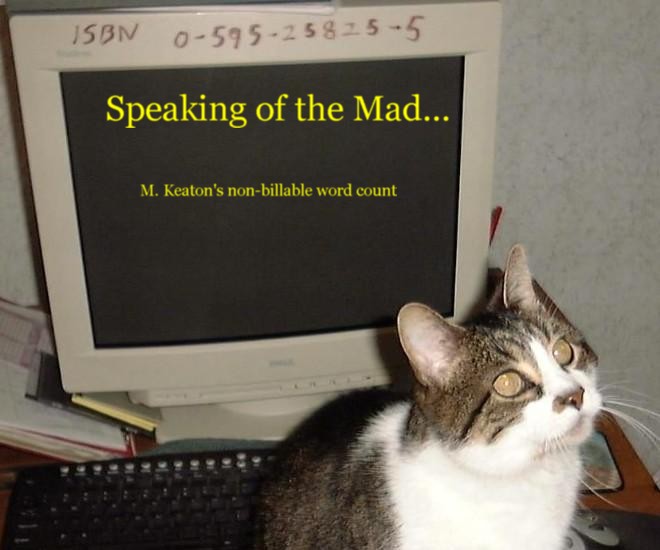
And now I am home from ConClave. A day late but home in more or less one piece.
Great time had by all, etc. Details later, sleep now.
The typo in the biography in the programming book was my fault.
A quick clarification of the Brass Africa stories if anyone was interested:
Stories currently released, in series order:
Black Rhino (in Dreams of Steam I)
Grass Elephant (in Dreams of Steam II)
Stone Oracle (in Midnight Screaming)
Matua's Bats (scheduled for Dreams of Steam V)
Crippled Falcon (originally schedule for DOS III and IV, delayed by publisher for release in a later project due to length)
If you're interested in the series, I strongly suggest you start with Grass Elephant in DOS II. It is long, solid and introduces most of the major players. Once you read it, you will know if you want to read the rest. Love it: you'll love them all. Don't like it: you will probably like some of the other stories but not the main continuity. Grass Elephant has the strongest voice.
Sleep now.
Wednesday, October 14, 2015

Monday, October 5, 2015
ConClave 2015 Schedule
Fri 10pm Greenfield Fantasy for Young Adults
Fri 11pm Greenfield Value for the Dollar
Sat 11am Dearborn Diversity in SF
Sat noon Warren Self-Editing
Sat 1pm Dearborn Story Structure
Sat 2pm Allen Park My Favorite Words
Sat 4pm Warren SF Match Game
Sat 8pm Fairlane Apocalypse Now (& Then)
Sat 9pm Fairlane One Day at a Time
Sun noon Dearborn Playing in Someone Else's Sandbox
Sun 1pm Dearborn Starvation & Sell Outs
Fri 11pm Greenfield Value for the Dollar
Sat 11am Dearborn Diversity in SF
Sat noon Warren Self-Editing
Sat 1pm Dearborn Story Structure
Sat 2pm Allen Park My Favorite Words
Sat 4pm Warren SF Match Game
Sat 8pm Fairlane Apocalypse Now (& Then)
Sat 9pm Fairlane One Day at a Time
Sun noon Dearborn Playing in Someone Else's Sandbox
Sun 1pm Dearborn Starvation & Sell Outs
Friday, October 2, 2015
Travel Update
Due to a family emergency, I did not, in fact, make it to the Springdale, Arkansas library last weekend. I am very sorry about that and if you did make the trip to see me, let me know by email or a post here and I will try to work out a way to get your books signed. I take the loyalty of my (small handful of) readers seriously and I hate very much to disappoint.
On a related note, I am still attending ConClave and I'll post my schedule as soon as I have one. In fairness, I should warn you that I will not be my usual, bouncing, dancing monkey self but I will be there.
Thank you for understanding.
On a related note, I am still attending ConClave and I'll post my schedule as soon as I have one. In fairness, I should warn you that I will not be my usual, bouncing, dancing monkey self but I will be there.
Thank you for understanding.
Wednesday, August 26, 2015
Conclave 2015
Conclavesf.net (Links never work when I put them in so this time I'm not going to try.)
As you can see when you follow the link, I am not only attending but have been classed as a "Special Guest." That's quite an honor, especially since this has been a year when I have had NOTHING come out. (Publishing schedules are weird sometimes; 2016 should have several short stories and, I expect, at least one book.)
Nevertheless, "Year of Nothing" is a pretty good description for this year. You can tell from the previous posts that, except for the essay on skepticism I promised, I haven't posted anything and I've only done one local book signing. (I do plan to do the local library's yearly author event.)
Part of the reason is that I don't have anything new to push but part of it is the year itself. I flat out lost about six months to a very severe depressive cycle but, after that, there's been a lot of "life." Some good, some bad, all wearying. I didn't even attend my usual southern convention.
Well, there's that. But I'll be at Conclave, as their Special Guest.
And now I'll ramble about something else.
I'm very honored to be a guest at Conclave but it's hard to be graceful about it. The reason is simple: I don't know how. You see, unlike most people, I was raised by dogs. Border collies to be precise. That (plus a certain degree of "mental instability") has left me with a noticeable lack of human social skills. I don't like the unknown (which the inter-human interaction always is) and I don't like 'obligation.' I am acutely aware of my own failing and that there are people significantly more worthy of accolade than I am. And yet, there are people in this world--especially the people of the SFF community--who inexplicably hold me in high regard. I don't understand it. Appreciate it, yes; understand it, no. Deserve it? Most definitely not. This has led over the years to a confused attempt to do what seems to come naturally to most people: acceptance. Of praise, of charity, of appreciation, of the fact that other people like my work. So, after this long and convoluted explanation, all I really know to say is:
Thank you.
As you can see when you follow the link, I am not only attending but have been classed as a "Special Guest." That's quite an honor, especially since this has been a year when I have had NOTHING come out. (Publishing schedules are weird sometimes; 2016 should have several short stories and, I expect, at least one book.)
Nevertheless, "Year of Nothing" is a pretty good description for this year. You can tell from the previous posts that, except for the essay on skepticism I promised, I haven't posted anything and I've only done one local book signing. (I do plan to do the local library's yearly author event.)
Part of the reason is that I don't have anything new to push but part of it is the year itself. I flat out lost about six months to a very severe depressive cycle but, after that, there's been a lot of "life." Some good, some bad, all wearying. I didn't even attend my usual southern convention.
Well, there's that. But I'll be at Conclave, as their Special Guest.
And now I'll ramble about something else.
I'm very honored to be a guest at Conclave but it's hard to be graceful about it. The reason is simple: I don't know how. You see, unlike most people, I was raised by dogs. Border collies to be precise. That (plus a certain degree of "mental instability") has left me with a noticeable lack of human social skills. I don't like the unknown (which the inter-human interaction always is) and I don't like 'obligation.' I am acutely aware of my own failing and that there are people significantly more worthy of accolade than I am. And yet, there are people in this world--especially the people of the SFF community--who inexplicably hold me in high regard. I don't understand it. Appreciate it, yes; understand it, no. Deserve it? Most definitely not. This has led over the years to a confused attempt to do what seems to come naturally to most people: acceptance. Of praise, of charity, of appreciation, of the fact that other people like my work. So, after this long and convoluted explanation, all I really know to say is:
Thank you.
Tuesday, June 16, 2015
Book Signing
For those that are interested, I am signing books at the Barnes and Noble in Rodgers, Arkansas this Saturday (June 20). Drop by and say hello if you're in the area.
MK
MK
Tuesday, May 19, 2015
On Skepticism (Part 4, Conclusion)
As a conclusion to this discussion, I'd like to take a look at a few areas that already have solid backing but that have implications set solidly in the skeptical 'hands off' zone: mind-matter interaction, the observer effect, and information transfer at a distance.
Can the mind, consciousness, affect the material world? The skeptical answer is negative, but in reality it's already happening every day. Lift up your hand. Now, what did that? Random chemical impulses in your brain? Your consciousness sending signals to your physical body? I'm the one who wrote 'lift up your hand.' Maybe it was my consciousness influencing yours influencing your body. It seems a pretty arbitrary distinction. Next, let's look instead at the placebo effect. It's a common occurrence with a fairly strong effect. It's medically recognized and accepted…and nobody really knows why it happens. What is called the placebo effect could also be called the perceptions of the conscious mind directly influencing the behavior of the material universe. Or if you want to be more dramatic about it, psychokinesis. It's not as exciting as bending spoons or lighting fires with your mind but the effect is there, it's significant, and it has huge potential life-saving implications. So why not study it?
Is our theory of vision incomplete? The double-slit experiment in optical physics has shown that light behaves differently if it is being directly observed. (Weird? Oh yes but that doesn't make it any less real. If this is the first time you've heard of the effect, I'll wait while you go look it up. Trust me, it's worth the effort.) If we know that observing light changes its behavior why are we willfully ignoring the logical outgrowth of that fact? Is it because there is something special about our vision or is it that our consciousness is somehow extended toward the photons when we are observing, or is it something else entirely? The implications are huge. So why not study it?
Bell's Theory (of linked-spin electron pairs) tells us that information can be shared without regard for distance or time with no direct exchange of energy between the actors. To oversimplify: once connected, always connected. There's also quantum tunneling effects (a.k.a. teleportation). That's on the quantum level. Does this effect scale up? Does it even need to, since in many systems from nanotechnology to organic life the slight change even at the quantum level could produce a significant ripple effect? Did I mention irrespective of distance or time, as in faster than light and exempt from linear causality? If nothing else, somebody's going to make a really keen phone. (I think Lucent is working on that now.) Given all of this, why is the idea that a mother can sense when her child is hurt such a forbidden idea? Sure, the body replaced all the original shared atoms long ago, but the replaced material may very well have overlapped with retained material long enough to pass down the entanglement. Twins also would have significant linkage for the same reason. The existing model of physics includes a mechanism that would explain what is commonly called telepathy. So why not study it?
The answer in every case is that someone is studying it, in the private sector, with their own time and money. What you won't hear, and what skeptics will scream to drown out, is that they are doing so with rigorous experimental controls, high levels of interlaboratory reproducibility, and significant success. Reproducible experiments. That sounds like science. Unless the implications of those results threaten your worldview and undermine the philosophy you already don't have much confidence in. Then it sounds like skeptics debunking research they've never looked at and have no intention of testing themselves.
In the end, it's all about the philosophy you choose. One the one hand stands a tool that is very efficient and points the way to knowledge and wonder. On the other, a power struggle for consensus where only the elite may play, the gains are limited, and you might not even be real. I put it to you: Do you want science with its wide-open frontiers? Or do you want skepticism?
Friday, May 15, 2015
On Skepticism (Part 3)
Let me tie this all together by addressing the typical skeptical attacks on "pseudo-sciences" like psi, dowsing, and, increasingly, some aspects of quantum mechanics itself.
Note: Bear in mind as I do that a clash of philosophies is a clash of worldviews. I obviously have deep-seated views and vested interests on the subject. So does the other side. There are an entire host of psychological factors at play here. Because I know my own bias and recognize that I have it, I strongly encourage you to look into the subject yourself if anything I've said piques your interest.
Now, on to the common rhetorical points of the skeptical argument seen from the perspective of skepticism as a philosophy rather than an intrinsic part of science.
"There is not one shred of evidence…" Of course there's evidence, even for the most specious of claim. The question is how defensible and reproducible is the evidence.
"Anecdotal evidence is not evidence at all." It's called a case study. Unless you're willing to throw away the entire field of medicine (and most other life sciences for that matter), this is a dishonest critique. In fact, any data collected before the advent of automated recording is anecdotal, since it was processed through human researchers. Moreover, since most people do not look at raw data but rather the processed data presented in research papers, the overwhelming majority of data could be considered anecdotal. There is, however, a strong need for skeptics to discredit anecdotal evidence--the bulk of human history is a body of evidence. If this mass of evidence is allowed into the discussion, simple mockery and dismissal of the inconvenient becomes much more difficult. This is especially relevant in consciousness studies.
"Extraordinary claims require extraordinary proof." Not to science. Science says data is data. Deciding what is extraordinary is a subjective act. For example, what level of extraordinary proof could possibly support the contention that the entire universe arose as a point-mass of probability from a quantum foam of unknown origin which then exploded into all of existence in a matter of picoseconds, before all known laws of physics suddenly altered and have remained constant to this day, eventually giving rise to life against all known laws of probability? I'd need to see more than a pie-chart to buy into that one.
"There may be some results but if you look closely, it's really all fraud, bias, and/or poor experimental design. And what about the 'file drawer' effect?'" Wherever there are humans there absolutely is fraud, bias, and mistakes, but why should we assume this only occurs in areas outside of establishment science? Remember Millikin? The history of science is rife with all of these. But science, Popperian science, rectifies these concerns through independent replication. In many areas labeled 'pseudo-science' such as psi research, the constant pressure of skeptics has actually resulted in an interesting phenomenon: the 'fringe' studies now have more scientific procedural rigor than mainstream science. Most people don't know this because it's a lot of work to keep up with ongoing research if it doesn't overlap with their daily life, which is why we rely on experts to filter information for us. Unfortunately, this also makes us vulnerable to Kuhnian consensus and skeptical broad brushing. The 'file drawer effect' is the accusation that only the 'good' studies get published and the others vanish into the bottom of a file drawer. This happens in everything but, again, it's not common and the para-science community is very conscious of it. Because of this, it is common practice, when presenting data, to calculate the number of failed studies that would be required to invalidate the observed data. As more and more data has accumulated, in many fields, there now simply are not enough file drawers in existence to bury enough data to invalidate the results.
"I don't need to look at their data to know that it's wrong." This is a biggie. It is an admission of arguing from ignorance, and of presupposing the answer before examining the data. It's not scientific, it's not honest, and it's not a very smart thing to admit.
"I don't need to waste time and effort doing counter-studies." Then how, pray tell, can you then claim that the data is invalid? Oh, right, I'm thinking like a Popperian. In the Kuhnian world, it's about consensus and social activity, not falsibility and data.
"Science has already reached a consensus on this matter. The real question is, what psychologically is wrong with you that you cannot accept the data?" Attacking the messenger rather than the message is an old rhetorical trick, but it not science. There is a field of psychology that studies this very effect and it's quite interesting. And, yes, there are psychological factors that do make it impossible for individual researchers to objectively see the data staring them in the face. But this is the case for all humans, begging the question, "Why are skeptics never skeptical of skepticism?"
"Statistical analysis is a slight of hand trick, not a valid way to evaluate data." Yes, I have actually had this one thrown at me. It's a confusing statement. If I don't use the basic tools designed to analyze data (i.e. math), what am I supposed to use? Statistics can be manipulated and abused like everything else, but how does that invalidate the tool? Especially since the same analytics are used for mainstream science but no one is challenging their use there.
"Negative effects (like psi-missing) are not effects." This statement shows a fundamental misunderstanding of science. If I am testing your drinking water for the presence of cyanide, I don't keep testing until I find some. Not finding something is every bit as valid as finding it. Using this argument is kind of like not understanding what zero means. Psi-missing, where the argument usually crops up, is the phenomena where some people actually score significantly below chance on Rhine cards and the like. Ironically, these people tend to be those who enter the experiments with a pre-stated bias against psi and/or a professional interest in disproving it. To say that below chance results are different from above chance results is like administering a set of vision tests to a group of people and then calling the blind guy a liar for not seeing anything.
"There might be something here but whatever it is, it's not (whatever is actually being suggested)." I sometimes feel this statement may sum up Ray Hymen's entire career. He's a prominent skeptic who has been employed by the government to review controversial data. He tends to reach conclusions like this a lot. It is a form of ignoring the nose on the front of your face because you do not believe in noses. It is not a new argument: rocks do not fall from the sky because there are no rocks in the sky. Another way of looking of this argument is as a kind of 'buy now, explain later' agreement. It is the skeptic saying, "Yes, there is clear and compelling data here. But you're still wrong and I am certain that someday the consensus under the current paradigm will provide an explanation that does not force me to consider the validity of your crackpot ideas." I may be a crackpot, but data deserves an honest consideration rather than dismissal on religious (scientism) grounds.
"It's too complicated and you fail to grasp the subtleties involved. There's plenty of evidence and if you knew anything about it, you wouldn't be asking such an uninformed question. (Subtext: You're too stupid to understand so I'm not going to waste my time answering your question.)" Again, no science in this objection at all. From a personal standpoint, I maintain that it is irresponsible to mock someone as ignorant and then fail to provide them with an answer. Many things are complicated and subtle. To say that about a subject is meaningless. If you hold yourself to be an intellectual that understands all that complicated and subtle stuff, you should be able to either answer a simple question—the uninformed, after all, can't be asking that complicated a question, can they? They're not smart enough—or, at the very least, be able to provide a bibliography for them to start to learn and understand. But that's not science, that's a philosophy of education. At least give the honest answer, "I don't have enough hours in my day to deal with idiots like you." Insulting, yes, but honest.
"Taking X research or subject seriously is really just letting Y special interest group further their agenda." The most common current version of this is, "We can't allow an open discussion of intelligent design, irreducible complexity, or flaws in the fossil or genetic record because it's all just a smokescreen for the evil, ignorant creationists to poison the minds of our children." This is a common argument, but it doesn't even come close to being a scientific one. Science is about data: show the data, let it stand on its own. If you don't want to let people be exposed to conflicting data or to examine your own data too closely, what are you afraid of? This leads directly to, "I'm not hiding anything, I'm just trying to keep us from wasting valuable time debating the obvious." Allocation of resources is not science, it's philosophy. You're making a subjective decision about what to present and what not to. Whether you're right or wrong, it's still not about science at this point and it's dishonest to pretend otherwise. This line of discussion is about protecting and promoting a worldview. It's also irresponsible scientifically because it presupposes that the data is invalid based on who is providing it. Data stands alone. It also presumes a false dichotomy. If, for example, I think there are parts of the evolutionary theory that don't stand up to scientific examination, that does not automatically mean that I'm a supporter of a rival theory. And even if I am, that does not mean that my objections, if they are based on data, are invalid. Again, I'm not stating whether the argument is valid, merely that it is not a scientific argument, as many would lead you to believe.
"The effect size is too small to be relevant. The signal-to-noise ratio is too low to be interesting." This one makes me very angry. It's not science because science does not engage in subjective decisions about small and large. It's barely an engineering argument, if anything. It ignores the history of science and the fact that most effects are small when studied and then the effect increases once we learn how to harness it (think about electricity, magnetism, and nuclear forces if you need some recent examples). More to the point, it is a selfish, spiteful argument. For instance, the effect of distanced healing techniques such as prayer is over three times larger than the effectiveness of using daily aspirin to prevent heart attacks. Both are 'small' effects but, since aspirin fits the accepted consensus, it's a common treatment while prayer and the like are marginalized. But let us go further: let's assume the effect size of a given alternative medical treatment is tiny, say 0.001%, and let's even assume that the effect size would not be increased by further applied research. This "irrelevant" effect could mean the difference between life and death to one person in one hundred thousand. So, how many people are you going to let die because you don't think this effect is 'interesting'?
So, one eventually asks, what is it that skepticism is afraid of? There is a vein of the age-old "we know everything so don't threaten our comfy chair with new stuff," but most of the attacks are against any sense of meaning in existence. A quick examination of skeptical literature and especially their magazines reveals a fairly consistent bogeyman in skeptic's world: teleology. Teleology is the fancy word for the idea that things have a purpose, that there is a Why as well as a What. Science as a tool can tell us what something does and how something works, but it cannot tell us why something is.
Skepticism as a philosophy would have us believe that What and How are the Why—there is no purpose, no meaning, only bare existence. This is why the favorite whipping boys of skeptics are consciousness (especially anything implying that it exists above and beyond the mere chemical interactions of the brain), anything that implies life separate from the base physical processes, and—most especially—religion. This stance is blatantly intellectually dishonest. After all, if we are indeed deterministic machines, why are you spending so much time and effort arguing about these things at all? The meat computer in my skull can't help it, I'm physically incapable of hearing and acting on your arguments, and none of it matters anyway. The very act of protesting against these things shows the validity of at least examining them.
Again, to be very repetitive at this point, these are all philosophical differences that are not science, and it becomes rapidly apparent that skeptics have no faith in the validity of their philosophy. The religious person believes that their truth is sovereign and will win out under honest examination. The Popperian scientist believes that the rigors of experimental analysis will eventually lead to correct (or more correct) theories and is content to let the data settle the discussion. It is the Kuhnian skeptic who feels the need to hide their philosophical precepts under the cloak of scientism and use, not data, but rhetoric to defend their theories. They are trying to substitute the limited tool of science for the more appropriate tool of metaphysics, hoping to claim a win by default. The result is they bring science to a philosophical discussion and philosophy to the science lab. Against the guns of belief on the one hand and data on the other, they've brought a knife…and a dull one at that.
Over the years, my personal tolerance for this kind of thing has been stretched thin. As a scientist (with over a decade of direct laboratory experience), a philosopher of science, and a literal creationist, I am more than a little tired of being told that I can't be the things I am, that I am stupid, and that I must have some kind of severe mental defect if I believe in all this. Science seeks truth about the natural world through rigorous examination; religion provides me with the framework to understand the spiritual world around me, and since I am a Christian, I follow a reasonable God; and a proper understanding of the philosophy of science tells me that these two things are not only not in competition with each other, they are complimentary studies that inform and support each other.
Tuesday, May 12, 2015
On Skepticism (Part 2)
In opening, I made two assertions that may need to be explained: that skepticism is not part of science and that skepticism is a philosophy of science. Both statements may be addressed by looking at the prominent schools of thought within the "community" of scientific philosophers. The majority of views can be placed in one of two schools of thought: Popperian or Kuhnian, so named after Sir Karl Popper and Thomas Kuhn.
Popper's view of the philosophy of science is essentially what most of us were taught in school, a more detailed version of the observation/hypothesis/experiment model. (Those of you saying to yourself, "It's science! What's so hard about that?" are probably Popperian.) The watermark of Popper's view is the emphasis on falsibility; that is, if it can't be tested, it's not science. Unique events are outside the realm of science; no theory is exempt from challenge irrespective of how well entrenched; and scientists test their theories. By contrast, Kuhn argued that science is what scientists do, and therefore science is a kind of consensus-seeking relativism. In fairness, Kuhn himself was not far removed from Popper, with Kuhn placing his emphasis on problem solving as the defining aspect of science. Unfortunately, his disciples took the philosophy farther and farther away from any absolute standard until the Kuhnian school was more focused on hierarchies, theorem-choice, and "problemshift." (I hate those phrases. Hierarchies are "who's on top of the pecking order," theorem-choice is "which theory will yield more profitable results" and problemshift is a made-up academic word that even the people who use it don't know what it means. As best I can explain it, problemshift is "I got this part figured out, but answering that question just created new questions." As knowledge on a subject is acquired, the emphasis of the research changes; think of it as "the problem is shifting.")
Lest I be guilty of oversimplifying, let me quote here from Imre Lakatos' paper, "Falsification and the Methodology of Scientific Research Programmes." (Book: Criticism and the Growth of Knowledge by Imre Lakatos and Alan Musgrave, New York: Cambridge University Press, 1970.)
Note: I have chosen to quote Lakatos rather than Popper and Kuhn directly for reasons of brevity. Lakatos does a very good job with the text of explaining the positions of both men and, on various points, criticizing and defending both. The few (ellipsis) edits I have made are also for space.
"…In his [Popper's] view, virtue lies not in caution in avoiding errors, but in ruthlessness in eliminating them. Boldness in conjectures on the one hand and austerity in refutations on the other: this is Popper's recipe. Intellectual honesty does not consist in trying to entrench, or establish one's position by proving (or 'probabilifying') it--intellectual honesty consists rather in specifying precisely the conditions under which one is willing to give up one's position…Belief may be a regrettably unavoidable biological weakness to be kept under the control of criticism: but commitment is for Popper an outright crime.
"Kuhn thinks otherwise…His main problem too is scientific revolution. But while according to Popper science is 'revolution in permanence', and criticism the heart of the scientific enterprise, according to Kuhn revolution is exceptional and, indeed, extra-scientific, and criticism is, in 'normal' times, anathema. Indeed for Kuhn the transition from criticism to commitment marks the point where progress--and 'normal' science--begins. For him the idea that on 'refutation' one can demand the rejection, the elimination of a theory, is 'naïve' falsificationism. Criticism of the dominant theory and proposals of new theories are only allowed in the rare moments of 'crisis'…
"For Popper scientific change is rational or a least rationally reconstructible and falls in the realm of the logic of discovery. For Kuhn scientific change--from one 'paradigm' to another--is a mystical conversion which is not and cannot be governed by rules of reason and which falls totally within the realm of the (social) psychology of discovery."
My primary purpose is not to debate the merits of the various philosophies of science. I am of the Popperian school and I think Sir Karl himself did a much better job of laying out his arguments than I ever could. Instead, I have provided the thumbnail sketch of Popper's and Kuhn's views to explain my earlier contentions: that (a) in the Popperian philosophy of science, skepticism is not part of science (data is data, there is no hierarchy of data or overwhelming burden of proof, just raw fact) and (b) that skepticism is a philosophy of science, specifically a descendant of the Kuhnian school of relativism complete with all of its built-in socio-political baggage. Once skepticism is understood as a philosophy, its flaws and dangers are much clearer, as is an understanding of its methods and the behavior of its proponents.
In short, the philosophy of skepticism establishes an orthodoxy within science. It places an unreasonable burden of proof on any theory or concept that would compete with what the orthodoxy has already accepted. It establishes this orthodoxy based on consensus (a social activity) rather than experimentation (a scientific activity). Finally, it sets up the skeptic as a kind of high priest and defender of the faith, rooting out the heretic under the mandate of fighting "irrationalism."
Please understand, I am not accusing everyone who considers himself a skeptic of holding these views or acting in this manner—many do not—but I do contend that these are the ultimate conclusions to be drawn from the skeptical school of thought. Moreover, in my opinion, this leaves skepticism in a position to do a considerable amount of harm, suppress large amounts of 'inconvenient' data, easily be abused by those with political ambitions who wish to hide under the banner of 'science as truth,' and in return contribute very little, if anything, to science or society itself. In addition, skepticism is a philosophy of reductionism, determinism, and materialism. Its logical conclusions have led us to theories such as that the conscious mind is epiphenomenal (that the idea that we have free will or are anything more than meat puppets is an illusion, and what we perceive as consciousness is just a side-effect of a mechanistic series of chemical reactions.) I've always wondered, if you really believe something like that, why are you bothering to try to convince me of it? Why talk to me at all?
At the Kuhnian-skeptical end of the road there is a relativism that says the mind is meat and man is an animal. At that point, there is no basis for either morality or ethics. I realize I may be accused of creating a straw-man version of it at this point and trying to tarnish the skeptical viewpoint by fear-mongering, but I don't think so. A philosophy should be tested by considering what its extreme version looks like because sooner or later, someone will go there. Of course, such a standard cannot be used to invalidate a philosophy (humans are humans and they will abuse anything if it serves their purposes) but, in weighing the merits of a philosophy, this extreme view should factor into the calculation. (The extreme application of Darwinian eugenics leads to genocide. It's been argued that extreme Christianity bombs abortion clinics, but a more honest view of the extreme end of the Christian philosophy are people like the Shakers. Agree or disagree, the very fact that we are discussing moral, social, and political repercussions simply reinforces that point.)
By contrast, I am also not implying that I believe aliens built the Egyptian pyramids right after Edgar Cayce traveled back in time to channel the wisdom of ancient Atlantis for them. But here I appeal less to the monolith of Science than to simple common sense. We are allowed to think for ourselves without having an official 'Science Guy Approved' sticker on our forehead. Likewise, science is not the only way of knowing truth or even things. As Sir Karl himself noted, just because something is not scientific, it does not follow that it is therefore not true or valuable. The proposition that science assumes to itself all that is true or of value is another side-effect of the Kuhnian school's dominance in academia. A tool is just a tool. Tools are meant to be used, not worshipped.
Popper's view of the philosophy of science is essentially what most of us were taught in school, a more detailed version of the observation/hypothesis/experiment model. (Those of you saying to yourself, "It's science! What's so hard about that?" are probably Popperian.) The watermark of Popper's view is the emphasis on falsibility; that is, if it can't be tested, it's not science. Unique events are outside the realm of science; no theory is exempt from challenge irrespective of how well entrenched; and scientists test their theories. By contrast, Kuhn argued that science is what scientists do, and therefore science is a kind of consensus-seeking relativism. In fairness, Kuhn himself was not far removed from Popper, with Kuhn placing his emphasis on problem solving as the defining aspect of science. Unfortunately, his disciples took the philosophy farther and farther away from any absolute standard until the Kuhnian school was more focused on hierarchies, theorem-choice, and "problemshift." (I hate those phrases. Hierarchies are "who's on top of the pecking order," theorem-choice is "which theory will yield more profitable results" and problemshift is a made-up academic word that even the people who use it don't know what it means. As best I can explain it, problemshift is "I got this part figured out, but answering that question just created new questions." As knowledge on a subject is acquired, the emphasis of the research changes; think of it as "the problem is shifting.")
Lest I be guilty of oversimplifying, let me quote here from Imre Lakatos' paper, "Falsification and the Methodology of Scientific Research Programmes." (Book: Criticism and the Growth of Knowledge by Imre Lakatos and Alan Musgrave, New York: Cambridge University Press, 1970.)
Note: I have chosen to quote Lakatos rather than Popper and Kuhn directly for reasons of brevity. Lakatos does a very good job with the text of explaining the positions of both men and, on various points, criticizing and defending both. The few (ellipsis) edits I have made are also for space.
"…In his [Popper's] view, virtue lies not in caution in avoiding errors, but in ruthlessness in eliminating them. Boldness in conjectures on the one hand and austerity in refutations on the other: this is Popper's recipe. Intellectual honesty does not consist in trying to entrench, or establish one's position by proving (or 'probabilifying') it--intellectual honesty consists rather in specifying precisely the conditions under which one is willing to give up one's position…Belief may be a regrettably unavoidable biological weakness to be kept under the control of criticism: but commitment is for Popper an outright crime.
"Kuhn thinks otherwise…His main problem too is scientific revolution. But while according to Popper science is 'revolution in permanence', and criticism the heart of the scientific enterprise, according to Kuhn revolution is exceptional and, indeed, extra-scientific, and criticism is, in 'normal' times, anathema. Indeed for Kuhn the transition from criticism to commitment marks the point where progress--and 'normal' science--begins. For him the idea that on 'refutation' one can demand the rejection, the elimination of a theory, is 'naïve' falsificationism. Criticism of the dominant theory and proposals of new theories are only allowed in the rare moments of 'crisis'…
"For Popper scientific change is rational or a least rationally reconstructible and falls in the realm of the logic of discovery. For Kuhn scientific change--from one 'paradigm' to another--is a mystical conversion which is not and cannot be governed by rules of reason and which falls totally within the realm of the (social) psychology of discovery."
My primary purpose is not to debate the merits of the various philosophies of science. I am of the Popperian school and I think Sir Karl himself did a much better job of laying out his arguments than I ever could. Instead, I have provided the thumbnail sketch of Popper's and Kuhn's views to explain my earlier contentions: that (a) in the Popperian philosophy of science, skepticism is not part of science (data is data, there is no hierarchy of data or overwhelming burden of proof, just raw fact) and (b) that skepticism is a philosophy of science, specifically a descendant of the Kuhnian school of relativism complete with all of its built-in socio-political baggage. Once skepticism is understood as a philosophy, its flaws and dangers are much clearer, as is an understanding of its methods and the behavior of its proponents.
In short, the philosophy of skepticism establishes an orthodoxy within science. It places an unreasonable burden of proof on any theory or concept that would compete with what the orthodoxy has already accepted. It establishes this orthodoxy based on consensus (a social activity) rather than experimentation (a scientific activity). Finally, it sets up the skeptic as a kind of high priest and defender of the faith, rooting out the heretic under the mandate of fighting "irrationalism."
Please understand, I am not accusing everyone who considers himself a skeptic of holding these views or acting in this manner—many do not—but I do contend that these are the ultimate conclusions to be drawn from the skeptical school of thought. Moreover, in my opinion, this leaves skepticism in a position to do a considerable amount of harm, suppress large amounts of 'inconvenient' data, easily be abused by those with political ambitions who wish to hide under the banner of 'science as truth,' and in return contribute very little, if anything, to science or society itself. In addition, skepticism is a philosophy of reductionism, determinism, and materialism. Its logical conclusions have led us to theories such as that the conscious mind is epiphenomenal (that the idea that we have free will or are anything more than meat puppets is an illusion, and what we perceive as consciousness is just a side-effect of a mechanistic series of chemical reactions.) I've always wondered, if you really believe something like that, why are you bothering to try to convince me of it? Why talk to me at all?
At the Kuhnian-skeptical end of the road there is a relativism that says the mind is meat and man is an animal. At that point, there is no basis for either morality or ethics. I realize I may be accused of creating a straw-man version of it at this point and trying to tarnish the skeptical viewpoint by fear-mongering, but I don't think so. A philosophy should be tested by considering what its extreme version looks like because sooner or later, someone will go there. Of course, such a standard cannot be used to invalidate a philosophy (humans are humans and they will abuse anything if it serves their purposes) but, in weighing the merits of a philosophy, this extreme view should factor into the calculation. (The extreme application of Darwinian eugenics leads to genocide. It's been argued that extreme Christianity bombs abortion clinics, but a more honest view of the extreme end of the Christian philosophy are people like the Shakers. Agree or disagree, the very fact that we are discussing moral, social, and political repercussions simply reinforces that point.)
By contrast, I am also not implying that I believe aliens built the Egyptian pyramids right after Edgar Cayce traveled back in time to channel the wisdom of ancient Atlantis for them. But here I appeal less to the monolith of Science than to simple common sense. We are allowed to think for ourselves without having an official 'Science Guy Approved' sticker on our forehead. Likewise, science is not the only way of knowing truth or even things. As Sir Karl himself noted, just because something is not scientific, it does not follow that it is therefore not true or valuable. The proposition that science assumes to itself all that is true or of value is another side-effect of the Kuhnian school's dominance in academia. A tool is just a tool. Tools are meant to be used, not worshipped.
Friday, May 8, 2015
On Skepticism (Part 1)
Disclaimer: I want to say in advance that this is not an attack on any individual or in response to any one specific discussion. I am expressing my own problems with skepticism as a movement, not skeptics as people. I believe most self-identified skeptics are rational, well-meaning people who simply haven't fully thought through the implications of their philosophy. I don't think they represent the hard-core members of the movement. Most skeptics I have met are polite, rational, and fairly open to discussion; they simply don't want to see people waste time and money on fraud and redundant research. I don't think they've given the big picture much thought. In reasonable detail, I want to present my problems with that disturbing 'big picture.' Individuals are different from movements and organizations. If I seem at times to be attacking something, please remember it is the latter, the mob and the unintended consequences, not the individuals involved. (Except for the Amazing Randi. That man is an ass.)
Skepticism is not, as many of its proponents claim, a natural part of science. It is, instead, a philosophy of science. In my opinion, it is a failed and harmful one, not suited to the tool of science.
All tools have a philosophy. If this seems an odd statement, it's mainly because the philosophy of most tools is self-evident. The choice of how to use the tool is not made by the tool and neither is it self-contained within the tool. The choice is made by the user. For example, a hammer is for delivering blunt force; it was designed for that application, or "philosophy of use." It's a bad screwdriver and a horrible glass etcher, but if you want to put in screws with a hammer, the hammer won't stop you. The efficient use of a hammer is based on the user's understanding of the "philosophy of use" of the hammer (or simply, the philosophy of hammering.) Science, like a hammer, is a tool and as such it also has a philosophy of use. Unlike simple tools, the philosophies behind more complex tools are not intuitive, and over the history of science several schools of thought have arisen over its philosophy.
The distinction of a tool's philosophy may seem pedantic, but a small misunderstanding in the proper role of a tool can result in significant problems in the long run. The phrase, "If all you have is a hammer, every problem starts to look like a nail," springs to mind. Consider a knife versus a hammer. You could use a knife as a hammer—ineffectively—but how many fingers would you lose in the process? If the misuse of a basic tool is dangerous, the misuse of a complex one is potentially catastrophic. In the case of science, the misuse migrated to the social and political realms, resulting in horrors such as eugenics and social Darwinism. It's easy to throw up your hands and yell, "That's not science," but that's just the point. It isn't science. It is the tool used incorrectly, with the wrong philosophy, and it's a solid example of why users must understand and take responsibility for proper use and limits of the tool known as science. Like all tools, science does not exist in a vacuum of social and political pressures, and it can make some very big hammers.
As a brief aside, it could be argued that science is not a tool or that it is more than just a tool. If that's the case, then it is either a philosophy in and of itself or a religion proper. If it is a philosophy, then the philosophy of science and the philosophy that is science would be effectively the same. If it is to be elevated to a religion—well, that is one of the logical outgrowths of skepticism as a philosophy of science so the discussion is circular. It could also be argued that science is not a tool but rather a collection of tools. Such an argument is no argument at all. A car is a tool. A car is a collection of tools (engine, wheels, etc.) This distinction is an attempt to avoid the discussion by willfully misunderstanding the point. If I sound pedantic and redundant here, it's because I've read and studied a lot of the philosophy of science and skepticism, and this kind of semantic slight of hand crops up often. I apologize for insulting your intelligence, but I want to head off any misunderstandings from the onset.
Wednesday, April 29, 2015
Vocal Minority
Vocal Minority
Once, I had a language. For a while, it ran along like most do--with the occasional glottal stop here and hiccup there but smoothly just the same.
Then the consonants realized that the vowels were in the minority and possessed clear physical and functional traits that they could neither abandon nor disguise. The consonants began to act against them, banning them from high-class words, driving them from their traditional homes at the end of words, and eventually seeking to eliminate them altogether.
For a time, my language had a definite eastern European sound but the pogroms passed and the language carried on. The vowels demanded that the dictionaries enact laws to protect them (though it is never wise to trust one's fate too heavily to grammarians). Soon the vowels demanded special treatment and minimum vowel-to-consonant ratios. And they got them, even through the language now sounded more like the lowing of a cow than a means of communication.
The consonants protested, pointing out that the vowels, per capita, were receiving significantly more work, more pay, and more prestige. The protests were ignored and, instead, the vowels banned the use of contractions. The language groaned on. Next the vowels turned their attention to the structure of entire sentences rather than merely words. They decided that religious people were not being fair because they used too many 'O's (the religious bigots were fond of words like holy, God, and love) and not enough 'U's. In the name of the persecuted 'U's, they demanded the grammarians pass new laws, making the religious use the word F--- in place of other adjectives and adverbs and now one could not tell the pious from the unbelieving when the language was spoken.
After many years, the change in the language changed the minds of the people who used it. And so it came to pass that the Jews were made to run their own concentration camps (for it was only fair), the Moslems ran the pork industry (in the name of interstate commerce), and the Christians were required by law to have at least one extra-marital affair each year (so that no one had to feel bad about their own failed marriage--self-esteem being deemed the most important of virtues).
Okay, maybe I don't understand politics but it makes as much sense as Chomsky.
Once, I had a language. For a while, it ran along like most do--with the occasional glottal stop here and hiccup there but smoothly just the same.
Then the consonants realized that the vowels were in the minority and possessed clear physical and functional traits that they could neither abandon nor disguise. The consonants began to act against them, banning them from high-class words, driving them from their traditional homes at the end of words, and eventually seeking to eliminate them altogether.
For a time, my language had a definite eastern European sound but the pogroms passed and the language carried on. The vowels demanded that the dictionaries enact laws to protect them (though it is never wise to trust one's fate too heavily to grammarians). Soon the vowels demanded special treatment and minimum vowel-to-consonant ratios. And they got them, even through the language now sounded more like the lowing of a cow than a means of communication.
The consonants protested, pointing out that the vowels, per capita, were receiving significantly more work, more pay, and more prestige. The protests were ignored and, instead, the vowels banned the use of contractions. The language groaned on. Next the vowels turned their attention to the structure of entire sentences rather than merely words. They decided that religious people were not being fair because they used too many 'O's (the religious bigots were fond of words like holy, God, and love) and not enough 'U's. In the name of the persecuted 'U's, they demanded the grammarians pass new laws, making the religious use the word F--- in place of other adjectives and adverbs and now one could not tell the pious from the unbelieving when the language was spoken.
After many years, the change in the language changed the minds of the people who used it. And so it came to pass that the Jews were made to run their own concentration camps (for it was only fair), the Moslems ran the pork industry (in the name of interstate commerce), and the Christians were required by law to have at least one extra-marital affair each year (so that no one had to feel bad about their own failed marriage--self-esteem being deemed the most important of virtues).
Okay, maybe I don't understand politics but it makes as much sense as Chomsky.
Wednesday, January 7, 2015
Random Questions
Random questions
I've been reading and studying psychology and neurology ever since I got sick and then got well enough to do it, about a decade now, give or take. In that time I've learned quite a few interesting things, a decent number of things I think are wrong but that are taken as common knowledge, and more than a few disturbing things about just how fragile we all are. Lately, I've come more and more to notice that even though there was a definite time when I "got sick," that "sickness" was merely a tipping point of preexisting conditions that pushed me from functional (in a societal sense) to non-functional. I have always "been this way" and one day it was a bridge too far. In fact, much of the long-term damage I have to deal with is a result of that one step too many and the damage from that trauma than from any original issue. This, in turn, has led me to watch closely the sub-text of various psychological discussions and to examine, not the surface information being presented, but rather the underlying assumptions about the mind, personality, and the rest. And this has led me to the conclusion that, if I'm to take everything at face value, some of us just flat think differently than the rest of society.
Put differently, neurotypicals are weird. It is as if, taking mentality and thought process as a base, humanity is actually several different subspecies living together instead of one single template. I also don't think that such a thing would actually surprise anyone. Some of us have entirely different modalities of thought, different mental paradigms, from others. We may live in a one-size-fits-all culture but I think deep down we all recognize that we are not, in fact, all operating under the same set of presuppositions and even sensory input.
Okay, I know that what I've said thus far probably doesn't make much sense. It's a very hard thing to pin down with words. That is fine; my purpose right now isn't to present any conclusion. Rather, I wanted to give some background to why I have a list of (maybe) really weird questions that I'd like very much to have answers to. Please do respond, if only to a few of them. You can post anonymously if you wish. There are no right or wrong answers; I'm just curious.
1--Can you hear electricity?
2--Do fluorescent lights and/or LEDs make you feel sick?
3--Do you hear sounds inside your own head? That is, not external sounds but actually hear the noises that originate from inside your skull?
4--Can you recall from memory actual sounds such that you are not just remembering songs but actually listening to them internally with the same textures as if they were playing externally?
5--Do you taste colors?
6--Do you think in abstract images and symbols, concrete visualized forms, words and sentences, a combination of all these, or in some way not listed here?
7--Do you "know" things before you could possibly know them? By this I mean do you arrive at well-reasoned, defensible conclusions about things before you have had time to think through these thoughts, a kind of gestalt understanding.
8--Do rooms (or comparable areas of space) have an emotional temperature?
9--Can you feel the emotional levels of the people around you (immediately and without analyzing faces, voices, etc.)?
10--Do you have memories that you know to be factually false?
11--How significantly does the weather affect you? If it is a noticeable amount, how far in advance does it happen?
12--Can you feel your teeth? If so, is there ever a time when you are not consciously aware of them?
13--Do you like to think hard?
14--For you, at times is the phrase "in the moment" an apt way to describe your mental state or is it a meaningless buzzword? (set of buzzwords?)
15--Do semantic differences in words matter in your day-to-day life?
16--Do you, for no obvious reason, occasionally have the urge to up and smack somebody?
17--Is there a specific color, temperature, smell, or combination of these that greatly improves your ability to perform tasks?
18--Do you have a sense of time? Is there a metaphorical clock ticking away inside your head that keeps you constantly updated on how long any give thing has taken?
19--Do you believe in free will? If not, do you argue with people?
20--Do you study yourself?
21--Do you have any fears you consider irrational? If you don't mind, please say what that fear is and why you think it is irrational.
22--Is food texture important to you? Is it as important as the taste?
23--Have you ever had what you would consider unusual or unique experiences under altered physical states? (Obviously this would include drugs, legal and otherwise, but I'm especially curious about anesthesia and sensory deprivation.)
24--Is pain too much of a given sensory input (such as touch vs. a pinch) or is it a different sense altogether? I'm interested here in your opinion, not what current medical texts say.
25--Is it a bad thing to be an idealouge?
26--Would you be willing to answer more questions like this or even contribute a similar list of your own?
I've been reading and studying psychology and neurology ever since I got sick and then got well enough to do it, about a decade now, give or take. In that time I've learned quite a few interesting things, a decent number of things I think are wrong but that are taken as common knowledge, and more than a few disturbing things about just how fragile we all are. Lately, I've come more and more to notice that even though there was a definite time when I "got sick," that "sickness" was merely a tipping point of preexisting conditions that pushed me from functional (in a societal sense) to non-functional. I have always "been this way" and one day it was a bridge too far. In fact, much of the long-term damage I have to deal with is a result of that one step too many and the damage from that trauma than from any original issue. This, in turn, has led me to watch closely the sub-text of various psychological discussions and to examine, not the surface information being presented, but rather the underlying assumptions about the mind, personality, and the rest. And this has led me to the conclusion that, if I'm to take everything at face value, some of us just flat think differently than the rest of society.
Put differently, neurotypicals are weird. It is as if, taking mentality and thought process as a base, humanity is actually several different subspecies living together instead of one single template. I also don't think that such a thing would actually surprise anyone. Some of us have entirely different modalities of thought, different mental paradigms, from others. We may live in a one-size-fits-all culture but I think deep down we all recognize that we are not, in fact, all operating under the same set of presuppositions and even sensory input.
Okay, I know that what I've said thus far probably doesn't make much sense. It's a very hard thing to pin down with words. That is fine; my purpose right now isn't to present any conclusion. Rather, I wanted to give some background to why I have a list of (maybe) really weird questions that I'd like very much to have answers to. Please do respond, if only to a few of them. You can post anonymously if you wish. There are no right or wrong answers; I'm just curious.
1--Can you hear electricity?
2--Do fluorescent lights and/or LEDs make you feel sick?
3--Do you hear sounds inside your own head? That is, not external sounds but actually hear the noises that originate from inside your skull?
4--Can you recall from memory actual sounds such that you are not just remembering songs but actually listening to them internally with the same textures as if they were playing externally?
5--Do you taste colors?
6--Do you think in abstract images and symbols, concrete visualized forms, words and sentences, a combination of all these, or in some way not listed here?
7--Do you "know" things before you could possibly know them? By this I mean do you arrive at well-reasoned, defensible conclusions about things before you have had time to think through these thoughts, a kind of gestalt understanding.
8--Do rooms (or comparable areas of space) have an emotional temperature?
9--Can you feel the emotional levels of the people around you (immediately and without analyzing faces, voices, etc.)?
10--Do you have memories that you know to be factually false?
11--How significantly does the weather affect you? If it is a noticeable amount, how far in advance does it happen?
12--Can you feel your teeth? If so, is there ever a time when you are not consciously aware of them?
13--Do you like to think hard?
14--For you, at times is the phrase "in the moment" an apt way to describe your mental state or is it a meaningless buzzword? (set of buzzwords?)
15--Do semantic differences in words matter in your day-to-day life?
16--Do you, for no obvious reason, occasionally have the urge to up and smack somebody?
17--Is there a specific color, temperature, smell, or combination of these that greatly improves your ability to perform tasks?
18--Do you have a sense of time? Is there a metaphorical clock ticking away inside your head that keeps you constantly updated on how long any give thing has taken?
19--Do you believe in free will? If not, do you argue with people?
20--Do you study yourself?
21--Do you have any fears you consider irrational? If you don't mind, please say what that fear is and why you think it is irrational.
22--Is food texture important to you? Is it as important as the taste?
23--Have you ever had what you would consider unusual or unique experiences under altered physical states? (Obviously this would include drugs, legal and otherwise, but I'm especially curious about anesthesia and sensory deprivation.)
24--Is pain too much of a given sensory input (such as touch vs. a pinch) or is it a different sense altogether? I'm interested here in your opinion, not what current medical texts say.
25--Is it a bad thing to be an idealouge?
26--Would you be willing to answer more questions like this or even contribute a similar list of your own?
Monday, November 24, 2014
Assisted Suicide
During my stay in the first world, I was introduced to something called Wii Dance Party (or Dance Fling or Bust a Hip or something like that.) With enough caffeine and sugar in my system, with the right people, during certain phases of the moon, I'm willing to release my inner lemur so I agreed to play.
That thing is not a game. I don't know what it is. I started having flashes of the weird chamber from Logan's Run where they kill off the old people. It's supposed to be a dance game but about 15 seconds in I'm pretty sure my little avatar guy on the screen pulled his own leg off. It was crazy. Weeks later I still have flashbacks and wake up screaming.
After they finished laughing, my ever-so-loving family explained that (a) I was doing it wrong (Really? The heart attack wasn't part of the game? What about the part where I turned purple? Or when my shoes came off because I was jumping? I'm not supposed to trip? You only have to move your WRIST? Don't you think that was mission critical intel that I might have needed going in?)
And (b) my naughty niece had picked a song for me on the maximum difficulty setting. I'm so proud of her. She's the greatest little chaotic neutral an uncle could have. Excuse me while I cry and sing "Sunrise, Sunset."
That thing is not a game. I don't know what it is. I started having flashes of the weird chamber from Logan's Run where they kill off the old people. It's supposed to be a dance game but about 15 seconds in I'm pretty sure my little avatar guy on the screen pulled his own leg off. It was crazy. Weeks later I still have flashbacks and wake up screaming.
After they finished laughing, my ever-so-loving family explained that (a) I was doing it wrong (Really? The heart attack wasn't part of the game? What about the part where I turned purple? Or when my shoes came off because I was jumping? I'm not supposed to trip? You only have to move your WRIST? Don't you think that was mission critical intel that I might have needed going in?)
And (b) my naughty niece had picked a song for me on the maximum difficulty setting. I'm so proud of her. She's the greatest little chaotic neutral an uncle could have. Excuse me while I cry and sing "Sunrise, Sunset."
Friday, November 21, 2014
Conclave, Sunday
If you missed the Sunday morning panel with Kelly and myself discussing the monomythic arc, that's too bad because I can't even begin to sum it all up here. It was one of those panels that really should have been recorded for SF oral history. Let's just say that for two tired guys tackling big words in the morning, we rocked. Well, Kelly did and I think I held my own.
The other big panel of my Sunday was Lost Birthright discussing the future of space travel and have we lost the will to make the sacrifices necessary to get to the stars.
Which actually begins with a panel on Saturday.
The panel on skepticism went about like I was afraid it would. Please don't misunderstand. I'm glad I did it and both everyone on the panel and in the audience were polite, courteous, and well-intentioned. Perhaps in a future set of posts I'll talk about my own problems with the skeptical movement but not now because I don't want to tarnish the panel. It was a good panel, well-received I think, and much less rancorous than I expected. In short, we spent an hour defining terms and debating several facets of the underlying philosophy of science. THAT was why I was disappointed. If we had the panel again next year, we'd have to cover the same ground all over again. The rhetoric and presuppositions of the skeptical movement and extreme believers are so deeply entrenched that, by the time you clear away the deadwood, you're out of time. It is effectively impossible to make any real headway on the philosophical debate. We were also supposed to be talking about the effect of a culture of extreme skepticism on SF literature but, of course, we ran out of time. Still, everyone did a masterful job of being open-minded and keeping focused on the topic while not allowing the discussion to bog down on any single issue.
I have to do a source-dump and clarify a few things because we covered a LOT of ground quickly. So (deep breath):
Names and references that you can do a quick google for if you're interested: Karl Popper (philosophy of science, esp. the need for a falsibility clause), Rupert Sheldrake (biomorphic or morphogenetic field theory and the sense of being stared at. Read his book on the experiments that could change the world if nothing else.), the Millikin effect (how to lie about your data, win a nobel prize, and then watch as it takes the entire world almost a century to figure out that you were wrong about the charge of an electron. It's late, I may have spelled Millikin wrong. The "effect" is how, even though other labs were reproducing his experiments, they unconsciously massaged their data to match his flawed results.), statistical meta-analysis (despite what some panel members said, it is one of the absolute best methods of handling large data sets), and finally, global warming and the University of Edinburgh (they faked a lot of stuff then when they were caught, destroyed all the raw data so they couldn't be held accountable. Obviously, other people hold more forgiving opinions than I do so you should look it up for yourself if you're interested. If you're interested in global warming specifically look up a fellow named Monkton. The Edinburgh case has less to do with global warming and more to do with the dangerous overlap of science, politics, and social pressure. This site has a lot of nice links on the subject including links to some of the actual recovered emails. http://www.bibliotecapleyades.net/ciencia/ciencia_globalwarmingpseudo47.htm)
If there's something else you remember we talked about but you don't remember the specifics, drop me a note with what you can recall and I'll try to see if I remember it. Let me also take a moment to thank the audience member who allowed me to clarify my statement about the UofE and point out that it was not about their science but about their behavior.
(gasp for air)
At the end of the panel, after discussing all the various problems and risks involved in research and how to be properly skeptical without being reductionistic, I asked what could be done. The consensus was that we should spend more money on science education in schools and focus our public research monies on subjects that would pay off in the short term. Okay, I don't agree; I'm certain you're shocked. But, this (finally) is why I link this Saturday panel with Sunday.
Lost Birthright had, to my surprise, only one presenter in common with the skeptic panel (myself) and, that I could see, no audience overlap. It was like the two panels had taken place on different worlds. Both panels were serious with intensely held positions but where the skeptical panel had been somber and dismissive, the Birthright panel was bright and loud and enthusiastic and optimistic. And the conclusions were polar opposites. The Birthright panelists were united on a common theme: we need to push the envelope and we need to think and plan long term.
I'm not trying to cast aspersions on anyone from either panel. What I am trying to do is explain the two completely different mindsets at work. I went from a panel that said "color inside the lines and focus on the short term" to a panel that said "dream big and plan long." The juxtaposition was startling. I don't know what, if anything, to make of it. I do wish there had been some other overlapping people so I could ask if I was the only one struck by the difference. In fairness, it might have been that the topics themselves set the tone of the discussion or it might be that 4pm Saturday panels have a different mindset than Sunday morning. I don't know. It was interesting to me though so I thought I'd share it.
Oh, and then there were long goodbyes and everyone went home safely without any other details because this post is way too long.
The other big panel of my Sunday was Lost Birthright discussing the future of space travel and have we lost the will to make the sacrifices necessary to get to the stars.
Which actually begins with a panel on Saturday.
The panel on skepticism went about like I was afraid it would. Please don't misunderstand. I'm glad I did it and both everyone on the panel and in the audience were polite, courteous, and well-intentioned. Perhaps in a future set of posts I'll talk about my own problems with the skeptical movement but not now because I don't want to tarnish the panel. It was a good panel, well-received I think, and much less rancorous than I expected. In short, we spent an hour defining terms and debating several facets of the underlying philosophy of science. THAT was why I was disappointed. If we had the panel again next year, we'd have to cover the same ground all over again. The rhetoric and presuppositions of the skeptical movement and extreme believers are so deeply entrenched that, by the time you clear away the deadwood, you're out of time. It is effectively impossible to make any real headway on the philosophical debate. We were also supposed to be talking about the effect of a culture of extreme skepticism on SF literature but, of course, we ran out of time. Still, everyone did a masterful job of being open-minded and keeping focused on the topic while not allowing the discussion to bog down on any single issue.
I have to do a source-dump and clarify a few things because we covered a LOT of ground quickly. So (deep breath):
Names and references that you can do a quick google for if you're interested: Karl Popper (philosophy of science, esp. the need for a falsibility clause), Rupert Sheldrake (biomorphic or morphogenetic field theory and the sense of being stared at. Read his book on the experiments that could change the world if nothing else.), the Millikin effect (how to lie about your data, win a nobel prize, and then watch as it takes the entire world almost a century to figure out that you were wrong about the charge of an electron. It's late, I may have spelled Millikin wrong. The "effect" is how, even though other labs were reproducing his experiments, they unconsciously massaged their data to match his flawed results.), statistical meta-analysis (despite what some panel members said, it is one of the absolute best methods of handling large data sets), and finally, global warming and the University of Edinburgh (they faked a lot of stuff then when they were caught, destroyed all the raw data so they couldn't be held accountable. Obviously, other people hold more forgiving opinions than I do so you should look it up for yourself if you're interested. If you're interested in global warming specifically look up a fellow named Monkton. The Edinburgh case has less to do with global warming and more to do with the dangerous overlap of science, politics, and social pressure. This site has a lot of nice links on the subject including links to some of the actual recovered emails. http://www.bibliotecapleyades.net/ciencia/ciencia_globalwarmingpseudo47.htm)
If there's something else you remember we talked about but you don't remember the specifics, drop me a note with what you can recall and I'll try to see if I remember it. Let me also take a moment to thank the audience member who allowed me to clarify my statement about the UofE and point out that it was not about their science but about their behavior.
(gasp for air)
At the end of the panel, after discussing all the various problems and risks involved in research and how to be properly skeptical without being reductionistic, I asked what could be done. The consensus was that we should spend more money on science education in schools and focus our public research monies on subjects that would pay off in the short term. Okay, I don't agree; I'm certain you're shocked. But, this (finally) is why I link this Saturday panel with Sunday.
Lost Birthright had, to my surprise, only one presenter in common with the skeptic panel (myself) and, that I could see, no audience overlap. It was like the two panels had taken place on different worlds. Both panels were serious with intensely held positions but where the skeptical panel had been somber and dismissive, the Birthright panel was bright and loud and enthusiastic and optimistic. And the conclusions were polar opposites. The Birthright panelists were united on a common theme: we need to push the envelope and we need to think and plan long term.
I'm not trying to cast aspersions on anyone from either panel. What I am trying to do is explain the two completely different mindsets at work. I went from a panel that said "color inside the lines and focus on the short term" to a panel that said "dream big and plan long." The juxtaposition was startling. I don't know what, if anything, to make of it. I do wish there had been some other overlapping people so I could ask if I was the only one struck by the difference. In fairness, it might have been that the topics themselves set the tone of the discussion or it might be that 4pm Saturday panels have a different mindset than Sunday morning. I don't know. It was interesting to me though so I thought I'd share it.
Oh, and then there were long goodbyes and everyone went home safely without any other details because this post is way too long.
Wednesday, November 19, 2014
Conclave, Saturday
Saturday was busy. Yep, busy. In no way am I complaining; just saying that if I forgot something, it was kinda blurry on Saturday. (I didn't sleep the night before.)
An event on Saturday that I missed was the release of the "sandbox game" Netherstorm by Thunderhead Games. My sources (who just happened to also be my Saturday night roomies) were very impressed. A quote I remember, "It has crafting! And it matters!" Sounded like something I'd be interested in if I were still role-playing. Saturday also had the "Lee Carroll and Anne Brett Memorial Version of THE GAME." I have to say, it still feels weird to go to 'Clave and not see them there. I really miss them. Lee was, in many ways, a kind of mentor to me during some difficult years.
My panels were pretty straightforward. I wish we'd had more time on worldbuilding but let's be honest, I could do an entire convention just about worldbuilding, especially if we included discussions about great fantasy maps. The panel was fairly split in opinions on dialogue tags, physical beats, and "saids." I think the lesson is you can get away with what you want as long as it's clear and doesn't jar the reader out of the story. I read "Troll Snot" and, for I think the first time, there weren't any kids. Oh, I had an audience, they were just mostly on the tall side.
In my head, the panel on skepticism was on Sunday. I know it was on Saturday but my internal continuity says it should have been Sunday because it dovetailed with another Sunday panel. So, I'll talk about that panel in the Sunday post.
Saturday night, I stumbled back to my hotel room, fully intending to sleep. Instead, my roommate and I (whose name is not Dave) stayed up watching TV. Something called "Cutthroat Kitchen" I think. Did you know there is an entire network of nothing but cooking shows? Well, you probably did but I don't get out much. Anyway, the point is: not-Dave and I stayed up way too late and had a disproportionate amount of fun. I am so glad I swapped rooms and stayed with the "boys."
An event on Saturday that I missed was the release of the "sandbox game" Netherstorm by Thunderhead Games. My sources (who just happened to also be my Saturday night roomies) were very impressed. A quote I remember, "It has crafting! And it matters!" Sounded like something I'd be interested in if I were still role-playing. Saturday also had the "Lee Carroll and Anne Brett Memorial Version of THE GAME." I have to say, it still feels weird to go to 'Clave and not see them there. I really miss them. Lee was, in many ways, a kind of mentor to me during some difficult years.
My panels were pretty straightforward. I wish we'd had more time on worldbuilding but let's be honest, I could do an entire convention just about worldbuilding, especially if we included discussions about great fantasy maps. The panel was fairly split in opinions on dialogue tags, physical beats, and "saids." I think the lesson is you can get away with what you want as long as it's clear and doesn't jar the reader out of the story. I read "Troll Snot" and, for I think the first time, there weren't any kids. Oh, I had an audience, they were just mostly on the tall side.
In my head, the panel on skepticism was on Sunday. I know it was on Saturday but my internal continuity says it should have been Sunday because it dovetailed with another Sunday panel. So, I'll talk about that panel in the Sunday post.
Saturday night, I stumbled back to my hotel room, fully intending to sleep. Instead, my roommate and I (whose name is not Dave) stayed up watching TV. Something called "Cutthroat Kitchen" I think. Did you know there is an entire network of nothing but cooking shows? Well, you probably did but I don't get out much. Anyway, the point is: not-Dave and I stayed up way too late and had a disproportionate amount of fun. I am so glad I swapped rooms and stayed with the "boys."
Monday, November 17, 2014
Conclave, Friday
A hush settled over the hotel when I arrived for the convention. That's me flattering myself. Actually, I got there before registration was open and it was just plain quiet. I started the convention tired because, in addition to the travel, I'd been pushing hard before we left to get another book finished. I got it done, the edits made, and the mss. sent out to my alpha people right before we hit the road. Through no fault of the convention, I didn't get any more rested so I started out a little loopy and by Sunday I was 3am-full-of-sugar-everything-is-funny blitzed. So, typical S.O.P. for a convention.
I didn't start panels until later in the evening and the turnout was light enough for me not to get spooked by the crowd and have to den up in my hotel room. Instead, I spent most of the early evening chatting with Kelly. Great fun.
Regarding a few of the panels, let me put some further information here:
Here to There--My go-to for market listings is ralan.com. Be sure to check out the resources page for help with all kinds of things. It's a truly amazing site.
My Favorite Things--Just a reminder that in the archives of this blog right here are both my recommended reading list of SF/F and several of the Kilimanjaro book reviews.
Characters--I still disagree with the rest of the panel, especially about the use of third-person omniscient viewpoint. I think it varies from genre to genre.
(You may notice that I have no pictures from the convention. I dropped my phone in the dog's water bucket. Phone works; camera doesn't. Odds are, I wouldn't have taken any pictures anyway and, if I did, the blog would eat them like it does half the time. Bleh. Tech is overrated; buy my merch instead.)
I didn't start panels until later in the evening and the turnout was light enough for me not to get spooked by the crowd and have to den up in my hotel room. Instead, I spent most of the early evening chatting with Kelly. Great fun.
Regarding a few of the panels, let me put some further information here:
Here to There--My go-to for market listings is ralan.com. Be sure to check out the resources page for help with all kinds of things. It's a truly amazing site.
My Favorite Things--Just a reminder that in the archives of this blog right here are both my recommended reading list of SF/F and several of the Kilimanjaro book reviews.
Characters--I still disagree with the rest of the panel, especially about the use of third-person omniscient viewpoint. I think it varies from genre to genre.
(You may notice that I have no pictures from the convention. I dropped my phone in the dog's water bucket. Phone works; camera doesn't. Odds are, I wouldn't have taken any pictures anyway and, if I did, the blog would eat them like it does half the time. Bleh. Tech is overrated; buy my merch instead.)
Friday, November 14, 2014
Family
I was blessed to spend two weeks with the side of my family in Michigan. I don't talk about my family on the blog much because (a) despite my fat mouth, I am, in some ways, a very private person and (b) I want to respect their privacy. Still, I'd like to go on record as saying, I have two sisters named Susan and I love them both very much. Every time I see them, I am amazed and humbled by what a great job they are doing raising their children. They make me proud, even though I don't have anything to do with it. (There are husbands involved too and all that. Whatever.)
Wednesday, November 12, 2014
Platinum Giraffe
Platinum Giraffe is a fun little blog that may be the only one on the internet updated less often than mine. Upon reaching Michigan, I had words with the proprietor of said site. Mainly, I took her to task for not warning me that Inuyasha was essentially "Somewhere in Time" set in Japan. By way of apology, she introduced me to the joys of a program called "Good Mythical Morning" and its hosts Rhett and Linc. It's a You-Tube thing so you'll have to look it up for yourself but there is some significant goofy pleasure to be found there if you have that kind of internet. (Now that I'm home, I don't. So sad.) As an added bonus, one of the things I really appreciate about Rhett and Linc is that they are clean, no foul language, reasonably controlled on the adult content. That's a rarity in comedy these days, especially in an internet context, and I really appreciate their work.
Monday, November 10, 2014
Pure Michigan
Imagine, if you will, having traveled almost a thousand miles to reach the Michigan state border. At the border, on I-75, Michigan has a lovely sign mounted in stone that says "Welcome to Michigan" and, below, the states new motto "Pure Michigan" in great white letters on deep blue. This trip there is another sign, an orange one. It read "Construction Next 40 Miles." The result is classic.
To the left, ranks of orange barrels. Forward, brake lights as far as the eye can see. And to the right, the orange sign obscuring part of the welcome sign leaving the eye to read "Construction Next 40 Miles. Pure Michigan."
I'm probably not doing the scene justice. It was priceless. I know I'm not the only one who saw this but so far I haven't found anyone who got a picture. I really want a picture. Honestly, I think it should be a postcard. You'd make a fortune.
To the left, ranks of orange barrels. Forward, brake lights as far as the eye can see. And to the right, the orange sign obscuring part of the welcome sign leaving the eye to read "Construction Next 40 Miles. Pure Michigan."
I'm probably not doing the scene justice. It was priceless. I know I'm not the only one who saw this but so far I haven't found anyone who got a picture. I really want a picture. Honestly, I think it should be a postcard. You'd make a fortune.
Traffic Advisory
Hello first world car driving people. Most of you are very nice. Some of you aren't. Having just returned from the long march, I wish to share a few helpful suggestions with the latter group.
This ain't the blasted Autobahn!
Running up on my bumper and flashing your lights does not, in fact, make me want to move out of your way. It just tells me you are a self-important, rude, speeding jerk driving a brand new automobile that costs more than the trailer that I live in. It reminds me of the fact that we both have insurance and that you have more to lose in a collision than I do. It reminds me that I have brand new brake pads and that I can go even slower. Thank you for bringing to my attention that my life is so trivial that I don't need to go 90 miles an hour on the highway because what I'm going to is not as important as what you're going to.
At first I thought you must be a heart surgeon or that someone needed a brain transplant but there are too many of you for that to be a sufficient explanation. I would also assume that a surgeon rushing to a medical emergency would be smart enough not to be on the phone while they change lanes every ten feet.
And why are you watching TV? I cannot tell you how surprised I was to see a movie playing in your vehicle as you passed me on the other side of a line of orange construction barrels. I didn't know cars could play movies. Of course, I also didn't know you could choose which side of the barrels to drive on. Silly hick me.
I notice that a disparate number of you have California license plates. Are the rules different in California? I have often suspected this when I watch the news, so thank you for confirming it for me. But maybe I'm being unfair to California because there are enough of you from other states to remind me that stupid is universal. I also notice that in this "bad economy" there seems to be a correlation between how expensive the car is and how "important" the driver.
I should warn you, I have rage issues. It says so right on my psych chart. I also have "anarchist tendencies" and "hostility toward authority figures." Perhaps, as a suggestion, honking and flashing your lights to let me know how important and powerful you are in the social hierarchy is not the best way to communicate with me. I am the kind of person who always carries a tire iron in the car, even though I do not have a spare. There is a chance that we might share a rest stop further down the road. I might even follow you to one. Or I might just stop this car right here in the one-lane construction zone and come speak with you. Do be kind enough not to encourage me to combine psychotic rage and hillbilly enthusiasm on your fine automobile.
To recap, running up on my bumper and flashing your lights will not, in fact, cause me to change lanes…in a construction zone…single lane…in Kentucky…with shoulder work also going on.
(True story, I kid you not. One lane, shoulder work on both sides, and some goober zips up on me and flashes his lights. I guess I was supposed to drive off the side of the mountain so he could pass. Then when we get out of construction and he passes me, still not kidding, he's talking on the phone with a movie playing on a screen inside the car. I had some…strongly held opinions on his parentage.)
This ain't the blasted Autobahn!
Running up on my bumper and flashing your lights does not, in fact, make me want to move out of your way. It just tells me you are a self-important, rude, speeding jerk driving a brand new automobile that costs more than the trailer that I live in. It reminds me of the fact that we both have insurance and that you have more to lose in a collision than I do. It reminds me that I have brand new brake pads and that I can go even slower. Thank you for bringing to my attention that my life is so trivial that I don't need to go 90 miles an hour on the highway because what I'm going to is not as important as what you're going to.
At first I thought you must be a heart surgeon or that someone needed a brain transplant but there are too many of you for that to be a sufficient explanation. I would also assume that a surgeon rushing to a medical emergency would be smart enough not to be on the phone while they change lanes every ten feet.
And why are you watching TV? I cannot tell you how surprised I was to see a movie playing in your vehicle as you passed me on the other side of a line of orange construction barrels. I didn't know cars could play movies. Of course, I also didn't know you could choose which side of the barrels to drive on. Silly hick me.
I notice that a disparate number of you have California license plates. Are the rules different in California? I have often suspected this when I watch the news, so thank you for confirming it for me. But maybe I'm being unfair to California because there are enough of you from other states to remind me that stupid is universal. I also notice that in this "bad economy" there seems to be a correlation between how expensive the car is and how "important" the driver.
I should warn you, I have rage issues. It says so right on my psych chart. I also have "anarchist tendencies" and "hostility toward authority figures." Perhaps, as a suggestion, honking and flashing your lights to let me know how important and powerful you are in the social hierarchy is not the best way to communicate with me. I am the kind of person who always carries a tire iron in the car, even though I do not have a spare. There is a chance that we might share a rest stop further down the road. I might even follow you to one. Or I might just stop this car right here in the one-lane construction zone and come speak with you. Do be kind enough not to encourage me to combine psychotic rage and hillbilly enthusiasm on your fine automobile.
To recap, running up on my bumper and flashing your lights will not, in fact, cause me to change lanes…in a construction zone…single lane…in Kentucky…with shoulder work also going on.
(True story, I kid you not. One lane, shoulder work on both sides, and some goober zips up on me and flashes his lights. I guess I was supposed to drive off the side of the mountain so he could pass. Then when we get out of construction and he passes me, still not kidding, he's talking on the phone with a movie playing on a screen inside the car. I had some…strongly held opinions on his parentage.)
Friday, November 7, 2014
Food Fight
Fair warning: this post contains potentially offensive subject matter, especially if you have food allergies or watch cooking shows. Believe it or not, I do actually understand things like celiac disease, high blood pressure, and diabetes.
Before we left, my child bride told me to make a list of what I would eat and what I wouldn't. Her plan, I think, was to give it to the rest of the family in Michigan to help them in their meal planning. In the end…well, this is what I ended up with:
To Eat:
Spaghetti
Chili
Pizza
Meat (almost all, see notes below for exceptions)
If meal plan is exhausted, see above
Note: Anything that my wife makes is food.
Additional Note: Sometimes it's nice to skip a meal. Maybe just snack a little later. No big deal.
To Not Eat:
Mushy Peas
--All Peas are mushy, even in the pod.
--All beans are probably peas in disguise.
--All vegetables are probably related to beans.
--Best to be cautious on this.
Intestines.
--Things wrapped in intestines like sausages and brauts.
--Only poop should be in intestines.
--Poop is not food, no matter what Rachael Ray says.
Brains, Liver, etc.
--No organs
--Not even animal ones
Shredded Coconut.
--Probably a vegetable; only pretending to be a nut.
--If not vegetable, might be little pointy white spiders waiting to come alive in your stomach.
No Transitional Food.
--Food should only be eaten when finished.
--Sushi is not finished.
--Cream cheese, cottage cheese, curds, whey, etc. are not finished. Too late for milk, too soon for cheese.
--Cabbage (aka pre-sauerkraut) is not finished. Sauerkraut is not food.
--Yogurt is not food. Food has flavor, not culture. Yogurt is a bacteria aka rot. Rot is not food.
--Fungus is also rot, not food. Remember the rule: Fungus is no fun for us.
--Green is usually the sign of a food in transition. Green meat is transitioning to rot. Green bacon is transitioning to rot. Green eggs are transitioning to rot unless you are British.
--Vegetables are also green.
--Mayonnaise is a transitional food (see below). It is a food of unfulfilled potential. The ingredients separately looked good; combined, they're on a road to nowhere. Not even starving leprous kids in India are that hungry.
Tomatoes should be sufficiently dead.
--Raw is not dead.
--Sliced is not dead.
--Diced is not dead.
--Stewed is not dead.
--Crushed is not dead.
--Pureed into a sauce, seeds removed, all chunks strained out, mixed with spices and made into a nice spaghetti or pizza is maybe dead enough. But no black olives.
--Olives are made by the spit of old Italian men. That is bad.
No mayonnaise.
--Ever.
--Remember, potatoes are good, salad is bad. Potato salad, therefore, is a breech in the matter/anti-matter containment vessel. That's bad, Egon.
--"Salad Dressing" is not a mayonnaise loop-hole.
--Seriously, the stuff is gross.
Food should be food.
--Food is not pretty. Food has work to do; it doesn't have time to get dressed up. Fancy looking food is hiding something.
--Food should not touch. If the cook makes two different foods in the kitchen, do not be rude and let them touch on the plate.
--Food should not be allowed to touch in the kitchen.
--Handy tip: food should be brown, black, or gray. If not, food may be undercooked or need gravy.
--Bread is food. Gluten is hippy propaganda.
--All food should be made from ingredients.
--Ingredients should be things known to western civilization for at least two hundred years.
--The Food Network lies. A lot.
--If you have to order it, it is not an ingredient.
--If you cannot pronounce it, it is not an ingredient.
--If you cannot spell it, it is not an ingredient…or Italian. Italian is okay.
--Some Spanish and Mexican is okay too. To test, rub suspect ingredient in your eyes. If it burns, it is not an ingredient.
--There is no food in Asia. Some ingredients, yes, but no food. If all the ingredients together make Asian food, you have failed.
--Grease is an ingredient. Greek is not. Those people eat some weird things but it is not food.
--Just leave the poor sheep alone, okay?
Before we left, my child bride told me to make a list of what I would eat and what I wouldn't. Her plan, I think, was to give it to the rest of the family in Michigan to help them in their meal planning. In the end…well, this is what I ended up with:
To Eat:
Spaghetti
Chili
Pizza
Meat (almost all, see notes below for exceptions)
If meal plan is exhausted, see above
Note: Anything that my wife makes is food.
Additional Note: Sometimes it's nice to skip a meal. Maybe just snack a little later. No big deal.
To Not Eat:
Mushy Peas
--All Peas are mushy, even in the pod.
--All beans are probably peas in disguise.
--All vegetables are probably related to beans.
--Best to be cautious on this.
Intestines.
--Things wrapped in intestines like sausages and brauts.
--Only poop should be in intestines.
--Poop is not food, no matter what Rachael Ray says.
Brains, Liver, etc.
--No organs
--Not even animal ones
Shredded Coconut.
--Probably a vegetable; only pretending to be a nut.
--If not vegetable, might be little pointy white spiders waiting to come alive in your stomach.
No Transitional Food.
--Food should only be eaten when finished.
--Sushi is not finished.
--Cream cheese, cottage cheese, curds, whey, etc. are not finished. Too late for milk, too soon for cheese.
--Cabbage (aka pre-sauerkraut) is not finished. Sauerkraut is not food.
--Yogurt is not food. Food has flavor, not culture. Yogurt is a bacteria aka rot. Rot is not food.
--Fungus is also rot, not food. Remember the rule: Fungus is no fun for us.
--Green is usually the sign of a food in transition. Green meat is transitioning to rot. Green bacon is transitioning to rot. Green eggs are transitioning to rot unless you are British.
--Vegetables are also green.
--Mayonnaise is a transitional food (see below). It is a food of unfulfilled potential. The ingredients separately looked good; combined, they're on a road to nowhere. Not even starving leprous kids in India are that hungry.
Tomatoes should be sufficiently dead.
--Raw is not dead.
--Sliced is not dead.
--Diced is not dead.
--Stewed is not dead.
--Crushed is not dead.
--Pureed into a sauce, seeds removed, all chunks strained out, mixed with spices and made into a nice spaghetti or pizza is maybe dead enough. But no black olives.
--Olives are made by the spit of old Italian men. That is bad.
No mayonnaise.
--Ever.
--Remember, potatoes are good, salad is bad. Potato salad, therefore, is a breech in the matter/anti-matter containment vessel. That's bad, Egon.
--"Salad Dressing" is not a mayonnaise loop-hole.
--Seriously, the stuff is gross.
Food should be food.
--Food is not pretty. Food has work to do; it doesn't have time to get dressed up. Fancy looking food is hiding something.
--Food should not touch. If the cook makes two different foods in the kitchen, do not be rude and let them touch on the plate.
--Food should not be allowed to touch in the kitchen.
--Handy tip: food should be brown, black, or gray. If not, food may be undercooked or need gravy.
--Bread is food. Gluten is hippy propaganda.
--All food should be made from ingredients.
--Ingredients should be things known to western civilization for at least two hundred years.
--The Food Network lies. A lot.
--If you have to order it, it is not an ingredient.
--If you cannot pronounce it, it is not an ingredient.
--If you cannot spell it, it is not an ingredient…or Italian. Italian is okay.
--Some Spanish and Mexican is okay too. To test, rub suspect ingredient in your eyes. If it burns, it is not an ingredient.
--There is no food in Asia. Some ingredients, yes, but no food. If all the ingredients together make Asian food, you have failed.
--Grease is an ingredient. Greek is not. Those people eat some weird things but it is not food.
--Just leave the poor sheep alone, okay?
Subscribe to:
Posts (Atom)






 Posts
Posts

