Today, the Thin Man reviews a book stylistically similar to his own Calamity's Child and one of the Thin Man's favorite books of all time.
Ivory by Mike Resnick
For those unfamiliar with Resnick’s significant body of work, you owe it to yourself to become so. He is one of (if not the) most decorated science fiction author of our time, especially in the short form, and these are honors rightly deserved. Resnick, in his own words, tells fables. The tenor of his style harkens back to the larger-than-life folklore of the American west while his familiarity with Africa injects a stern masculine mysticism into his themes. Though technically in a different genre, Resnick writes westerns—strong men, tough tasks, unforgiving settings, and the conquest of a new frontier. The frontier may be that of deep space instead of southwestern desert but Resnick’s name on the cover promises skilled writing, solid plots, intriguing characters, and a healthy dose of action and he consistently delivers.
From such a literary giant, much is to be expected and, in Ivory, much is given. The novel is the story of the history of the tusks of the Kilimanjaro Elephant and the historian seeking them. From the nineteenth century into the far future, the elusive ivory travels the universe in a saga that ends where it began. The section on the Kilimanjaro Elephant, from the elephants point of view, is nothing short of classic.
Ivory stands head and shoulders above Resnick’s already impressive works and is a deeply stirring and rewarding read.
Related Reading:
Mike Resnick, any and all
The Jungle Book (I and II) by Rudyard Kipling
Call of the Wild by Jack London
The Lensman Series by E. E. “Doc” Smith
Calamity's Child by M. Keaton
Six-gun Planet by John Jakes
Their Master’s War by Mick Faren
In Legend Born by Laura Resnick
(This review original written for and published in Kilimanjaro magazine, reprinted with permission.)
Thursday, October 23, 2008

Monday, October 20, 2008
Calamity's Child Christmas Contest
Have a Calamitous Christmas indeed! Yes, it seems rather early to talk of the holidays, but here we are and we're holding our first contest for the new book. That's right. As hard as it is to believe, the Thin Man is actually going to give something away!
What, you may ask, is the contest for? Nothing less than a complete Calamity's Child Christmas Collection: a copy of the novel Calamity's Child signed by both the author and the cover artist, a Calamity's Child bookstore promotional poster, and a lovely blue Calamity's Child t-shirt. We'll also throw in a bookmark and a bag of Catnip! (No catnip. No catnip? Are you sure? No catnip. I'm keeping the Catnip! Merry Christmas to me!)
Is that all? That depends on you. Tell your friends, relatives, neighbors, and strangers on the street and, if there are enough entries, we'll add a second and third prize as well. It's all up to you.
"Golly, cat, what do I have to do to get in on all this Calamitous goodness?" Hold on to your hats, 'cause I'm gonna tell you. You have to guess the soundtrack for the book! What music did the Thin Man listen to as he wrote? What are the key musical numbers for the main characters? For fight scenes? For specific chapters or moods? You tell me. And the person who comes the closest to the Thin Man's actual play list will find themselves the recipient of a big ol' box of Frontier Fun. You can be as specific or as general as you want and, if you're really nice, I'll drop hints here along the way. Email your list along with your snail-mail address (try to put Calamity's Child in the header so the spam filter doesn't eat it). I'll snip off the personal information and paste the list here in the comments. Worried about somebody stealing your ideas? Don't! Think of it as sharing suggestions for good music with other interested readers. Contest ends December 1, 2008, and the winner will be announced sometime that week (provided I don't crash the internet connection or something else weird like that).*
"But, I don't even know the characters?" Fortunately for you, the first four chapters are available free online over at Ray Gun Revival. "Well, if you're going to give hints, why shouldn't I wait until the last minute to enter?" Because you might forget and you can always amend your list at any time before the contest deadline. Just send over an email with your changes on it. What could be simpler?
But wait, there's more! Want to give Calamity's Child as a gift for your favorite active duty military service man or woman? Are you one yourself and feel like giving yourself a gift? Well, as you may already know, any copies of the book ordered directly from the author come signed—but from now until Christmas, either of the Thin Man's books (Calamity's Child or Speakers and Kings) that you order for active duty military (APO/FPO addresses) is only $18—including shipping. Sending as a gift or ordering for yourself, it doesn't matter, just 18 tiny slips of US currency. Or try this on for size: both for $30! Interested? Don't wait because shipping can be slow. Send an email and order today.
Let's recap:
--Email your entry (with the words Calamity's Child in the subject line) along with your address to be entered for the Cacophonous Calamitous Calamity's Child Christmas Contest.
--If there are enough entries, additional prizes may be announced.
--December 1, 2008, contest ends and I ship the winner a Catastrophic Cacophonous Calamitous Calamity's Child Christmas Contest Collection (a.k.a. box of stuff).
--Books for active duty military for Christmas only $18 including shipping (US and APO/FPO only) or two for $30.
Can one cat contrive to communicate more confusion for Christmas? Not with a clear conscience. Enter the clash for the Catastrophic Cacophonous Calamitous Calamity's Child Christmas Contest Collection of Things! (Things? What do you mean 'things,' cat? Sorry, boss, I think I broke the sea-key.)
Enter the Kontest now!
*Legal Minutia:
Okay, this contest is for fun. Void where prohibited. Standard restrictions apply. Email any questions if you need more details. You bring in lawyers and all you're going to get is a bag of cat poop for Christmas. Seriously, the management reserves the right to change the rules, invalidate entries, or even shut down the contest if the privilege is abused. I can't imagine why there would be a problem, but the world is full of strange people.
In case of a tie or barring a clear-cut victory, the winner will be selected at random. Entries will be scored as follows: Correct album, performer, or song to the proper character, chapter, or scene type--one point each. Not each category is relevant to every other category. Author, cat, author's family, and other people who already heard all the banging, thumping noises from the office as the book was written are not eligible.
Saturday, October 18, 2008
On Criticism, the giving and taking of
Another reprint from the boss (lesser boss, not SHE WHO MUST NOT BE NAMED) because, as he put it to me earlier, "Once it's said, it shouldn't need resaid if it can be reread. That's the problem with kids today, if a book isn't brand-new, they won't read it. It leaves them stupid. I tell you, cat, no good comes of dealing with human beings."
So, without futher ado:
On Criticism
In the life of a writer, the twin dark arts of receiving and giving criticism are two of the most important to learn.
To accept and apply criticism, the author must first decide what it is that he actually wants from the critique. Is mere "I liked/disliked the piece" cheerleading enough or does the writer need more, and if so, how much more? There is no stock answer to this question; it varies from author to author, work to work, and from critiquer to critiquer. First and foremost, an author must learn to ask the proper questions if he intends to get useful answers. The author must be honest enough with himself to know what he needs, committed to the work enough to know what it needs, and know the critiquer well enough to properly gauge the weight of the criticism offered.
Anyone can give advice. It is the author's responsibility to sift through it to determine what is wheat and what is chaff. A common mistake is to confuse a good writer with a good critiquer, to assume that, because someone has sold a few books or works "in the industry" that they automatically know more about what is good for the story than someone with a less distinguished pedigree or even the author himself. This is not always the case—good critiquers tend to be better authors but the inverse is not always true.
This is part of learning to ask the right questions. A passage that may be clear to someone familiar with a particular genre may be impenetrable to a more generalized reader. Whether this is good or bad depends on who the author envisions as his listeners and what he wants for and from his story. Put another way, a swordfight rife with technical detail that excites a lifelong fantasy reader may not be as good for a given story as a swordfight described more emotively that excites the author's kid sister because she "finally understood what was going on."
Notice that I say the critiquer, not the critic. A critic is someone who loves their own voice and looks for what is wrong with a work. A critiquer is someone committed to making the work the best that it can be; they are, in effect, advocates of story. Separating the critics from the critiquers is the first step to learning to gauge a critique.
So, then, how does one become a good critiquer? Is there a singular formula that can be applied or is it an amorphous skill learned by trial and error? I fear the answer is a bit of both but there are definite steps you can take to give a useful critique. Practice will help you hone your skills, especially if you work with authors who know to ask the right questions.
The key unquantifiable part of giving a writer advice on their work is the art of presentation. The basics of what makes a good story—of clean prose, basic grammar, developed characters, clear settings, and consistent, compelling plots—remain unchanged from author to author and story to story. But there are many ways to say the same thing and a good critiquer should strive to understand the author and present the problems in the manuscript and suggestions for improvement in a manner that the author can accept and use. Some writers need a coach while others need a taskmaster, some a cheerleader, others a brutal bucket of cold water—if you truly want your critique to be useful, you will have to chose the most efficient way to present your observations. Try also to make certain that you are criticizing the work and not the genre.
The nuts and bolts are a bit simpler, read the author's mind. As dramatic as that sounds, it's the core of a useful critique. The author's goal is to tell the story they want to tell in the way they want to tell it. To help them reach it, you need to see that same goal or at least as close to it as possible. Since you cannot actually read minds (I'm assuming), you will have to use the next best alternative. The most useful thing you can do for any author is to tell them their own story. Read their work and then tell them what you saw—this is the plot, these are the characters, this is the setting, this is the effect it had on me. It seems redundant but, trust me, it is not. The author knows their story but they are too close to see objectively if what they wrote is the same as what you read. And, after you do this, if they should begin to explain "what they really meant", look them squarely in the eye and say, "All that stuff you're telling me now should have been in the story instead of the stuff that's there now."
Once this hurdle is overcome, most of your work is done and it is time to look at the technical details. Is the plot interesting? Is the central conflict large enough to support the rest of the story? Is the resolution satisfying? Does the plot carry the theme successfully? If there is a problem with the pacing the weakness is probably here as the author is trying to do too much too fast or stretch too little too long. Look closely at the narrative voice. Is it consistent with the work? Does the point of view help or hinder the plot and theme? Is the setting clear in your mind and is it fully developed? Are the characters deep and real instead of cutouts (this includes secondary characters as well as the main)? Is economy of stage maintained (that is, are the fewest possible characters used)? Characters who exist for no other purpose than to toss in a few lines that could be placed in another characters mouths should be cut and their functions moved. Would anybody care if the main characters fell down a well and drowned? If not, why? If so, why? Does the dialogue ring true? Does each character speak with their own voice or do they all sound like the narrator? Does the prose flow? Read the story aloud to insure there are no clumsy passages. Is the writing style clear and enjoyable to read? Most of all, did you like the work and if so or if not, why?
Sprinkle liberally with commas to make editors happy and you have a decent start. Remember too that critiquing doesn't just benefit the writer being critiqued; it helps the critiquer as well. The best way to learn is to teach and critiquing another writer's work is also learning to critique your own. It brings us full circle; the better you get at answering questions for other writers, the closer you come to learning the right questions to ask yourself.
(Sanctuary Press Writers' Workshop introduction, Penguicon 5)
Wednesday, October 15, 2008
Guys Read the Classics
Today, a book review by the Thin Man:
1984 by George Orwell
Like most folks, I tend to shirk on reading the classics. I read them once long ago as a school assignment, I know all about them, I’ve read what other people say about them—the list of excuses goes on and I skip to the next book in my reading pile. When I finally force myself to return to a classic and actually read it through the eyes of an adult, I am consistently surprised at what I find. George Orwell’s 1984 was no exception.
In popular perception, Orwell’s Big Brother overshadows the real villains, a situation counterproductive to Orwell’s intent. With so much emphasis on governmental surveillance, the underlying menaces—the memory holes, historical revisionism, the dissolution of the family unit, the systematic disassembling of the language—are forgotten, overshadowed by a ‘character’ inflated out of context for its Hollywood appeal. Orwell’s work has been perverted into a political tool to demagogue government while ignoring the societal dangers 1984 was written to warn against. If there is one concept which exemplifies the novel, it is not Big Brother, it is the idea that history is mutable.
This altered emphasis is a disservice to the work and its author. I would urge readers to take the time to revisit the book and read it with an open mind, free of preconceptions, and fresh with the memory of today’s evening news. In a day and age where textbooks are rewritten to match the politically correct flavor of the day and politicians propose the creation of a cabinet level Department of Peace (minipax anyone?), Orwell’s message is more important than the simplicity of Big Brother and much more relevant.
Related Reading:
The Iron Heel by Jack London
Brave New World by Aldous Huxley
We by Zamyatin
Fahrenheit 451 by Ray Bradbury
The Moon is a Harsh Mistress by Robert Heinlein
Stand on Zanzibar by John Brunner
Kirinyaga by Mike Resnick
(This review original written and published in Kilimanjaro magazine, reprinted with permission.)
Sunday, October 12, 2008
And so the argument continues
"Blast it, cat. I could have written an entire short story in the time it took to do this thing!" Yea, well, he's right but that's rather beside the point. If you take everything the Thin Man and I both know about these mechanical geegaws and spit it in a thimble, you can still sew. But he needs a blog for marketing purposes and to host contests for all the nice people— "There ain't no nice people. Not on the interweb." Ahem. For all the nice people so...here we are, still in the middle of the same argument.
"And it's on Google! I hate Google!" Right on that one as well. After Google tried to steal the copyrights on the first book, he's been really touchy about it but, well, business is business.
"Ugly too. I'm going to bed."
For those of you who came in late, you're probably always going to be a little lost unless you go back to the website (archangelpress.net) and read up on our confused operation but I'll try to run you through the basics.
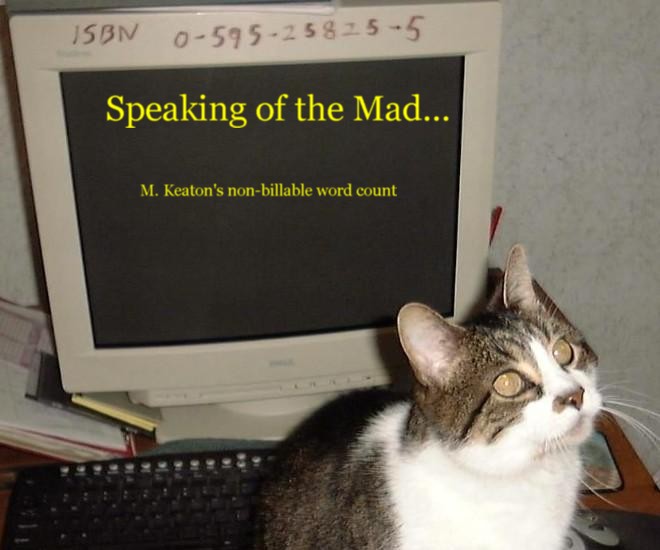
I'm a cat and I work for a grumpy, hate-filled human who has the misfortune of being reasonably skilled at telling stories and worthless for everything else. Technology heads his list of "needless distractions leading the world to heck in a handbasket" and since a cat's got to eat and authors need to be on the web these days to make a living, I end up running the website and, after about a four year argument, the blog. I'm Chaos, he's the Thin Man (also known as M. Keaton on the checks that buy the food), and the real power behind the throne is SHE WHO MUST NOT BE NAMED.
Welcome to the madhouse.
Subscribe to:
Posts (Atom)





 Posts

