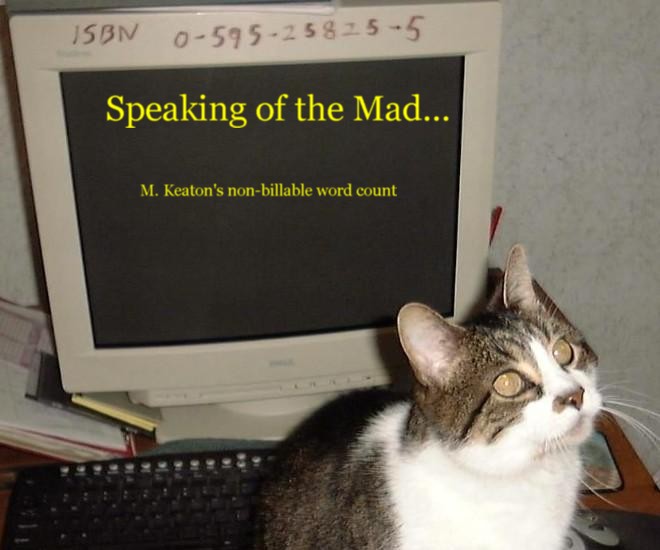
And here's the interview for Calamity's Child.
An Interview with the Author of Calamity's Child
Q: How'd it all get started?
A: Originally, there was no Calamity's Child; there was only a short story. In fact, before there was a short story, there were two authors at a convention...
I had known John Scalzi for a few years previously. Old Man's War had only recently come out and he was gearing up to edit a special edition of Subterranean. It was to be a theme edition and he chose sci-fi clichés. All the old, ugly, beaten-to-death ideas that filled every submission guideline under the heading of "Do not send us this", but done right. He asked if I'd send something in and, after a bit of noodling, I came up with Subject Real. Its cliché was one of my own pet peeves—the holodeck episode. (If a machine messed up half as often for no more benefit than various incarnations of VR in sci-fi, then we'd lynch the inventor and outlaw the premise. My challenge was to make the risks of the technology worthwhile; I vent a bit of my own opinion when Ivan insists that anyone trapped in VR deserves to stay there.)
In the end, the story didn't fit the issue. John tracked me down the next time we were in the same building and made sure I knew it was a matter of making the issue consistent in tone (he opted for more hard sci-fi than space opera); he was quite happy with the story. (John's a class act that way and he doesn't blow smoke. If he'd disliked it, he'd have told me that too. I'd expect no less and I respect him for it.) To digress a bit, it is ironic that,in the Foreword to the book, the editor compares Calamity's Child to Scalzi's work (as well as Mike Resnick's).
I shopped the story a bit but, as most RGR (Ray Gun Revival) readers know, space opera is not a sellers market (though, with the benefit of hindsight, I probably could have sold it to Jim Baen’s Universe). To shorten a long story a bit, a reader of mine pointed me at RGR and asked if I'd send something over. I sent Subject Real and overall, I think everyone was happy.
Several months passed and I didn't give the matter much thought, but I kept getting mail asking where the rest of the story was—the object real part. Roughly parallel to this, timewise, I pitched a serial to RGR (“FT7" for those who've read the slush). That story didn't go, but out of the ensuing give and take emerged Calamity's Child.
Q: After Speakers and Kings, why space opera?
A: Timing mostly. I had actually started work on two other books—one epic fantasy, the other military sci-fi, also on an epic scope—when RGR (and Double-Edged Publishing) picked up the pitch for Calamity's Child. In addition, after S&K, I felt that I needed to do more work on character development and character-driven stories.
Q: You're happy with the characters in Calamity's Child?
A: I am. One of my biggest worries was Kylee herself. I was really worried over whether I could present a teenage girl accurately—that split between little girl and grown woman at the same time. Plus, she has a good deal of other problems mixed in as well. I worried that, in presenting her baggage in addition to the 'normal' behaviors of that age, she might come across as forced. As it is, I've had a couple of early readers tell me that I hit it spot on.
Q: Why write space opera at all? It's not exactly a hot commodity with publishers these days.
A: More's the pity, assuming it's true and I'm not so certain it is. I am sure that the reading public has an appetite for it.
To understand space opera, you have to understand the history of the entire genre. First, space opera is part of a larger block of literature: the literature of the frontier. It includes space opera, westerns, H. Rider Haggard, Joseph Conrad, Rudyard Kipling, and a host of others. With the recent success of shows like Firefly, a lot of people have the misconception that space opera is westerns in space—Bat Durstans—but it's a lot more that that. It's the literature of man on the edge, away from 'civilization' and truly free. To paraphrase Kipling, it's where a man must be who he is and do what he must.
The one great defining theme of all these works is loyalty, with honor and duty vying for second. I believe that, while these themes may go out of vogue with publishers, they will always have a place with readers.
As for space opera specifically, it all began with the pulps. Most readers and almost every writer fondly remembers a childhood diet of Doc Savage, Tarzan, John Carter, the Lensmen, and Tom Swift or their equivalents. You have to ask yourself why. The pulps were the gateway to science fiction, the entry-level books. They were clean and simple. You could enjoy them without an extensive knowledge of the genre or literary theory and the science involved didn't stand in the way of seeing the story. Many were poorly written, but there was always an earnest energy to the writing and a feeling of mutual enjoyment between the author and the reader. The honest enthusiasm, straightforward presentation, and sheer fun of the books hooked more people on reading, and on reading science fiction specifically, than all the fancier, 'better' books around at the same time. More importantly, without these books—these much-maligned pulps—the 'better' books would never have been read at all, because it's the pulps that suck you in. Come for the gunfight, stay for the show.
Somewhere along the way, we lost a lot of that. Science fiction talked about itself and to itself more and more often. As it did so, the reader base dwindled. That's not an accident. You have to start reading somewhere; it's unrealistic to assume that the average reader is going to jump straight into the hard core dystopias of John Brunner or Gibson's cyberpunk. And heaven forefend that a reader's first exposure to science fiction is the Left Hand of Darkness, because then they're gone for good.
To come full circle, look at the excitement for Firefly, Star Wars, and Scalzi's Old Man's War. They're the pulps come back again with a new coat of chrome; the stories of war and the frontier, good versus evil, the stories of and for the Everyman.
Without space opera, we give up our childhood. To dismiss space opera and pulp as 'junk' is to disdain the very heart and love of the science fiction genre itself.
Q: The obvious question then is: what did you do with Calamity's Child to stay true to that history and still give a good story for modern readers?
A: Good storytelling is timeless; worrying about the 'modern reader' as opposed to any other reader is largely a waste of time better spent writing. For Calamity, I set certain guidelines for myself early on. The story should be clean enough for young adult readers but deep enough for the hard-core sci-fi fan. I wanted to keep the main themes of loyalty, duty, honor, sacrifice, and the frontier ethos intact without turning the characters, even the antagonists, into mere caricatures. Ivan, for example, is initially presented as a grizzled, cynical bounty hunter; a stereotype that the reader starts to see through by the second chapter. I also wanted the story to be approachable to anyone, not just science fiction readers. That meant I had to back off the fancy technical descriptions, keep the vocabulary simple, and really focus in on the story itself and the characters. In some ways, it's harder to write that way because all your bells and whistles are put away and you're back to the basics of the craft.
That's not to say the book is simple; it's not. There's depth, but it's the kind of depth that springs from the characters themselves, not the fancy technology or sweeping worlds. Good versus evil is primal and basic, but not simplistic.
I also tried to make certain that my aliens, the few that there are, were truly alien, not just humans in funny hats; and that my humans, like the Kwakiutl, were real and diverse as well. That meant a lot background work on biology and cultures that never made it into the novel. Especially in the case of Red Dog; if you've got a few hours to kill, ask me to explain the nidus and the vespiary.
Q: Last question. Overall, which is a better book, Speakers and Kings or Calamity's Child?
A: Apples to oranges. S&K is about big, sweeping gestures: language, communi-cation, the coming of age of an entire race and what it means to be unique. Calamity is about the smaller scope. It's more intimate, more driven by characters than plot. If I were to guess, I'd say with S&K either you love it and it really sticks with you or you don't get it at all. Calamity offers entertainment over a wide scope but might not strike as deep. S&K was serious and consciously thematic. Calamity is just a fun ride.
Wednesday, December 31, 2008

Sunday, December 28, 2008
Speakers and Kings
I thought I'd round out the year by posting the two interviews the Thin Man has done for Kilimanjaro magazine about his novels, just in case you were new to the site and wanted to know a little more about them. First, the S&K interview.
An Interview With the Author of Speakers and Kings, M. Keaton
Q: To start with, what is Speakers and Kings about?
A: The short answer is: wartime epic fantasy in a medieval, quasi-Arabic context. The long answer is, well, longer. The “what if” premise is a race of spirit beings (called the Eerith) that are telepathic, which means they have no language, and are ex-slaves with no history; they joined the world ‘in progress’ and were immediately enslaved. With no history and no language, what kind of people are they? What do they do? That’s where it all starts. How important is the past to the present? How important is history and a physical body to language and how important is language to individuality?
Q: So, pretty heavy philosophy?
A: No, yes, a little. Those are the underlying themes that drive the actions and the story is about the actions. The book really covers the decade or so of jyhad with these spirits being caught in the middle of the war. There’s plenty of action. Let me try it again: the book is the story of a war and the focus is the people caught in the middle of this war. The deeper themes come into play with the actions of the Eerith on both sides. The story is on two levels. There are some parts that can get deep if the reader wants to really dwell on them but if the reader doesn’t want to, they don’t have to, the action moves things along on its own.
Q: You dedicated the book to the men and women of the armed forces. Why?
A: First off, the fact that they are out there defending my country is always sufficient reason to dedicate something to them. In this case, there was a little more to it.
A lot of my ‘beta-readers’, the folks I run my rough drafts past, are in the military and they were a lot of help to begin with since this book is about a war. But, while I wrote it, there was the attack on the USS Cole and the embassy bombings and then 9-11. I was about halfway through the final version when the US was attacked and I just froze. It just didn’t seem right to be writing about a made up war when we were in the middle of the real one.
Now the humbling thing occurs. These guys out there, going off to fight and die, start e-mailing me to see if I’m all right. That’s the kind of men and women we have in this country’s military, that kind of selflessness. They tell me, to paraphrase, “Write the book. We need it. Distract us and tell us a story of honor and nobility, good versus evil.” The book became a lot deeper, a lot more personal, and a lot more important then because it really became for them. I went to press right before we rolled into Iraq.
As a nation, really as a culture, we’ve lost the good wholesome stories. Everything is about ‘sensitive cultural issues’ and angst and navel gazing and shades of gray. Nobody’s telling the good tales of men being men and fighting the good fight. I’ve always said that my writing was to balance that kind of thing, that I’d tell the good pulp adventure and let other people worry about writing the great novels. I really hope that with SK I’ve done that, for them.
Q: Did you do anything different in this book than you would have otherwise because of that?
A: Yes, but no one seems to have noticed it. I broke a lot of the so-called rules of writing to cater to the real-world needs of my readers. I’ve jokingly called myself the modern master of the serial because of the way I structured the book. Every chapter is like an episode in the old movie reel serials. Each chapter begins and ends and the reader can put the book down at the end of each chapter. Like the old serials, there are cliff-hangers and the like but I break the rule that says never give the reader a good stopping point. Also I tried to keep each chapter under fourteen thousand words so that it could be read in about an hour and I don’t slow down or repeat myself or explain everything to death. The reason is, these guy have a few hours a day of free time and then hours of duty at station, much of which is watching and waiting. I tried to give them a book that they could read one chapter at a time, in the time window that they had, with enough meat on the bones that they could think and talk about it while they were on duty if it was a boring day—and I pray that every day on duty is a boring day.
The one thing that I couldn’t change that I wish I could is the price. I truly wish that the economics were such that I could give the book to our soldiers for free. That’s part of why I’m such a proponent of the ASEs. We pay fat toad Senators a small fortune to pass laws stealing our freedoms while we give the poor guys risking their lives to protect our freedoms a shiny nickel and a pat on the head. Free books are the least we should do.
Q: What about non-military people, is the book accessible to them?
A: Oh yes. It’s a solid book no matter where you come at it from. In fact, I’ve gotten a lot of feedback from teenagers and women who really like it. That surprised me because I figured that I was writing a very masculine book but I also have strong women as main characters too. I think the, well, moral clarity of the characters and the fact that they struggle with themselves without selling out, angst without lapsing into self-pity; I think that’s really refreshing to a lot of people, especially young readers.
Q: A required interview question, why buy your book?
A: I need to buy groceries. Seriously though, it’s a good book, maybe a great one. That’s not me talking, I can’t judge my own work. That’s what the readers are telling me. They don’t just like it; they’re blown away. I have a weird kind of second-hand confidence. Enough people have told me it’s good that I have to admit that it is.
Q: Last question. What is Dog?
A: (laughs) Nope. No way. I’m not telling.
Friday, December 26, 2008
Calamity's Child Music (Part 3 of 3)
Character specific music:
Ivan Steponovich
Freedom's Child by Billy Joe Shaver
Stone of Destiny by Steve McDonald
Handful of Rain by Savatage (esp. Handful of Rain and Chance)
The Highwayman by Danny Doyle
Snowblind Friend by Hoyt Axton
Gunfighter Ballads and Trail Songs by Marty Robbins
Red Dog
Lost in the Beauty You Slay by Sacrilege
The Best of Rob Zombie by Rob Zombie
Projekt Gothic by various artists (esp. When You're Evil by Voltaire)
Euthanasia by Megadeath
Bombtrack by Rage Against the Machine (esp. the one with all the bad words in it--I won't do what you tell me!)
Kylee Steponovich
Summer Storm by Wild Mercy
Lullabies (Celtic Twilight 3) by various artists
The Best of Rob Zombie by Rob Zombie (most esp. More Human Than Human)
Ugly As It Gets by Ugly Kid Joe (esp. Cat's in the Cradle)
Quicksilver Rose
Fallen and The Open Door by Evanescence
Nina Simone, The Definitive Collection by Nina Simone
Another Town... by The Whole Shabang
The Druid and the Dreamer by Draiocht
Ivan and Rose together
River of Dreams by Billy Joel (esp. Blond Over Blue)
Titania, The Fairy Queen by Mike Rowland
Rainmaker and Solomon (Cajuns in Space!)
Bayou Deluxe by Michael Doucet and Beausoleil
Mardi Gras Mambo by Cubanismo
Bobby Bare Super Hits by Bobby Bare
Pharaoh et. al. on Selous
Zambian Acapella by Zambian Acapella
Nina Simone, The Definitive Collection by Nina Simone
Lady First by Bob Thompson
On the Beach by Edgar Wallace Jr.
Fiddler On the Roof Soundtrack from the MGM movie
Monday, December 22, 2008
Calamity's Child Music (Part 2 of 3)
Chapter specific music:
1-Subject Real
No music, just the background crash of a SF/F convention and a long bus ride
2-Potlatch, 3-Suicide Straight, and 4-Domino
Dead Winter Dead by Savatage
Operation Mindcrime by Queensryche
Bond by Bond
Americana by The Offspring
5-Skip a Rope
Skip a Rope by Jimmy Dean
Kansas Super Hits by Kansas
A Rose for Iconoclasts by Steven Brust
6-Dante's Fourth by Gaslight
Eine kleine Nachtmusik, Idomeneo, The Abduction from the Seraglio, Don Giovanni by Mozart
The Four Seasons by Vivaldi
Canon (D major), Suite Number 6 (B flat major) by Pachelbel
Suite (G major), Concerto (D major), Symphony (G major), Symphony (A major) by Fasch
River of Dreams by Billy Joel
7-Rodeo Bull Ballet, 8-King in the Corner, and 9-Ransom in the Fall of the Mountain King
Snowblind Friend by Hoyt Axton (especially Water for My Horses, Funeral of The King, and Seven Come)
Gunfighter Ballads and Trail Songs by Marty Robbins
10-Ave Maria
River of Dreams by Billy Joel
Stigmata Movie Soundtrack by various artists (esp. Mary Mary)
Timeless Crime by Labyrinth (esp. Save Me)
Unleashed, The Half Tail by Wolfstone
Man of La Mancha, Original Cast Recording
11-Object Real
Handful of Rain by Savatage (esp. Taunting Cobras)
For the Sake of Revenge by Sonata Arctica
Timeless Crime by Labyrinth
Friday, December 19, 2008
Calamity's Child Music (Part 1 of 3)
Presenting the Music behind the writing of Calamity's Child! Yes, the list of music the Thin Man found essential to focusing his mind during the writing of the novel. It's a long list so I'll spread it over several days. Please note, the music listed is not an indication of good taste, the author's specific listening preferences, or an endorsement of some of the music. Also remember that the various albums were freely intermixed (for example, for every chapter with Rose in it, there was an Evanescence album in the rotation, even during the writing of the fight scenes). It is simply what put him in the right frame of mind. I hope you find it an interesting (and probably terrifying) look inside the symbiosis of music and writers.
General background music:
The Book of Secrets, The Visit, The Mask and Mirror by Loreena McKennitt
Another Way to Travel by Cats Laughing
Once Upon a Time... The Essential Ennio Morricone Collection by Ennio Morricone (esp. The Mission Suite)
Poets and Madmen by Savatage
Highlander, The Original Scores by Michael Kamen, Stewart Copeland, and J. Peter Robinson
Music Inspired by J. R. R. Tolkien's Lord of the Rings by Andy Street
Beethoven's Last Night by Trans-Siberian Orchestra
Eroica Trio by Eroica Trio
The Planets Suite, St. Paul's Suite by Holst
Fight scenes:
The Yngwie Malmsteen Collection by Yngwie Malmsteen
Blade, Movie Soundtrack by Mark Isham
Stigmata Movie Soundtrack by various artists
A Tribute to the Four Horsemen by various artist (Nuclear Blast records)
Brave New World by Iron Maiden
The Planets Suite (Mars thru Saturn) by Holst
Tuesday, December 16, 2008
He's a grumpy old man
At great personal risk, I have bearded the Thin Man in his den and once again demanded a project status update. His recap of November was short and to the point: "I didn't get a damn thing done." Technically, that's not true. I know for a fact that he wrote two short stories but it has become his official policy not to count short stories as word count unless they're longer than 10,000 words. The reasoning is mercenarily simple. A good short is almost as much work as several chapters of a novel but the pay is literally in pennies. (The so-called pro rate is 5 cents a word. For a well polished 5,000 word short story it takes close to a week of work and pays, at best, 250 bucks. In the same amount of time, he could generate about 10,000 words on a novel.) I should point out, he refused to stop writing short stories (this seems to be some kind of mental disorder for short story writers--they can't stop) but he doesn't count them as "billable word count".
I understand his frustration. Since the Thin Man tries to support National Novel Writing Month, November is usually a productive time. Last year, just over 45,000 words on Calamity's Child; the year before, the entire draft of Red Scythian. On the other hand, this November brought family illness, farm work, recovering from a book release, and a change in medication. I didn't bother to bring this up because I already know the answer: "Results, not excuses." So instead, I asked, "What did you read last month?"
"Blood and martyrs, Cat, I don't know! The wife, she keeps a journal of what she reads. Me, I just pick up the next closest book."
I have, however, reconstructed a partial list that I present below. It's not a complete list because, like most transients, the Thin Man pretty much lives out of cardboard boxes so as soon as a book is finished, it goes into storage and a new box comes out, but here's what I know for sure:
What is Your Dangerous Idea? Edited by John Brockman
Strange Matters by Tom Siegfried
Necroscope, NS: Defilers, and NS: Avengers by Brian Lumley
Amusing Ourselves to Death by Neil Postman
That Yellow Bastard and Hell and Back by Frank Miller
Ultraviolet by Yvonne Vavarro/Kurt Wimmer
The End of Time by Julian Barbour
Shamrock and Spear Edited and Translated by F. M. Pillkington
The Strange and Uncanny by John Macklin
Red as Blood by Tanith Lee
And now we know why he's in such a bad mood. Not many books, nowhere near enough fiction and no military sci-fi at all. Who wouldn't be a grump?
Saturday, December 13, 2008
Goofin' Around
The Thin Man is gearing up to cause all manner of turmoil with his dark matter research and his new theory of space-time. (I've sussed out this much: Einstein was wrong and there are two dimensions of space. This may be his craziest theory yet.) Since I'm sure trouble is a'coming, for now I'm sticking with a light theme. The following is something actually prepared by SHE WHO MUST NOT BE NAMED and is intended as a resource for all those who find themselves trapper with an author (based on her own personal experiences).
How do you know if your writer is an insane maniac likely to go off like a grenade at any moment? There are some simple warning signs. (Note: these warning signs taken from actual events, do not replicate at home without trained supervision.)
--72 hours (or more) without sleep
--The ability to survive on a steady diet of only one specific item for long periods of time. For example: rice every meal for a month. (Note: this is often a difficult symptom to identify, see below).
--The ability to survive on a diet of things not traditionally considered as 'food' such as candy, tree leaves, beef jerky, Taco Bell, rubbing alcohol and extreme amounts of soda or alcohol. Author may lapse into a completely liquid diet.
--No longer following what is traditionally considered a meal structure, much less a meal schedule. This period is marked by a phenomena known as 'spiking'. The author will ignore nourishment (often violently if it is forced upon him) until tremors of the hands and face prevent him from pursuing his current obsession. (Note: current obsession may or may not actually be a manuscript, depending on the progress of the condition. In its early stages, the obsession often manifests first in game playing, researching random topics, or learning new curse words in foreign languages before finally reaching the manuscript phase proper.) When the tremor condition occurs, the victim is then suddenly seized with a ravenous and indiscriminate hunger and will eat, sometimes quite literally, anything that does not outrun him until the hunger is sated. This may include the consumption of insects, ancient condiments from the refrigerator, dog food (especially those bacon treats), and scrap pieces of paper laying about. Spiking is usually followed by several other physical symptoms, see below.
--Ritual social ablutions are completely abandoned until action is forced, i.e. the Cheetos orange has built up on both fingers and keyboard until it is no longer possible to type. (Note: in extreme cases, the author has been know to replace the keyboard rather than stop writing.)
--The voiding of physical wastes is halted completely until some other, external event occurs (such as spiking) at which point, well, there had better be a clear path to the restroom.
--The need for physical rest seems to be suspended (see 72 hour rule above). This is actually a temporary illusion and may be followed by complete collapse (especially during the 'sugar crash' which follows spiking) or may result in short periods of unconsciousness. These short term collapses may be marked by a sudden occurrence of a series of the same letter within the manuscript for up to several pages like so: sssssssssssssssssssssssssssssssssssssssssssssssssssssssssssssssss
--In addition to the above, there exist a whole host of lesser symptoms that vary considerably from victim to victim such as extreme swearing, breaking down a wall in the household with an eight pound sledgehammer in the interest of 'research', carrying family pets around by their tails, losing every damn thing ever owned just when it's needed, a total disintegration of spelling and grammatical abilities, using the writer's own skin and available wall surfaces as writing materials, an irrational fear of Emma Bull, and the simultaneous description of own work as "unadulterated crap" while insisting "but I'm a damn sight better than so-and-so and his puke on the page."
--The most common and universal symptom of this disorder is extreme irritability. For the duration of the fugue state, the universe consists of the writer and his obsession. Anything that interferes with pursuit of the obsession must be destroyed in the simplest, fastest manner available irrespective of its previous, or subsequent, value. Writers are, therefore, to be avoided at all cost.
Hopefully, this short guide will prevent long term injury while a cure for this malady is sought. Research is underway and donations are accepted (just send them to me). Currently, the best available treatment is a six-book contract with a fat advance and the liberal application of hooch.
Friday, December 12, 2008
Christmas Contest Results
The Calamity's Child Christmas contest is over and the gift packs have gone out in the mail (one domestic, one to Iraq). I'll not announce to whom they are going since the winners may very well value their privacy. If, once they get them, they want to speak up in the comments, that's fine too.
And now, with the contest over, I'll start to put up the Thin Man's list of music for the novel over the next few weeks. He thinks it is a logical progression of music; SHE WHO MUST NOT BE NAMED thinks it looks like a superball attacked a jukebox. You decide.
And now, with the contest over, I'll start to put up the Thin Man's list of music for the novel over the next few weeks. He thinks it is a logical progression of music; SHE WHO MUST NOT BE NAMED thinks it looks like a superball attacked a jukebox. You decide.
Wednesday, December 10, 2008
Just funny
For your holiday entertainment, I'd like to pass along a conversation between the Thin Man and a car rental company that I overhead a few months back. The event occurred before I started blogging for him and it still greatly amuses the cat.
"Can I help you?"
"Yes. I'm coming to town for a convention and I need to rent a car."
"Excellent, which credit card do you use?"
"I don't use a credit card; I'll be paying cash."
"I'm afraid we can't do that sir."
"Do what?"
"Accept cash. We have no way of knowing that you're not a criminal."
"Ma'am, if I was a criminal, I'd have a credit card. I'm confused--what part of 'all debts public and private' was Mister Washington lying about?"
"I'm sorry sir but we only take credit cards. It's company policy."
"I understand that. I also understand that under Federal law, you have to take cash."
"Just a moment and I'll get my manager...
...What seems to be the problem here?"
"I'm trying to rent a car and you're company is refusing my money."
"Okay, let me see if I get this straight: I can pay for the car with cash and I can leave a cash deposit for the security fee, right?"
"That's correct, sir."
"Then why do I need a credit card if I can pay in cash?"
"Company policy will not allow me to rent out a car without a major credit card on file."
"On file for what?! This is some kind of discrimination isn't it? You're just yanking me around because I'm southern."
"I assure you sir--"
"What's your name? My lawyer's going to need it. The law is very clear: you cannot refuse a man service because of his race or creed and you must accept legal tender FOR ALL DEBTS PUBLIC AND PRIVATE!"
"Let me transfer you to my area manager."
"I'm sorry for the confusion, sir. My people should have explained the matter to you more clearly."
"That's all right. So I can pay with cash and leave the deposit in cash--that's payment. The major credit card is for identification purposes."
"Yessir. The card is ID along with your driver's license."
"Well I don't have a credit card. Surely you're not telling me that just because I'm a luddite you can't rent me a car."
"Oh, no sir, we work very hard to accommidate all religious beliefs. We'll just use another method of verifying your identity."
"You mean in addition to the three forms I already have to provide."
"That's correct."
"So what else do you need?"
"A current utility bill and a pay stub. The utility bill will need to be current showing a zero balance."
"You've got to be kidding."
"No sir, what would be the problem?"
"If my balance is zero, my utility company doesn't issue a bill. It's kind of implicit in the word BILL."
"Well, I'm sure we can work something out on that, just bring in your latest set of paperwork from them and the pay stub."
"About the pay stub, what if I'm self-employed?"
"Oh that's no problem, just bring in your last pay check."
"I don't cut checks to myself."
"What do you do for a living, sir?"
"I'm a writer."
"But surely you get paid."
"And don't call me Shirley but seriously, other than checks made out to my name, the only formal payments I recieve are royalty statements."
"Bring in a recent one of those."
"How recent?"
"One or two weeks should be fine."
"I only get statements quarterly."
"What?"
"Four times a year."
"Hmmmm. Well that certianly is irregular. How much was your latest one for?"
"Hold on, I'll check...twenty-one dollars and fifty cents."
"We can't rent you a car."
"Why not?"
"You don't make enough."
"I'm paying cash!!! You said all this other stuff was for identification purposes."
"That's correct."
"Then rent me a car."
"I'm afraid I can't do that without a major credit card."
"Cat, I don't think I'm renting a car."
Sunday, December 7, 2008
Fun with wikipedia
Edit: Stupid html interwhingee code eats the blasted links! All links now posted purely as text. Open a new window and paste them in. Sorry for the extra hassle.
The Thin Man is finally listed on wikipedia but it's a very short entry with a few errors and a derth of information. http://en.wikipedia.org/wiki/M._Keaton Now, I would encourage you to shoot over and update it but the problem is that he's very stingy with information, especially the personal stuff. So, it becomes a mystery--who is the Thin Man, where has he been, what has he done, is he even human? Well, to help, I've tried to complile a list of a few links that might help you find out more (and source the article as well). Not every page has a direct reference to the Thin Man but they all point at some aspect of his past and this just scratches the surface. Have fun looking:
http://www.baxter.com/
http://www.scifan.com/writers/kk/KeatonM.asp
http://www.blackmoore-global.com/
http://www.booksforsoldiers.com/
http://www.professional-events.com/
http://www.getfave.com/locations/15348481-midwest-analytical-services-inc
http://www.metaresearch.org/cosmology/
http://www.archive.org/search.php?query=subject%3A%22M.%20Keaton%22
http://www.michiganfandom.org/
http://www.qualight.com/
http://raygunrevival.com/
http://abyssandapex.com/
http://www.phoenyx.net/
http://www.aboutsf.com/speakers/speakerinfo.php?speakerID=232
Monday, December 1, 2008
Contest Update
I tried to do this as an update on the last post but the stupid interweb ate it so I'll do it this way. After much lobbying (and not just by me), the Thin Man has relented and allowed the contest deadline to be extended to the 6th of December. Plus, if you don't want to send out your address or email or the like, just post your entry and, after I (randomly) choose a winner, then you can send the necessary information to ship the stuff after you win.
In a slightly unrelated note, the Thin Man has been researching dark matter. (No, I'm not allowed to say why but it's book related.) If there's enough interest, I may press him to see if he'll discuss his rather unorthodox theories here on the blog (but without the math--I can't figure out how to embed all the equation symbols). Trust me, the Thin Man vs. modern cosmology is better than 'rastling on the TV. (And he ain't so thin these days either; the old man's getting a little round...sorta...if you squint just right.)
In a slightly unrelated note, the Thin Man has been researching dark matter. (No, I'm not allowed to say why but it's book related.) If there's enough interest, I may press him to see if he'll discuss his rather unorthodox theories here on the blog (but without the math--I can't figure out how to embed all the equation symbols). Trust me, the Thin Man vs. modern cosmology is better than 'rastling on the TV. (And he ain't so thin these days either; the old man's getting a little round...sorta...if you squint just right.)
Friday, November 28, 2008
Last Call for Free Stuff
Until next time, at least. I just wanted to draw attention to the fact that the Christmas Contest is ending in a few days and your chances of winning are REAL good. And remember, if you already have a copy of the latest book, you can always send the Christmas gift pack to someone else (or even have me send it to a military address).
Tuesday, November 25, 2008
The Bards' College
Following up on the last post, I asked the Thin Man what he had as a long term goal, the one great future dream that he'd like to see happen. It seems he's given it a good deal of thought.
"Admittedly, it is an abominably ambitious undertaking for an author who has not published anything of note in several years and is effectively homeless but, better to ask for too much and fail than too little and fail. But...
There currently does not exist a place for authors of one generation to pass down their knowledge to the next in a natural and intuitive context. Writing workshops (such as Clarion) and hosts of ‘formal’ writing teaching are available but these forums are stilted, regimented, and (most importantly) confine themselves to a very narrow portion of the craft while neglecting others. Even writing itself is only a part of the broader experiences and knowledge that are necessary to create a true storyteller. Today’s writers have lost contact with their bardic roots—they no longer venture outside their comfort zone or chosen genre in their reading, they do not value the music of words that was once taught through poetry and song, they lack the sympathetic connection with their listeners that was once indispensable. Instead, they focus on marketing, web-based salesmanship, and the fine art of romancing a publisher. Despite its incredible usefulness as a tool, today’s authors have sacrificed too much to the internet and forget the irreplaceable value of direct human interaction. Conventions approach this memory but they are short in duration and frequently too hectic for real, meaningful progress to be made. In short, the modern author is too isolated, too misunderstood, and too undervalued (considered merely one more ‘entertainer’ in a medium that is dying anyway). They have begun to believe their public perception and grow increasingly ignorant of anything outside of their own small circle and have forfeited their larger role in society.
This all sounds terribly melodramatic and is probably perceived by the average person as a very bad case of “poor me, the misunderstood artist”. This is not the case. My argument is that it is the author who has grown lazy and now, a generation or so removed, no longer even knows where to turn to grow and develop even if he were to perceive a problem (which many do not). The bottom line is that most modern authors are more concerned with marketing and selling their work than telling a good story let alone with being the kind of artist who actually contributes to the field or leaves a legacy behind.
The purpose of a modern bard’s college remains the same as that of the colleges of old, enumerated in the three duties of a bard: to preserve the language, family, and culture.
In its final, envisioned stage the college should fulfill these duties by (in order of importance): 1-Providing a retreat for working authors where they can write in peace and quiet in a natural setting. 2-Provide and promote mentoring of younger authors and the sharing of support, experience, and companionship between authors. 3-Act as a resource to authors by providing access to specifically knowledgeable individuals (through a range of contacts in the college, throughout the community, and across the world from professional archeologists to master bricklayers) and providing, not only dry information, but the opportunity to participate and learn by doing. This is further facilitated by the permanent presence of a select group of teachers/artisans on site (see further). 4-Teach (via apprenticeship) the traditional bardic skills to anyone interested. (Specifically, this would include the making and playing of a range of musical instruments, a basic knowledge of glassblowing and smithing, animal husbandry, along with the more predictable “literary” skills.) 5-Be a resource to the community by making the services and teachings of the college available to the public (including through visits to schools and libraries as well as a “formal” course structure on site). 6-Provide a place of retreat, mentoring, and guidance to the youth of the area via the residents of the college. The populace of the college, both permanent and temporary, should be approachable by and even seek out area youth who are having difficulty and influence them in the right direction. This could range from helping a struggling student understand a difficult subject to encouraging a failing student to remain in school to making the proper contacts to insure that migrant children do not ‘fall through the cracks’ when they are relocated to mentoring troubled children to physically going with a concerned brother to physically drag his sister out of the drug den and giving her a place to stay until she can get cleaned up and into rehabilitation. This may seem like quite a stretch but is actually a logical progression. Authors tend to have diverse backgrounds and have survived through very difficult circumstances. They have a natural empathy and problem solving skills that they themselves rarely realize are present.
Obviously, this will require significant infrastructure: several hundred acres of land, dozens of buildings, and a wide range of sympathetic contacts just to scratch the surface. It was, therefore, my thought to implement the college in stages, a gradual expansion of the structure without any increase or decrease in scope of ambition. This growth cannot be spelled out step-by-step because it is too dependent on external circumstances. It will have to start with spreading the vision of and explaining the need for the college. As the number of sympathetic people grows, attention can then be turned to the physical and it will probably be necessary to change locations, from small to large, several times. The college will exist first as a group of individuals supporting the same goal, expand to some land where at least author’s retreats and physical meetings can take place, and then continue down the best avenues available when it reaches that point. On a personal note, I do not expect to see it move beyond this primitive stage in my lifetime—this is a massive undertaking.
The network of people is the heart of the college idea. Even when the college is a physical entity, it is the people, either by direct experience, word of mouth, or reputation of the college, who provide the real services. This network is not a support group or a writers guild; it is something much more ambitious. It is a collection of people who believe in the college and its goals and who are willing, therefore, to expend their own time and effort to support it. It is the university professor who calls an author to help a student and who, in turn, will help another, different author in the college find research for his book. It is that same student, who happens to know a bit about plumbing, teaching and helping a writer to fix the plumbing in the author’s home and then sending another student to the author for help. And if it is something that author cannot help with, then he can contact someone else in the college who can who will do it because it needs done. The backbone of the bard’s colleges has always been the people who, though not bards themselves, support it—not with lip-service but with deed—because they believe that it is important. It is an intermingled flow of labor and knowledge, a kind of intellectual property barter system that does not keep a ledger.
This element will be the most difficult to achieve. It will be slow to grow and have no immediate gain for the individuals involved. By necessity, even though the idea can be spread by print and electronic media, most ground will be gained by direct personal conversation and explanation (and thereby must rely on a certain degree of “cheerleading” and charisma that the project is currently lacking). To help this, I shall try to assemble most of the key documentation from the original lore of the colleges as well as some tentative outlines of possible courses I can teach. (At this stage, the teaching will have to be by presentations and seminars rather than a permanent classroom.) If these foundational concepts can be articulated clearly, the idea should outlive me even if I should fall ill or otherwise not be able to keep up with it. It may be possible to offer, via a website, a kind of subscription patronage service (donate $20, get a certificate that means nothing but reminds you that you are involved, etc.) or even maintain a listing of contacts. If we are extremely blessed, someone with energy will take up the banner and promote the cause independently. It may also be possible to get libraries and schools, as entities, to sign on to the idea and make their resources available.
For example, a library agrees to support the college. They put promotional material in their flyers, run document/periodical searches for college members for free or at odd hours, etc. In turn the college could offer an infrequent stream of guest authors to sign books, read to kids, and present the occasional class or seminar. A university library could offer the use of its facilities free or at a reduced rate, even from non-students and, in turn, members of the college could speak to various classes or give assorted presentations. The same model could probably be follow for companies. However, let me stress that this cannot be a quid pro quo arrangement—the college functions on a shared belief in the common good in the cause, not as a business or sense of obligations. By necessity, there will be those who give little and get a lot and vice versa. This is more important than it would appear because more writers are loath to give formal commitments but by nature overly generous when asked for a favor."
Saturday, November 22, 2008
Questions, always questions
The Thin Man was complaining (again) about the blog so I tried to explain to him that we weren't blogging right. It seems to me that the point of a weblog is to communicate to your readers that you're a real, approachable human being--basically to show that he's a nice guy. The problem is, he ain't. And a blog is supposed to be about opinions and interests outside of just being a writer. Here again, the problem is, he ain't--interested is much outside of writing, that is. Actually, he has numerous other interests (I mean, ever seen his business card? How many wierd jobs can one guy hold? And that's not even counting a decade in the laboratory.) but that, in the end, every one of those interests feeds back into writing. I say "Talk about being a scientist" and he replies, "It helps me write sci-fi better." I say "Talk about farming" and he says, "Helps me remember there's more to a good description than just the visual." And round and round we go. Part of it is his difficult nature but, at the heart of it, it's true. For all practical intents and purposed, the Thin Man exists for the craft.
Well, I'm working on getting more interesting stuff out of him than just lectures and book reviews (and by all means give me ideas and ask questions) but, for now I guess I'll just let him keep on talking about writing. Specifically, I asked him to talk about what it's like to make a living writing. The answer...
But what I want to know is: what are the answers to his questions?
"It is popular to complain about the difficulties of being an
author and of making a living by writing. It is also popular to complain
about the difficulties in getting published and how it is increasingly
difficult to succeed.
Writing is not about doing what is popular.
To write, one must accept that it is a labor, not a hobby, and therefore, as
with all work, there is difficulty. The great "secret" is no more than
that: to write is to labor.
There is nothing new under the sun. The old ways were no
easier.
***
After review by three hundred men, upon the testimony of twelve
true men of country and aristocracy, upon the word of a magistrate-all of
which shall attest on conscience that the aspirant has the qualities and
attainments requisite for the struggle-and after demonstrating proficiency
in the Four and Twenty Games, the aspirant shall be subjected to oral
examination. Should his answers suffice, then the aspirant shall be deemed
worthy to begin his study of the craft. The questions are as follows:
a.. Who existed before darkness or light?
b.. Where are the roots of the world?
c.. On what day was Adam created?
d.. Whence comes night and day? Why is the eagle grey? Night dark?
Linnet green? Why does the sea swell? And, Why is this not known?
e.. What are the three fountains on the mountain of skill?
f.. What is the best deed man has performed?
g.. Who will measure Death? Who can tell the thickness of its veil? The
size of its maw? The value of its stones?
h.. Why do the treetops bend and bow? What were the words before words?
i.. Whence comes darkness when the day ends? Where does it go when day
dawns?
j.. What makes man a slave?
k.. Canst thou guide and judge?
l.. Will you sow and labor?
This shall be the minimum requirement.
(Paraphrased from The Four Welsh Texts)
***
That was then; this is now. The requirements have not,
essentially, changed in two millennia."
Tuesday, November 18, 2008
Contest News
"Cat," the Thin Man says to me, "Ain't nobody entering your dumb contest."
What can I say? "Maybe it's too hard. I mean, really, who can tell what you'll listen too? You drink Dr. Pepper mixed with grapefruit juice, for crying out loud. Your tastes are strange."
"Eclectic," he corrected. "And don't let the muddy brown color fool you, that's a good drink. Grows hair on your tounge." I'm still shuddering at the image when he adds, "Perhaps you have a point. Let's go with the random entry for the winner option then. But they have to at least guess five or six songs. I'm looking for new music and was hoping to pick up a few suggestions."
So there you have it. Just point the Thin Man at music YOU think would fit and you're in. But hurry, there's just under two weeks left.
Friday, November 14, 2008
A movie with literary themes
Today, a review, not of a book, but a movie. A good guy movie with strong themes.
Reign of Fire from Spyglass Entertainment
The makers of this film present the plot thusly: “In the year 2024, highly evolved dragons are the dominant species left on the planet. Only a few human beings exist. A brave Englishman, Quinn, and his followers battle for survival against the creatures, taking refuge in an abandoned castle. They unexpectedly encounter American dragon-slayer Van Zan and his rag-tag squad, who are planning a dangerous crusade to post-apocalyptic London to fight the dragons.”
It is a fair description of the movie but, like most of the advertising for the film, sets aside the strengths of the film in favor of concentrating on special effects. That is not to say that the movie does not have a pleasant level of violence and explosions, it does. The dragons are truly frightening and the sets are impressive. What was lost in the hype is that the movie is not primarily about dragon fighting and destruction.
The real theme of the movie is about leadership, strong male leadership. Both men, Quinn and Van Zan, are noble men and responsible leaders, driven by honor and duty. When their two styles of addressing the same problem collide, then the real conflict of the movie comes to the fore. The dragons are the vehicle, not the purpose. The movie is very well written, extremely well acted, and skillfully produced. The special effects are clean and more than sufficiently dramatic.
If you want to see the movie for the big lizards and widespread destruction, you will not be disappointed but if you are looking for a film with real depth and strong masculine themes, then you will find in Reign of Fire a rare treasure.
(This review original written and published in Kilimanjaro magazine, reprinted with permission.)
Tuesday, November 11, 2008
Veteran's Day, 2008
How do you say "thank you" for something you can barely even understand? Oh, we think we know, that we understand what it's like to go to war but those who haven't can't, not completely. It's not just the old line of "being willing to die for your country"; it's about being willing to kill for it as well. It's about being scared and cold and hungry and bored and confused...always confused. The fighting is better than the waiting in a lot of ways. Short of quoting Kipling's Snarleyow, what can really be said?
Except:
Thank you.
Thank you to every man that takes up arms to protect our nation. To those who volunteer, to those who join in peacetime and find themselves suddenly at war, to those who were pulled unwillingly by a draft--we don't care why you went. It is enough that you did. Thank you. For those who never fired a shot, whose entire time was spent in "peace", for nevertheless making the sacrifice and facing the risks full on. Thank you. To every husband, wife, child, mother, father, sibling--to everyone who keeps the homefront while the others are away. To every medic, contractor, USO worker, and the million-and-one "civilians" who serve as well. To the children who will never know their grandfathers and fathers who gave sons. To those who keep their experiences secret and refuse to speak of those dark times and to those who speak freely and with pride. To all and every veteran, past, present, and unflinchingly future.
Thank you.
Saturday, November 8, 2008
Just another short post today. If you like contests and free books, we're not the only folks who like to do it. William Jones runs contests and has one going right now. Ann Aguirre runs a bunch of contests, and big ones too, whenever she has a book come out or even when she finds a book she really likes and wants to get more people to read. Follow the links and check them out.
And a quick music note for the contest: a solid dose of international music plus an oblique hint "Ever listen to the music in the background of the American remake of La Femme Nikita?"
And a quick music note for the contest: a solid dose of international music plus an oblique hint "Ever listen to the music in the background of the American remake of La Femme Nikita?"
Wednesday, November 5, 2008
Sneaking and spying, peeking and prying
Today, I thought I'd sneak into the Thin Man's office and scout up some more hints for the Christmas contest. This is what I've got so far:
Lots of 'Best of" and movie soundtrack albums because he's cheap, plus, since he buys most of his music used or out of the bargain bin some of it is pretty obscure. Worse yet, he has albums from about every genre although not very much rap and I didn't see any hip-hop. Lots of classical and heavy metal with a solid dose of folk and western. (He makes a distinction there, insisting that country and western are two different kinds of music and he doesn't like country. I don't know if that's helpful or not.) He also has music by other authors! He doesn't have any singles and doesn't have an mp3 player so he listens to complete albums (although, for some of them, he only really cares about one or two songs).
That's all I could get today without getting caught. Maybe more later and good luck.
Monday, November 3, 2008
Guys Read the Classics
Education of a Wandering Man, a memoir by Louis L’Amour
If you are a fan of Louis L’Amour, read this book. If you are interested in authors as men as well as the tales they tell, read this book. If you draw breath, read this book.
Education of a Wandering Man is exactly what it calls itself, a memoir. It is Louis L’Amour’s remembrances of his travels, experiences, and ultimately, of how he became to be a self-educated man and how very important self-education is. A tight narrative, it is not. The stories wander and jump from topic to topic but this adds to the overall strength of the work rather than detracts from it. It is personal and conversational. Reading the book is like sharing a cup of coffee with the great western author in a roadside shelter while waiting for a storm to pass—intimate, charming, and deeply insightful. L’Amour tells of crossing the Mojave Desert on foot, working at sea, and serving in World War Two to mention only a fraction of his memories.
Most importantly, throughout his life, L’Amour sought books. Each memory is accompanied with a mention of what he was reading at the time and why. At its heart, everything for L’Amour comes back to reading. From pulp fictions to Greek histories to poetry and more, his life was spent seeking knowledge and finding it in the written word. By the end, almost unintentionally, L’Amour makes an irrefutable case for the importance of literature to being a man and, further, to being a wise one. As a wonderful bonus, the book includes a bibliography, for Louis kept a record of what he read throughout the years and shares this list with the reader. This listing of books, over six solid years of reading, is, alone, worth the cost of the book. In many ways, this book embodies, not just L’Amour, but the quest and love of all literary men. It is a definite must read and must have for every reader.
Related Reading:
The bibliography L’Amour himself lists within his book.
Subscribe to:
Posts (Atom)






 Posts

